Yang Jun, Wen Zhengqi, Li Wenliang, Sun Xianghua, Ma Junrui, She Xueke, Zhang Hongbin, Tu Changling, Wang Guoqiang, Huang Depei, Shen Xudong, Dong Jian, Zhang Hushan
Department of Oncology, First Affiliated Hospital of Kunming Medical University, Kunming, China.
Department of Cadre Recuperation, The First Affiliated Hospital of Kunming Medical University, Kunming, China.
Front Oncol. 2021 Feb 8;11:570241. doi: 10.3389/fonc.2021.570241. eCollection 2021.
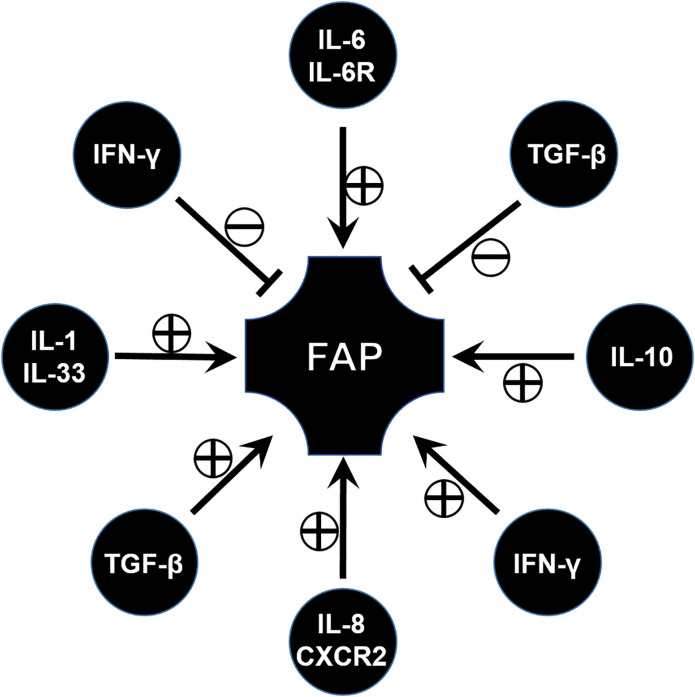
Currently, the main treatment for familial adenomatous polyposis (FAP) is surgery, however, surgery is far from ideal as there are many complications such as uncontrollable bowel movements, pouch inflammation, anastomotic stricture, and secondary fibroids. Therefore, it is necessary to further expand the understanding of FAP and develop new treatments for FAP. The immune microenvironment including immune cells and cytokines, plays an important role in FAP and the progression of FAP to adenocarcinoma, thus it may be a promising treatment for FAP. In the current review, we summarized the recent progress in the immune microenvironment of FAP.
目前,家族性腺瘤性息肉病(FAP)的主要治疗方法是手术,然而,手术远非理想选择,因为存在许多并发症,如无法控制的肠道运动、袋状结肠炎、吻合口狭窄和继发性肌瘤。因此,有必要进一步加深对FAP的认识,并开发针对FAP的新治疗方法。包括免疫细胞和细胞因子在内的免疫微环境在FAP以及FAP向腺癌的进展过程中发挥着重要作用,因此它可能是一种有前景的FAP治疗方法。在本综述中,我们总结了FAP免疫微环境的最新进展。