Akar Mustafa, Aydın Fuat, Kayman Tuba, Abay Seçil, Karakaya Emre
Department of Gastroenterology, Bursa Yüksek İhtisas Trainig and Research Hospital, University of Health Sciences, Bursa, Turkey
Department of Microbiology, Faculty of Veterinary Medicine, Erciyes University, Kayseri, Turkey
Turk J Med Sci. 2021 Jun 28;51(3):1445-1464. doi: 10.3906/sag-2101-69.
BACKGROUND/AIM: The prevalence of Helicobacter pylori is reported to be roughly 80% in Turkey, and only very few culture-based studies are available on antibacterial resistance in adult dyspeptic patients. This study was carried out in adult dyspeptic patients with an aim to: (i) detect H. pylori by invasive tests (culture, polymerase chain reaction, and histopathology) and (ii) determine the current resistance rates of H. pylori isolates to six antibiotics, including rifampicin.
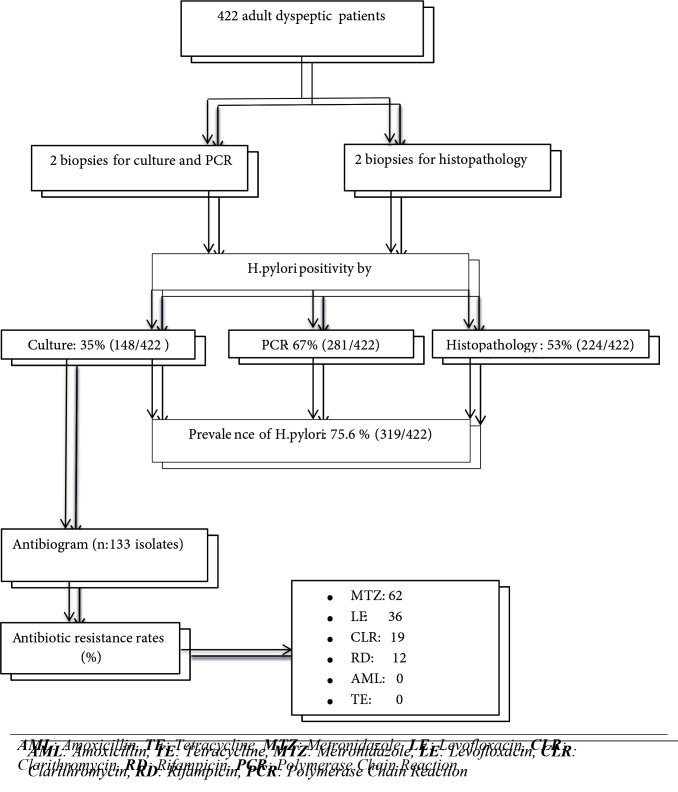
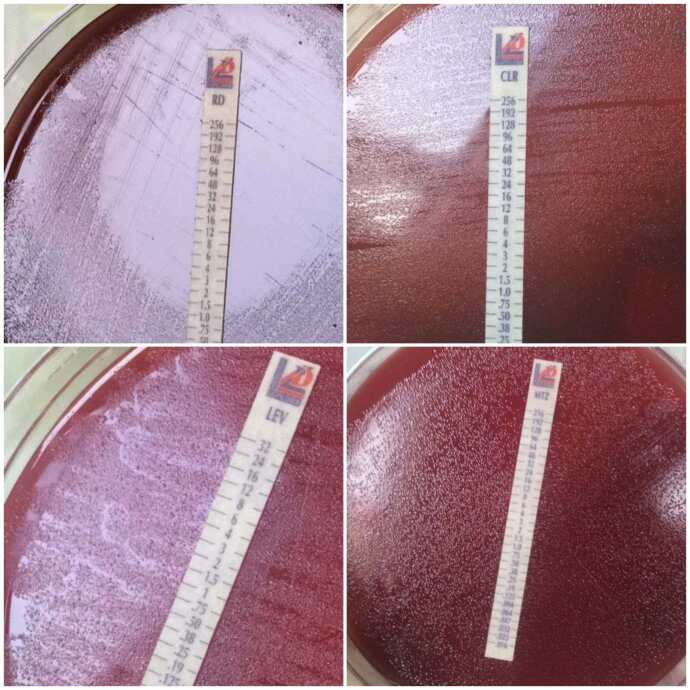
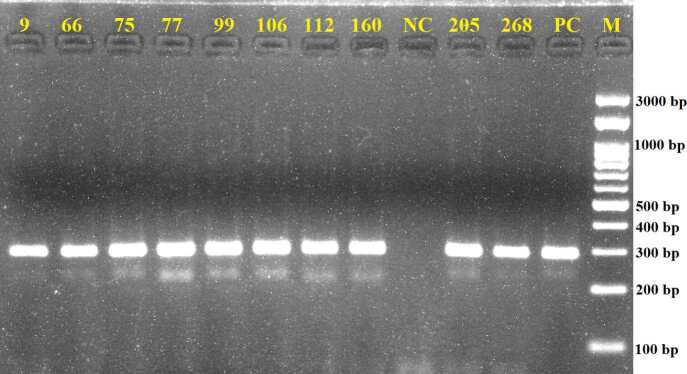
This study was conducted in 422 adult dyspeptic patients. The presence of H. pylori was demonstrated by culture, polymerase chain reaction, and the histopathology of gastric biopsy material. Antibacterial susceptibility was determined with the E-test.
The mean age of the patients was 50 ± 15 (range 18–90), and 265 (63%) of them were female. By culture, polymerase chain reaction, and histopathology, the presence of H. pylori was detected at rates of 35% (148/422), 67% (281/422), and 53% (224/422), respectively. The prevalence of H. pylori was determined as 75.6% (319/422). Metronidazole, levofloxacin, clarithromycin, and rifampicin resistance rates were 62%, 36%, 19%, and 12%, respectively. Monodrug, dual-drug, and multidrug resistance rates were ascertained as 36.9%, 29.4%, and 10.5%, respectively. All of the isolates were susceptible to amoxicillin and tetracycline.
This study revealed the current prevalence of H. pylori in adult dyspeptic patients as 75.6%, and thereby, showed that infection with this pathogen remains highly prevalent. Although resistance to metronidazole and levofloxacin has increased over time, clarithromycin resistance rate has decreased. The high levels of resistance to metronidazole and levofloxacin limit the empirical use of these antibiotics in the eradication protocol. Owing to the low level of resistance determined for rifampicin, this antibiotic could be included in the eradication protocol, in the event of the need for rescue therapy in Turkey.
背景/目的:据报道,土耳其幽门螺杆菌的感染率约为80%,而关于成年消化不良患者抗菌药物耐药性的基于培养的研究非常少。本研究针对成年消化不良患者开展,旨在:(i)通过侵入性检测(培养、聚合酶链反应和组织病理学)检测幽门螺杆菌;(ii)确定幽门螺杆菌分离株对包括利福平在内的六种抗生素的当前耐药率。
本研究纳入422例成年消化不良患者。通过培养、聚合酶链反应和胃活检材料的组织病理学检查证实幽门螺杆菌的存在。采用E-test法测定抗菌药物敏感性。
患者的平均年龄为50±15岁(范围18 - 90岁),其中265例(63%)为女性。通过培养、聚合酶链反应和组织病理学检查,幽门螺杆菌的检出率分别为35%(148/422)、67%(281/422)和53%(224/422)。幽门螺杆菌的感染率确定为75.6%(319/422)。甲硝唑、左氧氟沙星、克拉霉素和利福平的耐药率分别为62%、36%、19%和12%。单药、双药和多药耐药率分别确定为36.9%、29.4%和10.5%。所有分离株对阿莫西林和四环素敏感。
本研究显示成年消化不良患者中幽门螺杆菌的当前感染率为75.6%,表明该病原体感染仍然非常普遍。尽管随着时间推移,对甲硝唑和左氧氟沙星的耐药性有所增加,但克拉霉素耐药率有所下降。对甲硝唑和左氧氟沙星的高耐药水平限制了这些抗生素在根除方案中的经验性使用。由于利福平的耐药水平较低,在土耳其如有必要进行挽救治疗,该抗生素可纳入根除方案。