Department of Medicine, Division of Infectious Diseases and Global Public Health, University of California San Diego, 9500 Gilman Dr, La Jolla, California, 92093, USA.
The Center for Data Driven Health at the Qualcomm Institute, University of California San Diego, La Jolla, California, USA.
BMC Infect Dis. 2021 Feb 25;21(1):215. doi: 10.1186/s12879-021-05907-0.
Public health is increasingly turning to non-traditional digital data to inform HIV prevention and control strategies. We demonstrate a parsimonious method using both traditional survey and internet search histories to provide new insights into HIV testing and pre-exposure prophylaxis (PrEP) information seeking that can be easily extended to other settings.
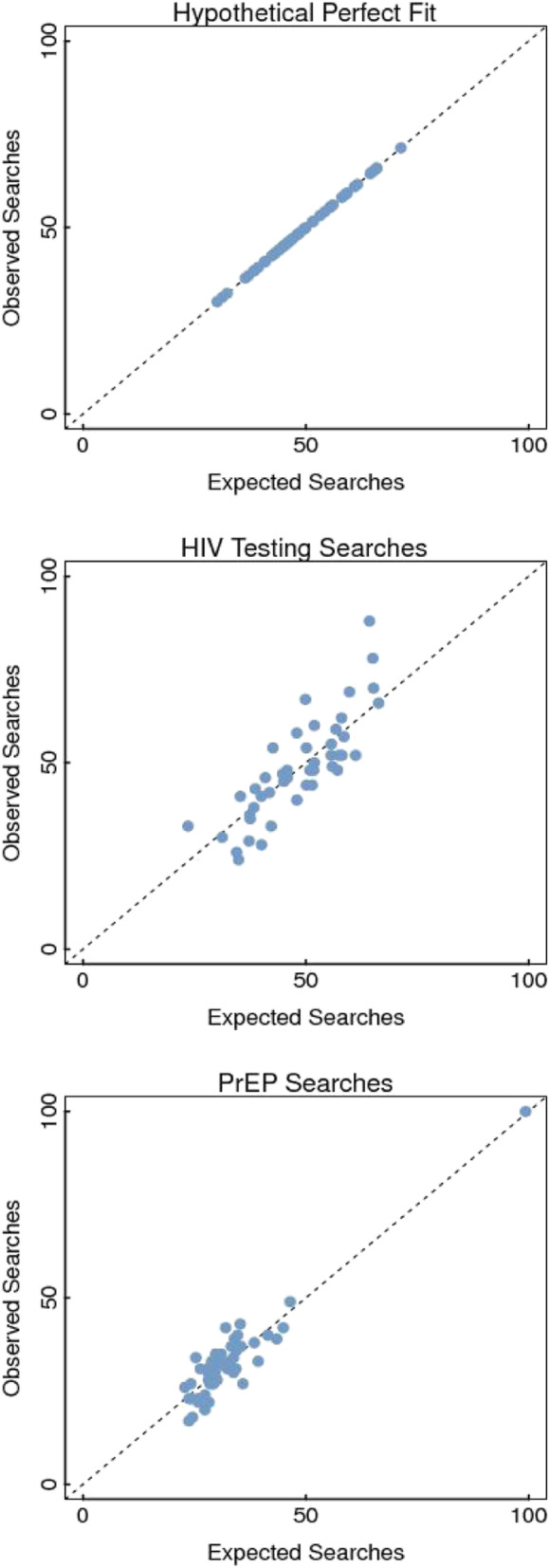
We modeled how US internet search volumes from 2019 for HIV testing and PrEP compared against expected search volumes for HIV testing and PrEP using state HIV prevalence and socioeconomic characteristics as predictors. States with search volumes outside the upper and lower bound confidence interval were labeled as either over or under performing. State performance was evaluated by (a) Centers for Disease Control and Prevention designation as a hotspot for new HIV diagnoses (b) expanding Medicaid coverage.
Ten states over-performed in models assessing information seeking for HIV testing, while eleven states under-performed. Thirteen states over-performed in models assessing internet searches for PrEP information, while thirteen states under-performed. States that expanded Medicaid coverage were more likely to over perform in PrEP models than states that did not expand Medicaid coverage. While states that were hotspots for new HIV diagnoses were more likely to over perform on HIV testing searches.
Our study derived a method of measuring HIV and PrEP information seeking that is comparable across states. Several states exhibited information seeking for PrEP and HIV testing that deviated from model assessments. Statewide search volume for PrEP information was affected by a state's decision to expand Medicaid coverage. Our research provides health officials with an innovative way to monitor statewide interest in PrEP and HIV testing using a metric for information-seeking that is comparable across states.
公共卫生领域越来越多地转向非传统的数字数据,以制定艾滋病预防和控制策略。我们展示了一种简洁的方法,同时使用传统的调查数据和互联网搜索历史记录,为了解艾滋病检测和暴露前预防(PrEP)信息搜索提供新的见解,这种方法可以很容易地扩展到其他环境。
我们使用美国 2019 年艾滋病检测和 PrEP 的互联网搜索量与根据 HIV 流行率和社会经济特征预测的 HIV 检测和 PrEP 预期搜索量进行建模。搜索量超出或低于置信区间上下限的州被标记为表现出色或表现不佳。通过以下方式评估州的表现:(a)疾病控制与预防中心将其指定为新 HIV 诊断热点的情况;(b)扩大医疗补助覆盖范围。
在评估艾滋病检测信息搜索的模型中,有 10 个州表现出色,而 11 个州表现不佳。在评估 PrEP 信息搜索的模型中,有 13 个州表现出色,而 13 个州表现不佳。扩大医疗补助覆盖范围的州在 PrEP 模型中表现出色的可能性大于没有扩大医疗补助覆盖范围的州。而新 HIV 诊断热点的州在 HIV 检测搜索中更有可能表现出色。
我们的研究提出了一种衡量艾滋病和 PrEP 信息搜索的方法,该方法在各州之间具有可比性。一些州的 PrEP 和 HIV 检测信息搜索与模型评估结果存在偏差。一个州决定扩大医疗补助覆盖范围会影响该州对 PrEP 信息的全州搜索量。我们的研究为卫生官员提供了一种创新的方法,通过一种在各州之间具有可比性的信息搜索指标来监测全州对 PrEP 和 HIV 检测的兴趣。