Department of Community Health Sciences, University of California, Los Angeles (UCLA), 650 Charles E. Young Drive South, 36-071 CHS, Box 951772, Los Angeles, CA90095-1772, USA.
California Center for Population Research, UCLA, Los Angeles, USA.
Public Health Nutr. 2021 May;24(7):1806-1817. doi: 10.1017/S1368980021000689. Epub 2021 Feb 26.
The Cambodian population has experienced an increase in the proportion of stunted children who have overweight mothers during a period of rapid social and economic growth. We aimed to identify socio-economic factors associated with this household-level double burden over time.
We used data from four Cambodia Demographic and Health Surveys from 2000 to 2014 to study the impact of socio-economic status (SES) on the link between child stunting and overweight mothers in two periods 2000-2005 v. 2010-2014. We hypothesised that SES would be a primary factor associated with this phenomenon.
We included 14 988 children under the age of 5 years, among non-pregnant mothers aged 15-49 years of age and conducted analysis on a subsample of 1572 children with overweight mothers.
Nationally representative household survey across all regions.
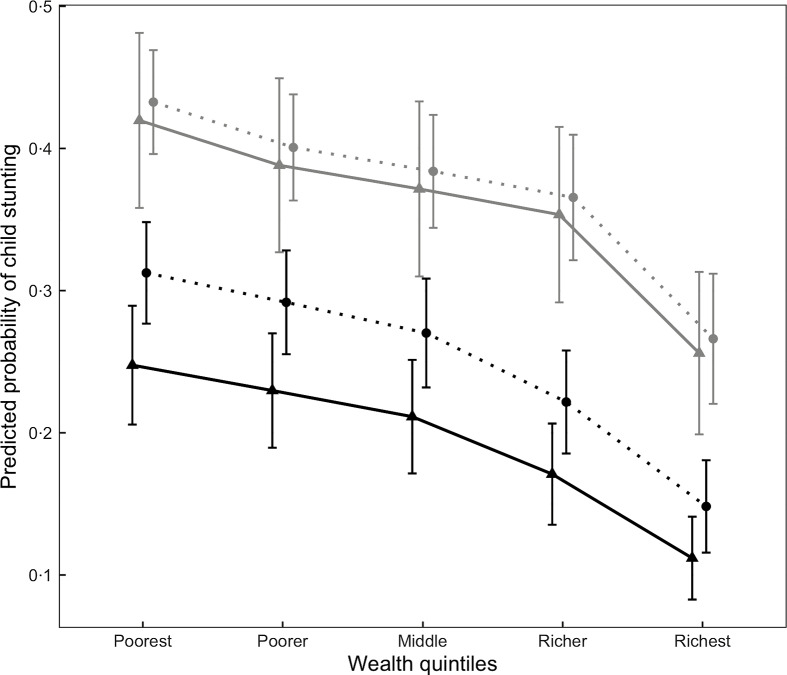
SES factors, specifically household wealth and maternal employment in service or manual occupations (in 2010-2014), are the main drivers of stunting among children of overweight mothers. Children with overweight mothers in the poorest households are more than twice as likely to be stunted than in the richest in both periods (2000-2005: adjusted OR (aOR) = 2·53, 95 % CI: 1·25, 5·13; 2010-2014: aOR = 2·61, 95 % CI: 1·43, 4·77), adjusting for other SES factors, indicating that despite decreasing income inequality, the poorest continue to bear excess risk of a double burden of malnutrition. Maternal short stature also doubled the likelihood of child stunting in both periods, which suggests intergenerational transmission of adversity and physical underdevelopment.
Socio-economic inequalities should be addressed to reduce disparities in the household-level double burden of malnutrition.
在社会经济快速增长的时期,柬埔寨人口中出现了超重母亲所生发育迟缓儿童比例增加的情况。本研究旨在确定与这一家庭层面双重负担相关的社会经济因素随时间的变化情况。
我们使用了 2000 年至 2014 年期间四次柬埔寨人口与健康调查的数据,研究了社会经济地位(SES)对 2000-2005 年和 2010-2014 年两个时期儿童发育迟缓与超重母亲之间关联的影响。我们假设 SES 是与这一现象相关的主要因素。
我们纳入了 14988 名 5 岁以下儿童及其年龄在 15-49 岁之间的非孕妇母亲,并对超重母亲的 1572 名儿童子样本进行了分析。
全国各地区具有代表性的家庭调查。
SES 因素,特别是家庭财富和母亲从事服务或体力劳动职业(2010-2014 年),是超重母亲的孩子发育迟缓的主要驱动因素。在两个时期(2000-2005 年:调整后的 OR(aOR)=2.53,95%CI:1.25,5.13;2010-2014 年:aOR=2.61,95%CI:1.43,4.77)中,最贫困家庭中超重母亲的孩子发育迟缓的可能性是最富裕家庭的两倍以上,表明尽管收入不平等程度有所下降,但最贫困家庭仍面临着过度的营养不良双重负担风险。母亲身材矮小也使两个时期儿童发育迟缓的可能性增加了一倍,这表明代际间逆境和身体发育不良的传递。
应解决社会经济不平等问题,以减少家庭层面营养不良双重负担的差异。