Fumagalli Elena, Dolmatzian Marina Belen, Shrum L J
School of Business, Universidad Torcuato Di Tella, Buenos Aires, Argentina.
Facultad de Ciencias Humanas y de la Conducta, Universidad Favaloro, Buenos Aires, Argentina.
Front Psychol. 2021 Feb 9;12:620739. doi: 10.3389/fpsyg.2021.620739. eCollection 2021.
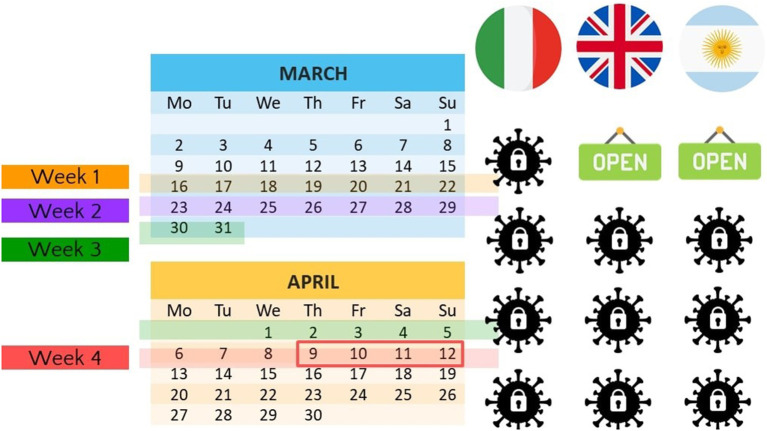
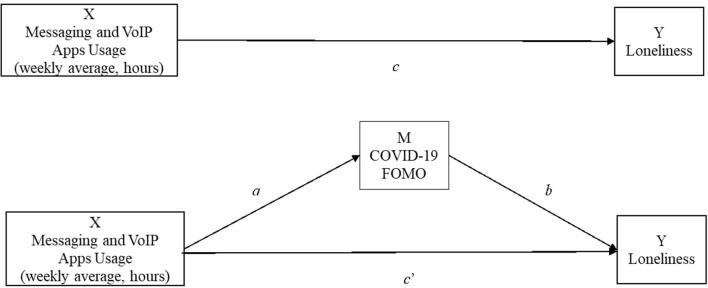
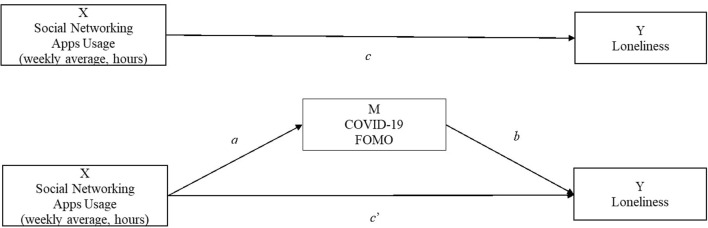
The current COVID-19 pandemic has had obvious, well-documented devastating effects on people's physical health. In this research, we investigate its potential effects on people's mental health. Many people have experienced social isolation, as countries attempt to stem the spread of the disease through confinement and other forms of social distancing. Intuitively, such social isolation may increase feelings of loneliness, and people may take logical steps to reduce their feelings of social isolation and loneliness. One route is through the use of social networking apps (e.g., Facebook, Instagram) and messaging and VoIP apps (e.g., WhatsApp, iMessage). In this research, we investigate the effects of pandemic-induced social isolation on social networking and messaging apps, and potential related effects on loneliness. We surveyed young adults ( = 334) who are part of the Centennial cohort (born after 1995) from three different countries (Italy, Argentina, UK) and obtained their screen time usage data over a 4-week period starting from mid-March 2020. This sampling procedure allowed us to obtain data from respondents who were experiencing different degrees of mandated social isolation (lockdowns), which enabled us to determine whether social network and messaging app usage increased as a function of social isolation, and to test potential effects on levels of loneliness. Results showed that only social network usage increased in the initial stage of confinement as a function of lockdown initiation. Additionally, social network app usage was associated with increased feelings of loneliness, and this relation was mediated by fear of missing out (FOMO). In contrast, messaging app usage was associated with decreased feelings of loneliness, and was unrelated to FOMO. These results suggest that technology may be useful for mitigating the impact of loneliness during social isolation but that it is necessary to promote usage of messaging and VoIP apps, rather than social networking apps, because they are directly associated with decreases in loneliness without increasing FOMO.
当前的新冠疫情对人们的身体健康产生了明显的、有充分记录的毁灭性影响。在本研究中,我们调查了其对人们心理健康的潜在影响。随着各国试图通过封锁和其他形式的社交距离措施来遏制疾病传播,许多人经历了社交隔离。直观地说,这种社交隔离可能会增加孤独感,人们可能会采取合理措施来减少社交隔离和孤独感。一种途径是通过使用社交网络应用程序(如脸书、照片墙)以及即时通讯和网络电话应用程序(如瓦次艾普、信息)。在本研究中,我们调查了疫情引发的社交隔离对社交网络和即时通讯应用程序的影响,以及对孤独感的潜在相关影响。我们对来自三个不同国家(意大利、阿根廷、英国)的百年队列(1995年后出生)中的334名年轻人进行了调查,并获取了他们从2020年3月中旬开始的4周内的屏幕使用时间数据。这种抽样程序使我们能够从经历不同程度强制社交隔离(封锁)的受访者那里获取数据,这使我们能够确定社交网络和即时通讯应用程序的使用是否随着社交隔离程度的增加而增加,并测试对孤独感水平的潜在影响。结果表明,在封锁开始时,只有社交网络的使用在隔离初期随着封锁的开始而增加。此外,社交网络应用程序的使用与孤独感的增加有关,并且这种关系是由错失恐惧症(FOMO)介导的。相比之下,即时通讯应用程序的使用与孤独感的降低有关,并且与错失恐惧症无关。这些结果表明,技术可能有助于减轻社交隔离期间孤独感的影响,但有必要推广即时通讯和网络电话应用程序的使用,而不是社交网络应用程序,因为它们与孤独感的降低直接相关,而不会增加错失恐惧症。