Department of Psychology, University of Turin, Turin, Italy.
Department of Molecular Psychology, Institute of Psychology and Education, Ulm University, Ulm, Germany.
J Med Internet Res. 2021 Sep 30;23(9):e27093. doi: 10.2196/27093.
Social communication via instant messaging (IM) and social networking (SN) apps makes up a large part of the time that smartphone users spend on their devices. Previous research has indicated that the excessive use of these apps is positively associated with problematic smartphone use behaviors. In particular, image-based SN apps, such as Instagram (Facebook Inc) and Snapchat (Snap Inc), have been shown to exert stronger detrimental effects than those exerted by traditional apps, such as Facebook (Facebook Inc) and Twitter (Twitter Inc).
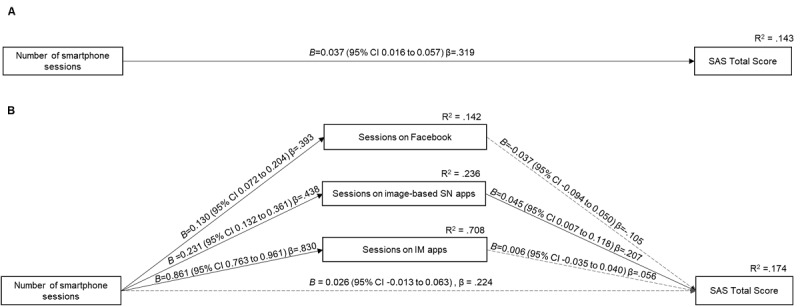
In this study, we investigated the correlation between individuals' tendencies toward smartphone use disorder (SmUD) and objective measures of the frequency of smartphone usage. Additionally, we put to test the hypothesis that the pathway linking the frequency of actual smartphone usage to self-reported tendencies toward SmUD was mediated by the increased frequency of IM and SN app usage.
We recruited a sample of 124 adult smartphone users (females: 78/124, 62.9%; age: mean 23.84 years, SD 8.29 years) and collected objective information about the frequency of smartphone and SN app usage over 1 week. Participants also filled in a self-report measure for assessing the multiple components of tendencies toward SmUD. Bivariate associations were investigated by using Spearman correlation analyses. A parallel mediation analysis was conducted via multiple regression analysis.
The frequency of smartphone usage, as well as the use of IM apps (Messenger, Telegram, and WhatsApp [Facebook Inc]), Facebook, and image-based apps (Instagram and Snapchat), had significant positive associations with at least 1 component of SmUD, and the cyberspace-oriented relationships factor exhibited the strongest associations overall. We found support for an indirect effect that linked actual smartphone usage to SmUD tendencies via the frequency of the use of image-based SN apps.
Our novel results shed light on the factors that promote SmUD tendencies and essentially indicate that image-based SN apps seem to be more strongly associated with problematic smartphone behaviors compared to IM apps and traditional SN apps, such as Facebook.
通过即时通讯 (IM) 和社交网络 (SN) 应用程序进行社交交流占据了智能手机用户在设备上花费的大部分时间。先前的研究表明,过度使用这些应用程序与有问题的智能手机使用行为呈正相关。特别是,基于图像的 SN 应用程序,如 Instagram(Facebook Inc.)和 Snapchat(Snap Inc.),已被证明比传统应用程序(如 Facebook(Facebook Inc.)和 Twitter(Twitter Inc.))产生更强的不利影响。
在这项研究中,我们调查了个体智能手机使用障碍 (SmUD) 倾向与智能手机使用频率的客观测量之间的相关性。此外,我们验证了这样一个假设,即实际智能手机使用频率与自我报告的 SmUD 倾向之间的联系途径是通过增加 IM 和 SN 应用程序使用频率来介导的。
我们招募了 124 名成年智能手机用户(女性:78/124,62.9%;年龄:平均 23.84 岁,标准差 8.29 岁)作为样本,并在一周内收集了有关智能手机和 SN 应用程序使用频率的客观信息。参与者还填写了一份自我报告量表,用于评估 SmUD 倾向的多个组成部分。通过 Spearman 相关分析研究了双变量关联。通过多元回归分析进行了平行中介分析。
智能手机使用频率以及 IM 应用程序(Messenger、Telegram 和 WhatsApp[Facebook Inc.])、Facebook 和基于图像的应用程序(Instagram 和 Snapchat)的使用与 SmUD 的至少 1 个组成部分呈显著正相关,而网络导向关系因素总体上具有最强的相关性。我们发现了一种间接效应的支持,该效应通过基于图像的 SN 应用程序使用频率将实际智能手机使用与 SmUD 倾向联系起来。
我们的新结果揭示了促进 SmUD 倾向的因素,并指出基于图像的 SN 应用程序似乎与 IM 应用程序和传统的 SN 应用程序(如 Facebook)相比,与有问题的智能手机行为更密切相关。