Division of Cardiology, Department of Internal Medicine, Kangwon National University School of Medicine, Chuncheon, Republic of Korea.
Department of Cardiology, Cardiovascular Center, Chonnam National University Hospital, Gwangju, Republic of Korea.
Cardiol J. 2022;29(4):647-659. doi: 10.5603/CJ.a2021.0007. Epub 2021 Feb 26.
Limited data are available comparing the combined effects of statins and renin-angiotensin system inhibitor (RASI) between patients with ST-segment elevation myocardial infarction (STEMI) and those with non-STEMI (NSTEMI). We compared the effects of statins combined with RASI in STEMI and NSTEMI patients after stent implantation during a long-term follow-up period.
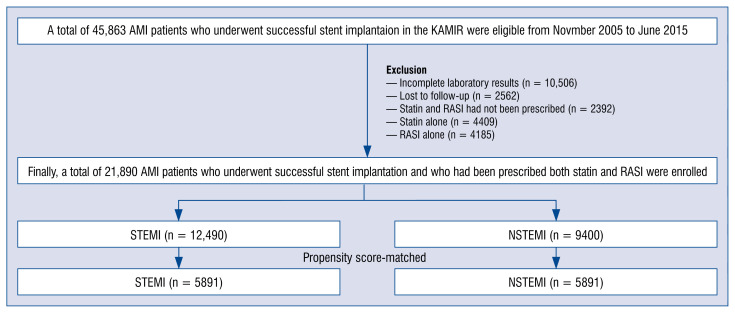
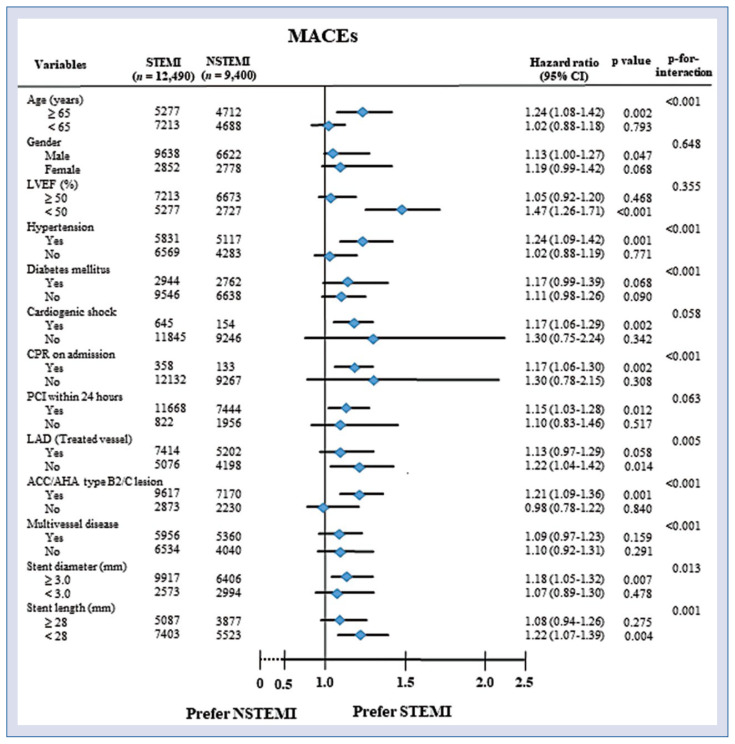
A total of 21,890 acute myocardial infarction (AMI) patients who underwent successful stent implantation and who received statins with RASI were enrolled. They were separated into the STEMI group (n = 12,490) and the NSTEMI group (n = 9400). The major clinical endpoint was the occurrence of major adverse cardiac events (MACEs) defined as all-cause death, recurrent myocardial infarction (Re-MI), and any repeat revascularization.
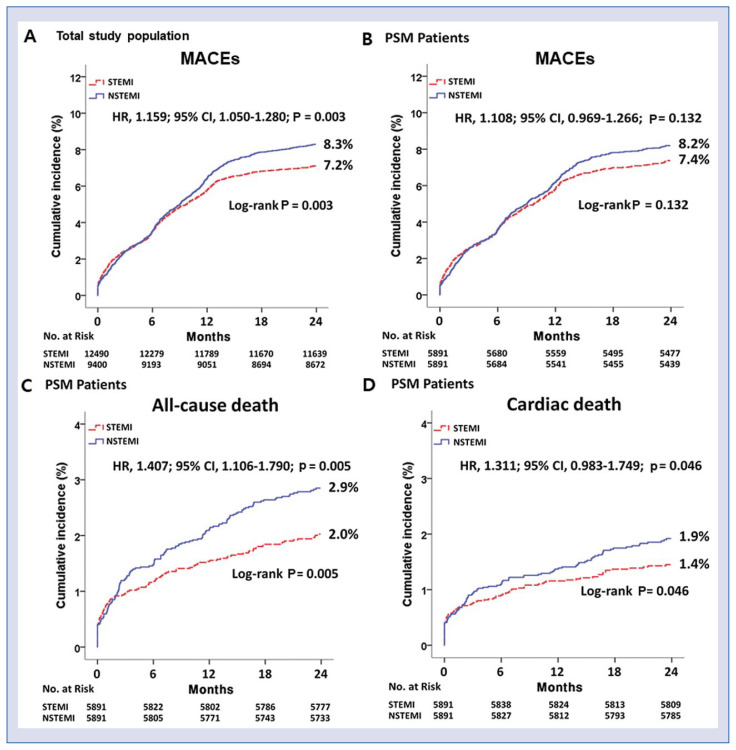
Two propensity score-matched (PSM) groups (5891 pairs, n = 11782, C-statistic = 0.821) were generated. Even though the cumulative incidences of MACE, re-MI, total repeat revascularization were similar between the two groups, the cumulative incidences of all-cause death (hazard ratio [HR] 1.407; 95% confidence interval [CI] 1.106-1.790; p = 0.005) and cardiac death (HR 1.311; 95% CI 1.983-1.749; p = 0.046) were significantly higher in the NSTEMI group.
In this study, statin with RASI combination therapy was more beneficial to the STEMI patients than to the NSTEMI patients in reducing all-cause death and cardiac death.
比较 ST 段抬高型心肌梗死(STEMI)和非 ST 段抬高型心肌梗死(NSTEMI)患者联合使用他汀类药物和肾素-血管紧张素系统抑制剂(RASI)的综合效果的数据有限。我们比较了在长期随访期间,STEMI 和 NSTEMI 患者在支架植入术后联合使用他汀类药物和 RASI 的效果。
共纳入 21890 例急性心肌梗死(AMI)患者,这些患者成功接受了支架植入术,并接受了他汀类药物和 RASI 的治疗。他们被分为 STEMI 组(n=12490)和 NSTEMI 组(n=9400)。主要临床终点是发生主要不良心脏事件(MACE),定义为全因死亡、再发心肌梗死(Re-MI)和任何再次血运重建。
生成了 2 个倾向评分匹配(PSM)组(5891 对,n=11782,C 统计量=0.821)。尽管两组的 MACE、再发心肌梗死和总再次血运重建的累积发生率相似,但全因死亡(风险比 [HR] 1.407;95%置信区间 [CI] 1.106-1.790;p=0.005)和心脏死亡(HR 1.311;95% CI 1.983-1.749;p=0.046)的累积发生率在 NSTEMI 组更高。
在这项研究中,与 NSTEMI 患者相比,STEMI 患者使用他汀类药物联合 RASI 治疗可更显著降低全因死亡和心脏死亡风险。