Liu Kaizhen, Chen Long, Xiong Jing, Xie Shuqin, Hu Yuan, Shi Yuan
Department of Neonatology, Children's Hospital of Chongqing Medical University; National Clinical Research Center for Child Health and Disorders; Ministry of Education Key Laboratory of Child Development and Disorders; Chongqing Key Laboratory of Pediatrics, Chongqing, People's Republic of China.
Department of Nephrology, The Second Affiliated Hospital of Chongqing Medical University, Chongqing, People's Republic of China.
Eur J Pediatr. 2021 Jul;180(7):2155-2164. doi: 10.1007/s00431-021-03953-z. Epub 2021 Feb 27.
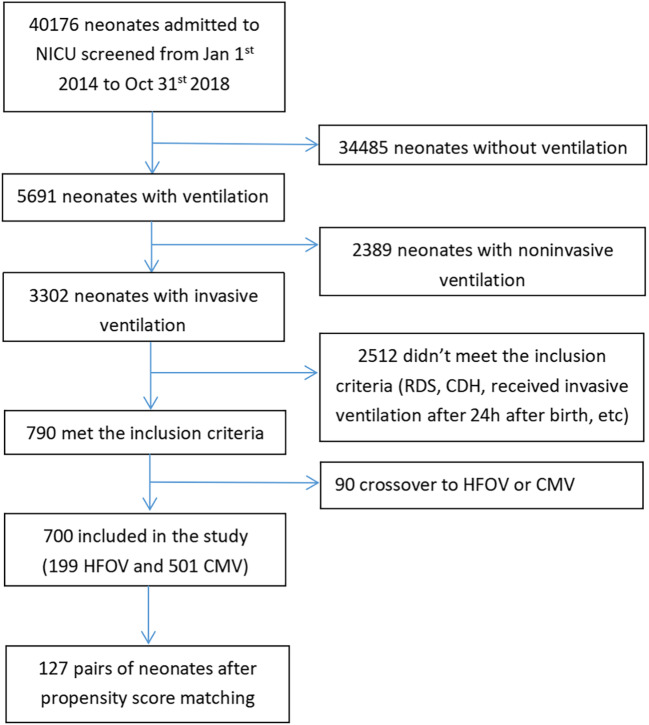
This study aimed to evaluate whether high-frequency oscillatory ventilation (HFOV) could reduce mortality and the incidence of bronchopulmonary dysplasia (BPD) of perinatal-onset neonatal acute respiratory distress syndrome (NARDS) compared with conventional mechanical ventilation (CMV). Medical records were collected and retrospectively analyzed. Among the 700 neonates with NARDS who needed invasive ventilation, 501 (71.6%) received CMV, while 199 (28.4%) received HFOV. One-to-one propensity score matching (127:127) was used to match the baseline characteristics of patients who received CMV and HFOV. The results showed that birth weight and oxygenation index (OI) were independently associated with mortality in the multivariate logistic regression. No significant differences were observed in mortality or the incidence of BPD between the two groups. The incidence of intraventricular hemorrhage (IVH) and ventilation-free days were significantly lower in the HFOV group than in the CMV group (3.9 vs 11.80%, p=0.02; 15.226 vs 20.967 days, p=0.01). There were no significant differences between the two groups regarding other secondary outcomes.Conclusion: HFOV was associated with a decreased incidence of IVH in infants with NARDS compared with CMV. However, there were significantly more VFDs in the CMV group than in the HFOV group, and HFOV did not appear to be superior to CMV in decreasing the mortality and incidence of BPD in infants with NARDS. What is Known: • The diagnostic criteria of neonatal acute respiratory distress syndrome (Montreux criteria) were established in 2017. • To date, studies comparing high-frequency oscillatory ventilation and conventional mechanical ventilation in the treatment of neonatal acute respiratory distress syndrome are insufficient. What is New: • High-frequency oscillatory ventilation did not appear to be superior to conventional mechanical ventilation in decreasing the mortality and incidence of bronchopulmonary dysplasia in infants with moderate-to-severe perinatal-onset neonatal acute respiratory distress syndrome. • High-frequency oscillatory ventilation was associated with a decreased incidence of intraventricular hemorrhage in infants with moderate-to-severe perinatal-onset acute respiratory distress syndrome compared with conventional mechanical ventilation.
本研究旨在评估与传统机械通气(CMV)相比,高频振荡通气(HFOV)能否降低围产期发病的新生儿急性呼吸窘迫综合征(NARDS)的死亡率和支气管肺发育不良(BPD)的发生率。收集并回顾性分析了病历。在700例需要有创通气的NARDS新生儿中,501例(71.6%)接受了CMV,而199例(28.4%)接受了HFOV。采用一对一倾向评分匹配法(127:127)对接受CMV和HFOV的患者基线特征进行匹配。结果显示,在多因素logistic回归中,出生体重和氧合指数(OI)与死亡率独立相关。两组在死亡率或BPD发生率方面未观察到显著差异。HFOV组的脑室内出血(IVH)发生率和无通气天数显著低于CMV组(3.9%对11.80%,p=0.02;15.226天对20.967天,p=0.01)。两组在其他次要结局方面无显著差异。结论:与CMV相比,HFOV与NARDS婴儿IVH发生率降低相关。然而,CMV组的无通气天数显著多于HFOV组,且在降低NARDS婴儿的死亡率和BPD发生率方面,HFOV似乎并不优于CMV。已知信息:• 新生儿急性呼吸窘迫综合征的诊断标准(蒙特勒标准)于2017年确立。• 迄今为止,比较高频振荡通气和传统机械通气治疗新生儿急性呼吸窘迫综合征的研究不足。新发现:• 在降低中重度围产期发病的新生儿急性呼吸窘迫综合征婴儿的死亡率和支气管肺发育不良发生率方面,高频振荡通气似乎并不优于传统机械通气。• 与传统机械通气相比,高频振荡通气与中重度围产期发病的急性呼吸窘迫综合征婴儿脑室内出血发生率降低相关。