Department of Anesthesiology, University Medical Center Göttingen, Robert-Koch-Straße 40, 37075, Göttingen, Germany.
Institute for Medical Microbiology, University of Göttingen, Kreuzbergring 57, 37075, Göttingen, Germany.
BMC Microbiol. 2021 Feb 28;21(1):69. doi: 10.1186/s12866-021-02102-8.
Hospital-acquired pneumonia (HAP) is a common problem in intensive care medicine and the patient outcome depends on the fast beginning of adequate antibiotic therapy. Until today pathogen identification is performed using conventional microbiological methods with turnaround times of at least 24 h for the first results. It was the aim of this study to investigate the potential of headspace analyses detecting bacterial species-specific patterns of volatile organic compounds (VOCs) for the rapid differentiation of HAP-relevant bacteria.
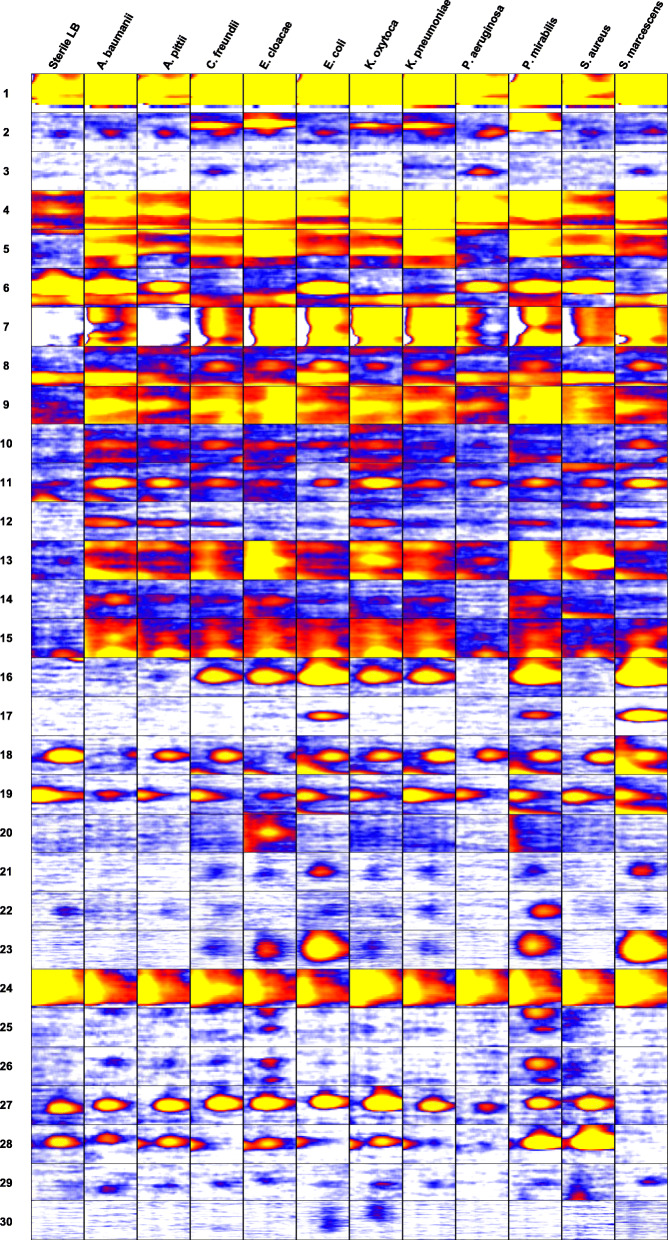
Eleven HAP-relevant bacteria (Acinetobacter baumanii, Acinetobacter pittii, Citrobacter freundii, Enterobacter cloacae, Escherichia coli, Klebsiella oxytoca, Klebsiella pneumoniae, Pseudomonas aeruginosa, Proteus mirabilis, Staphylococcus aureus, Serratia marcescens) were each grown for 6 hours in Lysogeny Broth and the headspace over the grown cultures was investigated using multi-capillary column-ion mobility spectrometry (MCC-IMS) to detect differences in the VOC composition between the bacteria in the panel. Peak areas with changing signal intensities were statistically analysed, including significance testing using one-way ANOVA or Kruskal-Wallis test (p < 0.05).
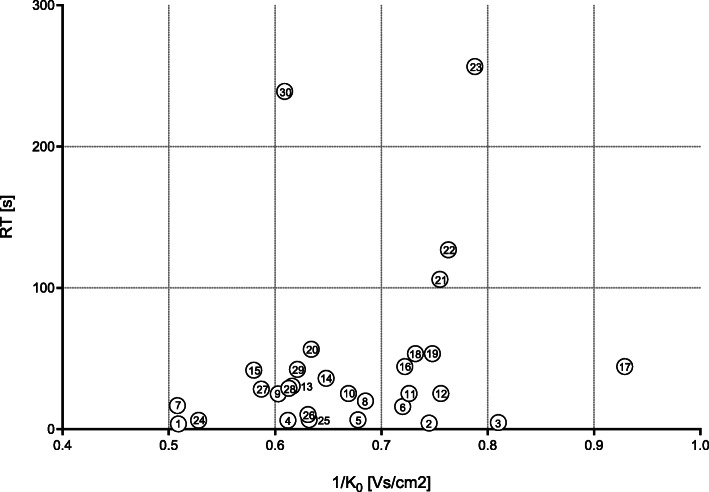
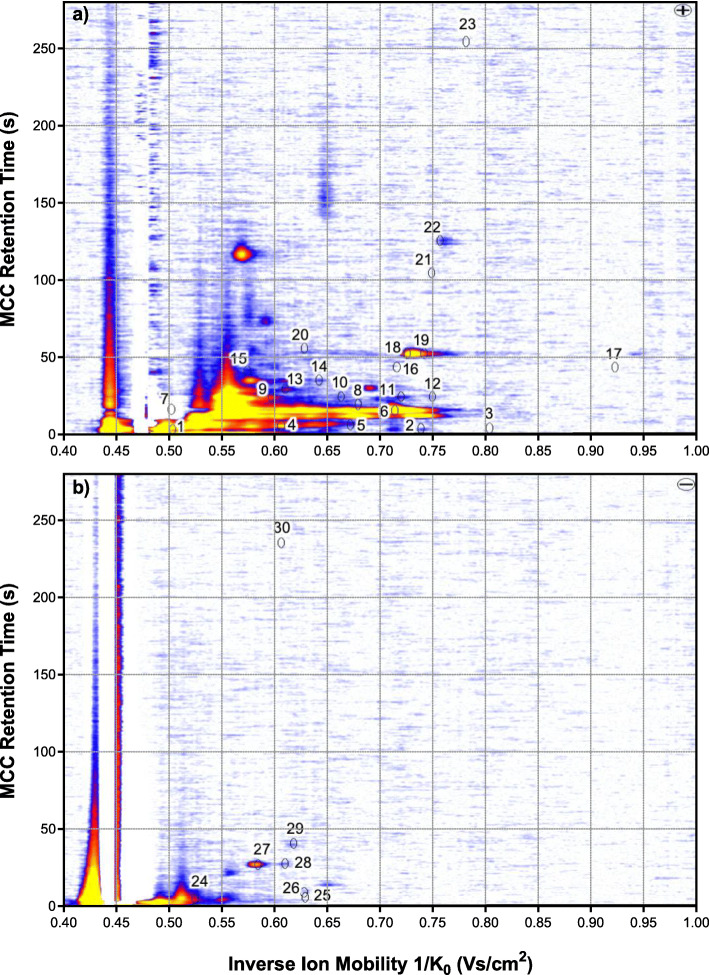
30 VOC signals (23 in the positive ion mode and 7 in the negative ion mode of the MCC-IMS) showed statistically significant differences in at least one of the investigated bacteria. The VOC patterns of the bacteria within the HAP panel differed substantially and allowed species differentiation.
MCC-IMS headspace analyses allow differentiation of bacteria within HAP-relevant panel after 6 h of incubation in a complex fluid growth medium. The method has the potential to be developed towards a feasible point-of-care diagnostic tool for pathogen differentiation on HAP.
医院获得性肺炎(HAP)是重症监护医学中的常见问题,患者的预后取决于快速开始进行适当的抗生素治疗。直到今天,病原体鉴定仍采用常规微生物学方法,首次结果的周转时间至少为 24 小时。本研究旨在探讨顶空分析检测细菌种特异性挥发性有机化合物(VOC)模式快速区分 HAP 相关细菌的潜力。
将 11 种 HAP 相关细菌(鲍曼不动杆菌、皮特不动杆菌、弗氏柠檬酸杆菌、阴沟肠杆菌、大肠埃希菌、催产克雷伯菌、肺炎克雷伯菌、铜绿假单胞菌、奇异变形杆菌、金黄色葡萄球菌、粘质沙雷菌)分别在 Lysogeny Broth 中培养 6 小时,并用多毛细管柱离子迁移谱(MCC-IMS)检测培养物上方的顶空,以检测面板中细菌之间 VOC 组成的差异。对信号强度发生变化的峰面积进行统计学分析,包括使用单向方差分析或 Kruskal-Wallis 检验(p<0.05)进行显著性检验。
30 种 VOC 信号(MCC-IMS 的正离子模式下有 23 种,负离子模式下有 7 种)在至少一种被研究的细菌中表现出统计学上的显著差异。HAP 面板中细菌的 VOC 模式差异很大,允许进行物种分化。
MCC-IMS 顶空分析允许在复杂液体生长培养基中孵育 6 小时后区分 HAP 相关面板中的细菌。该方法有可能发展成为一种可行的 HAP 病原体鉴别即时诊断工具。