MicroDiagnostics, Fraunhofer Institute for Cell Therapy and Immunology IZI, Leipzig, Germany.
Institute for Biochemistry and Biology, University of Potsdam, Potsdam, Germany.
Appl Microbiol Biotechnol. 2021 May;105(10):4297-4307. doi: 10.1007/s00253-021-11315-w. Epub 2021 May 11.
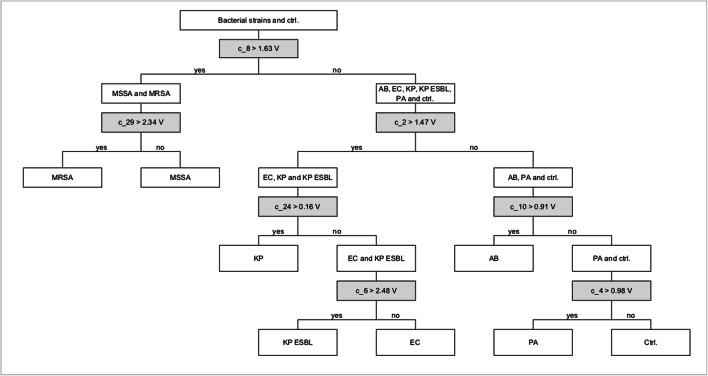
Rapid screening of infected people plays a crucial role in interrupting infection chains. However, the current methods for identification of bacteria are very tedious and labor intense. Fast on-site screening for pathogens based on volatile organic compounds (VOCs) by ion mobility spectrometry (IMS) could help to differentiate between healthy and potentially infected subjects. As a first step towards this, the feasibility of differentiating between seven different bacteria including resistant strains was assessed using IMS coupled to multicapillary columns (MCC-IMS). The headspace above bacterial cultures was directly drawn and analyzed by MCC-IMS after 90 min of incubation. A cluster analysis software and statistical methods were applied to select discriminative VOC clusters. As a result, 63 VOC clusters were identified, enabling the differentiation between all investigated bacterial strains using canonical discriminant analysis. These 63 clusters were reduced to 7 discriminative VOC clusters by constructing a hierarchical classification tree. Using this tree, all bacteria including resistant strains could be classified with an AUC of 1.0 by receiver-operating characteristic analysis. In conclusion, MCC-IMS is able to differentiate the tested bacterial species, even the non-resistant and their corresponding resistant strains, based on VOC patterns after 90 min of cultivation. Although this result is very promising, in vivo studies need to be performed to investigate if this technology is able to also classify clinical samples. With a short analysis time of 5 min, MCC-IMS is quite attractive for a rapid screening for possible infections in various locations from hospitals to airports.Key Points• Differentiation of bacteria by MCC-IMS is shown after 90-min cultivation.• Non-resistant and resistant strains can be distinguished.• Classification of bacteria is possible based on metabolic features.
快速筛查感染者在阻断感染链方面起着至关重要的作用。然而,目前鉴定细菌的方法非常繁琐和费力。基于离子迁移谱(IMS)的挥发性有机化合物(VOC)的快速现场病原体筛查,可以帮助区分健康和潜在感染的受试者。作为迈向这一目标的第一步,使用多毛细管柱(MCC-IMS)评估了 IMS 区分包括耐药菌株在内的七种不同细菌的可行性。在孵育 90 分钟后,直接从细菌培养物的顶空提取并通过 MCC-IMS 进行分析。应用聚类分析软件和统计方法选择有区别的 VOC 簇。结果,鉴定了 63 个 VOC 簇,使用典型判别分析能够区分所有研究的细菌菌株。通过构建分层分类树,将这 63 个簇减少到 7 个有区别的 VOC 簇。使用该树,通过接收者操作特征分析,所有细菌包括耐药菌株都可以以 1.0 的 AUC 进行分类。总之,MCC-IMS 能够根据培养 90 分钟后 VOC 模式区分测试的细菌种类,甚至是非耐药菌株及其相应的耐药菌株。尽管这一结果非常有希望,但需要进行体内研究以调查该技术是否能够对临床样本进行分类。MCC-IMS 的分析时间短,仅需 5 分钟,非常适合在从医院到机场等各种场所进行可能感染的快速筛查。关键点:· 经过 90 分钟的培养,MCC-IMS 可以区分细菌。· 可以区分非耐药和耐药菌株。· 可以基于代谢特征对细菌进行分类。