Department of Neurology, National Neuroscience Institute, Singapore, Singapore.
Duke-NUS Medical School, Singapore, Singapore.
Clin Interv Aging. 2021 Feb 19;16:301-309. doi: 10.2147/CIA.S290055. eCollection 2021.
Rivastigmine is used to treat cognitive impairment in Alzheimer's disease (AD); however, the efficacy of Rivastigmine in patients with AD and concomitant small vessel cerebrovascular disease (svCVD) remains unclear. We investigated the effectiveness of Rivastigmine Patch in patients with AD and svCVD.
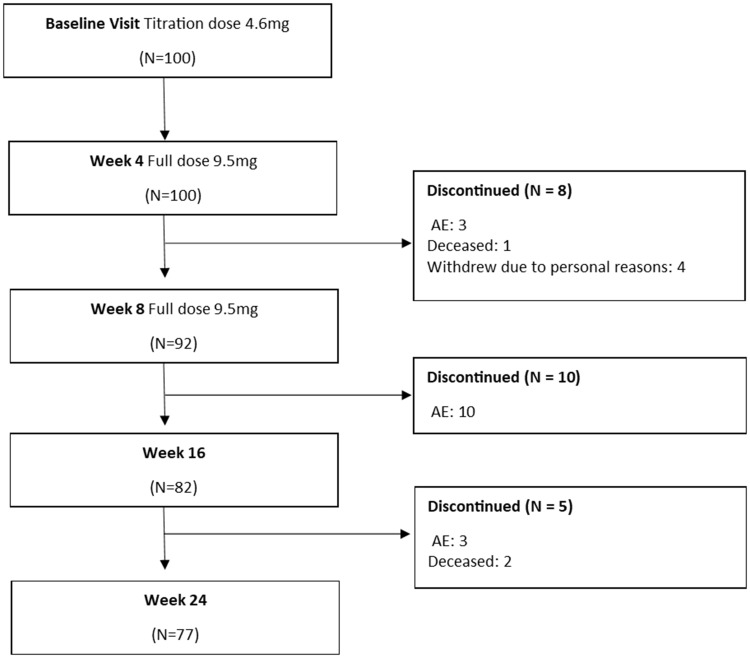
In this open-label study, 100 patients with AD and MRI confirmed svCVD received 9.5mg/24 hours Rivastigmine transdermal treatment for 24 weeks. The primary outcome was global cognition indexed using the ADAS-Cog. Secondary outcomes included clinical-rated impression of change (indexed using (ADCS-CGIC), activities of daily living (indexed using ADCS-ADL) and side effects.
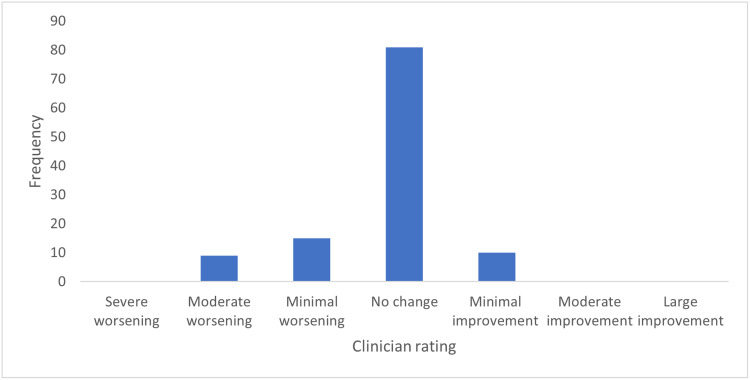
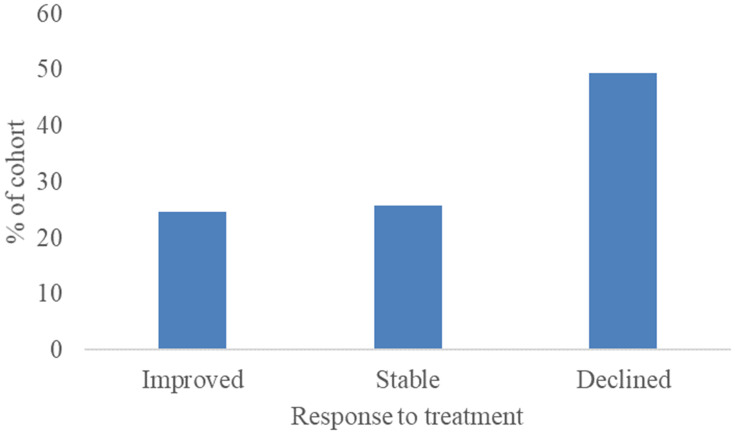
Overall, performance on the ADAS-Cog after 24 weeks deteriorated by 1.78 (SD = 5.29) points. Fifty-two percent of the sample demonstrated improvement or remained stable, while 48% demonstrated worsening of ADAS-Cog scores. Of the 52%, significant improvement (2 or more-point decline) on the ADAS-Cog was observed in 25% of the sample, with a mean change of -5.08 (SD = 3.11). A decline on the ADAS-Cog was observed in 48% of the sample, with a mean change of 6 (SD = 2.98) points. Cognitive outcome did not interact with severity of svCVD. ADCS-ADL scores remained stable from baseline to week 24 and ADCS-CGIC reports indicated that 81% of the patients remained stable after treatment. Side effects were reported by 16% of the patients, with contact dermatitis being the most common.
Our findings suggest that Rivastigmine may have a role in the management of patients having AD and concomitant mild-severe svCVD, with minimal side effects.
卡巴拉汀用于治疗阿尔茨海默病(AD)的认知障碍;然而,卡巴拉汀在 AD 合并小血管脑血管病(svCVD)患者中的疗效尚不清楚。我们研究了卡巴拉汀贴片在 AD 合并 svCVD 患者中的疗效。
在这项开放标签研究中,100 名 AD 患者和 MRI 证实的 svCVD 患者接受了 9.5mg/24 小时卡巴拉汀透皮治疗,持续 24 周。主要终点是使用 ADAS-Cog 评估的总体认知。次要结局包括临床评定变化印象(使用 ADCS-CGIC 评估)、日常生活活动(使用 ADCS-ADL 评估)和副作用。
总的来说,24 周后 ADAS-Cog 的表现恶化了 1.78(SD=5.29)分。52%的样本表现出改善或稳定,而 48%的样本表现出 ADAS-Cog 评分恶化。在 52%的样本中,有 25%的样本出现了显著改善(ADAS-Cog 下降 2 分或更多),平均变化为-5.08(SD=3.11)。48%的样本出现了 ADAS-Cog 的下降,平均变化为 6(SD=2.98)分。认知结果与 svCVD 的严重程度没有相互作用。ADCS-ADL 评分从基线到第 24 周保持稳定,ADCS-CGIC 报告显示 81%的患者在治疗后保持稳定。16%的患者报告出现副作用,最常见的是接触性皮炎。
我们的研究结果表明,卡巴拉汀可能在治疗 AD 合并轻-重度 svCVD 的患者中具有作用,副作用最小。