• 文献检索
  • 文档翻译
  • 深度研究
  • 学术资讯
  • Suppr Zotero 插件Zotero 插件
  • 邀请有礼
  • 套餐&价格
  • 历史记录
应用&插件
Suppr Zotero 插件Zotero 插件浏览器插件Mac 客户端Windows 客户端微信小程序
定价
高级版会员购买积分包购买API积分包
服务
文献检索文档翻译深度研究API 文档MCP 服务
关于我们
关于 Suppr公司介绍联系我们用户协议隐私条款
关注我们

Suppr 超能文献

核心技术专利:CN118964589B侵权必究
粤ICP备2023148730 号-1Suppr @ 2026

文献检索

告别复杂PubMed语法,用中文像聊天一样搜索,搜遍4000万医学文献。AI智能推荐,让科研检索更轻松。

立即免费搜索

文件翻译

保留排版,准确专业,支持PDF/Word/PPT等文件格式,支持 12+语言互译。

免费翻译文档

深度研究

AI帮你快速写综述,25分钟生成高质量综述,智能提取关键信息,辅助科研写作。

立即免费体验

在预测前列腺切除术后生化复发方面,深度神经网络优于CAPRA评分。

Deep Neural Networks Outperform the CAPRA Score in Predicting Biochemical Recurrence After Prostatectomy.

作者信息

Sargos Paul, Leduc Nicolas, Giraud Nicolas, Gandaglia Giorgio, Roumiguié Mathieu, Ploussard Guillaume, Rozet Francois, Soulié Michel, Mathieu Romain, Artus Pierre Mongiat, Niazi Tamim, Vinh-Hung Vincent, Beauval Jean-Baptiste

机构信息

Department of Radiation Oncology, Institut Bergonié, Bordeaux, France.

Division of Radiation Oncology, Department of Oncology, McGill University, Montreal, QC, Canada.

出版信息

Front Oncol. 2021 Feb 11;10:607923. doi: 10.3389/fonc.2020.607923. eCollection 2020.

DOI:10.3389/fonc.2020.607923
PMID:33643910
原文链接:https://pmc.ncbi.nlm.nih.gov/articles/PMC7906005/
Abstract

BACKGROUND

Use of predictive models for the prediction of biochemical recurrence (BCR) is gaining attention for prostate cancer (PCa). Specifically, BCR occurs in approximately 20-40% of patients five years after radical prostatectomy (RP) and the ability to predict BCR may help clinicians to make better treatment decisions. We aim to investigate the accuracy of CAPRA score compared to others models in predicting the 3-year BCR of PCa patients.

MATERIAL AND METHODS

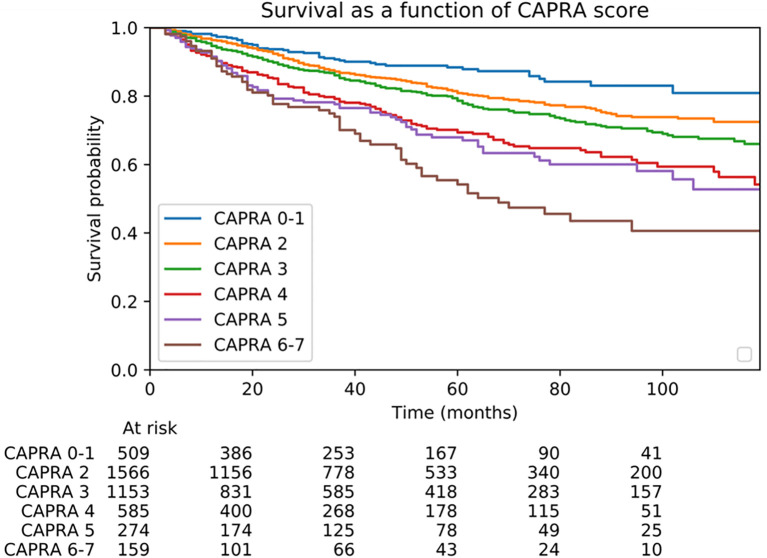
A total of 5043 men who underwent RP were analyzed retrospectively. The accuracy of CAPRA score, Cox regression analysis, logistic regression, K-nearest neighbor (KNN), random forest (RF) and a densely connected feed-forward neural network (DNN) classifier were compared in terms of 3-year BCR predictive value. The area under the receiver operating characteristic curve was mainly used to assess the performance of the predictive models in predicting the 3 years BCR of PCa patients. Pre-operative data such as PSA level, Gleason grade, and T stage were included in the multivariate analysis. To measure potential improvements to the model performance due to additional data, each model was trained once more with an additional set of post-operative surgical data from definitive pathology.

RESULTS

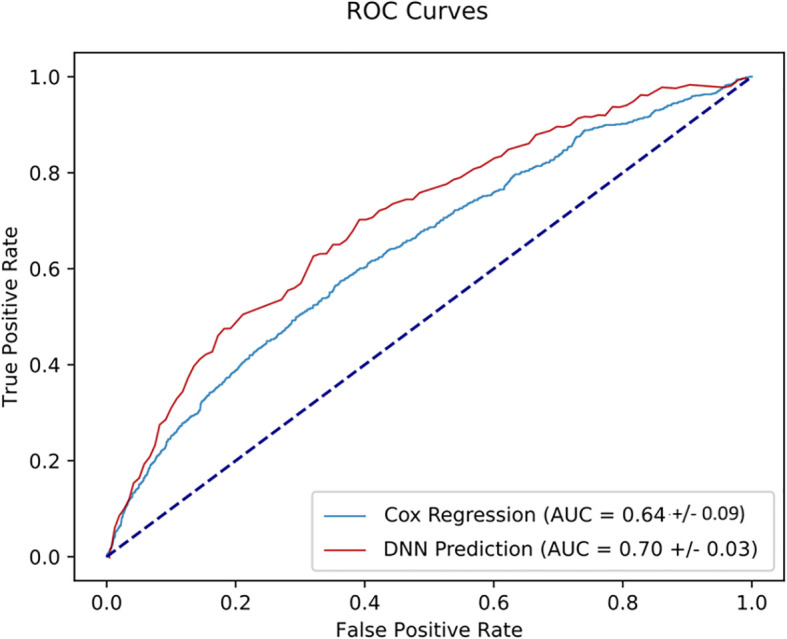
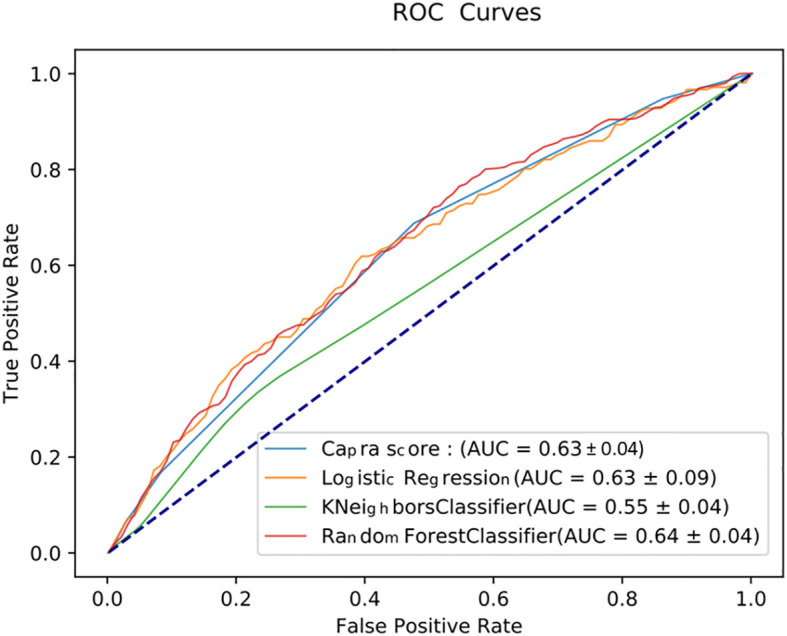
Using the CAPRA score variables, DNN predictive model showed the highest AUC value of 0.7 comparing to the CAPRA score, logistic regression, KNN, RF, and cox regression with 0.63, 0.63, 0.55, 0.64, and 0.64, respectively. After including the post-operative variables to the model, the AUC values based on KNN, RF, and cox regression and DNN were improved to 0.77, 0.74, 0.75, and 0.84, respectively.

CONCLUSIONS

Our results showed that the DNN has the potential to predict the 3-year BCR and outperformed the CAPRA score and other predictive models.

摘要

背景

预测模型用于预测前列腺癌(PCa)的生化复发(BCR)正受到越来越多的关注。具体而言,约20%-40%的患者在根治性前列腺切除术(RP)后五年会发生BCR,而预测BCR的能力可能有助于临床医生做出更好的治疗决策。我们旨在研究CAPRA评分与其他模型相比在预测PCa患者3年BCR方面的准确性。

材料与方法

对总共5043例行RP的男性患者进行回顾性分析。比较了CAPRA评分、Cox回归分析、逻辑回归、K近邻(KNN)、随机森林(RF)和密集连接前馈神经网络(DNN)分类器在3年BCR预测值方面的准确性。主要使用受试者工作特征曲线下面积来评估预测模型在预测PCa患者3年BCR方面的性能。多变量分析纳入了术前数据,如前列腺特异性抗原(PSA)水平、Gleason分级和T分期。为了衡量由于额外数据对模型性能的潜在改善,每个模型都使用一组来自最终病理的术后手术数据再次进行训练。

结果

使用CAPRA评分变量时,DNN预测模型的曲线下面积(AUC)值最高,为0.7,而CAPRA评分、逻辑回归、KNN、RF和Cox回归的AUC值分别为0.63、0.63、0.55、0.64和0.64。在模型中纳入术后变量后,基于KNN、RF、Cox回归和DNN的AUC值分别提高到0.77、0.74、0.75和0.84。

结论

我们的结果表明,DNN有潜力预测3年BCR,并且优于CAPRA评分和其他预测模型。
https://cdn.ncbi.nlm.nih.gov/pmc/blobs/93d5/7906005/ef09155a7eaa/fonc-10-607923-g003.jpg
https://cdn.ncbi.nlm.nih.gov/pmc/blobs/93d5/7906005/98a1fc7320d8/fonc-10-607923-g001.jpg
https://cdn.ncbi.nlm.nih.gov/pmc/blobs/93d5/7906005/45cdc51c2dcc/fonc-10-607923-g002.jpg
https://cdn.ncbi.nlm.nih.gov/pmc/blobs/93d5/7906005/ef09155a7eaa/fonc-10-607923-g003.jpg
https://cdn.ncbi.nlm.nih.gov/pmc/blobs/93d5/7906005/98a1fc7320d8/fonc-10-607923-g001.jpg
https://cdn.ncbi.nlm.nih.gov/pmc/blobs/93d5/7906005/45cdc51c2dcc/fonc-10-607923-g002.jpg
https://cdn.ncbi.nlm.nih.gov/pmc/blobs/93d5/7906005/ef09155a7eaa/fonc-10-607923-g003.jpg

相似文献

1
Deep Neural Networks Outperform the CAPRA Score in Predicting Biochemical Recurrence After Prostatectomy.在预测前列腺切除术后生化复发方面,深度神经网络优于CAPRA评分。
Front Oncol. 2021 Feb 11;10:607923. doi: 10.3389/fonc.2020.607923. eCollection 2020.
2
Evaluation of biochemical recurrence-free survival after radical prostatectomy by cancer of the prostate risk assessment post-surgical (CAPRA-S) score.通过前列腺癌术后风险评估(CAPRA-S)评分评估根治性前列腺切除术后无生化复发生存率。
Asian Pac J Cancer Prev. 2015;16(6):2527-30. doi: 10.7314/apjcp.2015.16.6.2527.
3
Evaluation of four pre-operative models for prediction of biochemical recurrence after radical prostatectomy in localised prostate cancer.评估四种局部前列腺癌根治性前列腺切除术后预测生化复发的术前模型。
Int J Clin Pract. 2021 Oct;75(10):e14682. doi: 10.1111/ijcp.14682. Epub 2021 Aug 6.
4
A novel nomogram provides improved accuracy for predicting biochemical recurrence after radical prostatectomy.一种新的列线图可提高前列腺癌根治术后生化复发预测的准确性。
Chin Med J (Engl). 2021 Jun 16;134(13):1576-1583. doi: 10.1097/CM9.0000000000001607.
5
Combined value of validated clinical and genomic risk stratification tools for predicting prostate cancer mortality in a high-risk prostatectomy cohort.用于预测高危前列腺切除队列中前列腺癌死亡率的经验证的临床和基因组风险分层工具的综合价值。
Eur Urol. 2015 Feb;67(2):326-33. doi: 10.1016/j.eururo.2014.05.039. Epub 2014 Jul 2.
6
Prostate Surface Distension and Tumor Texture Descriptors From Pre-Treatment MRI Are Associated With Biochemical Recurrence Following Radical Prostatectomy: Preliminary Findings.前列腺表面扩张及治疗前MRI的肿瘤纹理描述符与前列腺癌根治术后生化复发相关:初步研究结果
Front Oncol. 2022 May 20;12:841801. doi: 10.3389/fonc.2022.841801. eCollection 2022.
7
Predictors of biochemical recurrence in pT3b prostate cancer after radical prostatectomy without adjuvant radiotherapy.根治性前列腺切除术后未行辅助放疗的pT3b期前列腺癌生化复发的预测因素
Prostate. 2016 Feb;76(2):226-34. doi: 10.1002/pros.23114. Epub 2015 Oct 20.
8
Prognostic Implications of Multiparametric Magnetic Resonance Imaging and Concomitant Systematic Biopsy in Predicting Biochemical Recurrence After Radical Prostatectomy in Prostate Cancer Patients Diagnosed with Magnetic Resonance Imaging-targeted Biopsy.磁共振成像多参数分析及系统活检对经磁共振成像靶向活检诊断前列腺癌患者根治性前列腺切除术后生化复发的预测价值
Eur Urol Oncol. 2020 Dec;3(6):739-747. doi: 10.1016/j.euo.2020.07.008. Epub 2020 Aug 23.
9
Machine learning algorithms can more efficiently predict biochemical recurrence after robot-assisted radical prostatectomy.机器学习算法可以更有效地预测机器人辅助根治性前列腺切除术后的生化复发。
Prostate. 2021 Sep;81(12):913-920. doi: 10.1002/pros.24188. Epub 2021 Jul 5.
10
Incorporating artificial intelligence in urology: Supervised machine learning algorithms demonstrate comparative advantage over nomograms in predicting biochemical recurrence after prostatectomy.人工智能在泌尿科中的应用:监督机器学习算法在预测前列腺切除术后生化复发方面优于列线图。
Prostate. 2022 Feb;82(3):298-305. doi: 10.1002/pros.24272. Epub 2021 Dec 2.

引用本文的文献

1
Diagnostic systematic review and meta-analysis of machine learning in predicting biochemical recurrence of prostate cancer.机器学习在预测前列腺癌生化复发中的诊断性系统评价与荟萃分析
Sci Rep. 2025 Aug 4;15(1):28378. doi: 10.1038/s41598-025-11445-5.
2
Development of a deep learning system for predicting biochemical recurrence in prostate cancer.用于预测前列腺癌生化复发的深度学习系统的开发。
BMC Cancer. 2025 Feb 10;25(1):232. doi: 10.1186/s12885-025-13628-9.
3
Predicting Biochemical Recurrence of Prostate Cancer Post-Prostatectomy Using Artificial Intelligence: A Systematic Review.

本文引用的文献

1
Adjuvant radiotherapy versus early salvage radiotherapy plus short-term androgen deprivation therapy in men with localised prostate cancer after radical prostatectomy (GETUG-AFU 17): a randomised, phase 3 trial.根治性前列腺切除术后局部前列腺癌男性患者的辅助放疗与早期挽救性放疗加短期雄激素剥夺治疗的比较(GETUG-AFU 17):一项随机、3 期试验。
Lancet Oncol. 2020 Oct;21(10):1341-1352. doi: 10.1016/S1470-2045(20)30454-X.
2
Adjuvant or early salvage radiotherapy for the treatment of localised and locally advanced prostate cancer: a prospectively planned systematic review and meta-analysis of aggregate data.辅助或早期挽救性放疗治疗局限性和局部进展性前列腺癌:汇总数据的前瞻性计划系统评价和荟萃分析。
Lancet. 2020 Oct 31;396(10260):1422-1431. doi: 10.1016/S0140-6736(20)31952-8. Epub 2020 Sep 28.
3
使用人工智能预测前列腺切除术后前列腺癌的生化复发:一项系统综述。
Cancers (Basel). 2024 Oct 25;16(21):3596. doi: 10.3390/cancers16213596.
4
A Recursive Partitioning Analysis Demonstrating Risk Subsets for 8-Year Biochemical Relapse After Margin-Positive Radical Prostatectomy Without Adjuvant Hormone or Radiation Therapy.一项递归划分分析显示了在未接受辅助激素或放疗的切缘阳性根治性前列腺切除术后8年生化复发的风险亚组。
Adv Radiat Oncol. 2021 Aug 14;6(6):100778. doi: 10.1016/j.adro.2021.100778. eCollection 2021 Nov-Dec.
5
Post-Operative Radiotherapy in Prostate Cancer: Is It Time for a Belt and Braces Approach?前列腺癌术后放疗:是时候采取双重保险的方法了吗?
Front Oncol. 2021 Nov 18;11:781040. doi: 10.3389/fonc.2021.781040. eCollection 2021.
6
Single-Center Experience of Focal Thermo-Ablative Therapy After Pelvic Radiotherapy for In-Field Prostate Cancer Oligo-Recurrence.盆腔放疗后针对野内前列腺癌寡复发的局部热消融治疗的单中心经验
Front Oncol. 2021 Jul 26;11:709779. doi: 10.3389/fonc.2021.709779. eCollection 2021.
Timing of radiotherapy after radical prostatectomy (RADICALS-RT): a randomised, controlled phase 3 trial.根治性前列腺切除术后放疗时机(RADICALS-RT):一项随机对照 3 期试验。
Lancet. 2020 Oct 31;396(10260):1413-1421. doi: 10.1016/S0140-6736(20)31553-1. Epub 2020 Sep 28.
4
Prediction of biochemical recurrence in prostate cancer patients who underwent prostatectomy using routine clinical prostate multiparametric MRI and decipher genomic score.使用常规临床前列腺多参数 MRI 和破译基因组评分预测前列腺切除术患者的生化复发。
J Magn Reson Imaging. 2020 Apr;51(4):1075-1085. doi: 10.1002/jmri.26928. Epub 2019 Sep 30.
5
Integration of Radiomic and Multi-omic Analyses Predicts Survival of Newly Diagnosed IDH1 Wild-Type Glioblastoma.放射组学与多组学分析相结合可预测新诊断的异柠檬酸脱氢酶1野生型胶质母细胞瘤的生存期。
Cancers (Basel). 2019 Aug 10;11(8):1148. doi: 10.3390/cancers11081148.
6
A new era: artificial intelligence and machine learning in prostate cancer.一个新的时代:前列腺癌中的人工智能和机器学习。
Nat Rev Urol. 2019 Jul;16(7):391-403. doi: 10.1038/s41585-019-0193-3.
7
Predicting Gleason Score of Prostate Cancer Patients Using Radiomic Analysis.使用放射组学分析预测前列腺癌患者的 Gleason 评分
Front Oncol. 2018 Dec 18;8:630. doi: 10.3389/fonc.2018.00630. eCollection 2018.
8
Multimodal Radiomic Features for the Predicting Gleason Score of Prostate Cancer.用于预测前列腺癌 Gleason 评分的多模态放射组学特征
Cancers (Basel). 2018 Jul 28;10(8):249. doi: 10.3390/cancers10080249.
9
Use of machine learning to predict early biochemical recurrence after robot-assisted prostatectomy.应用机器学习预测机器人辅助前列腺切除术术后早期生化复发。
BJU Int. 2019 Jan;123(1):51-57. doi: 10.1111/bju.14477. Epub 2018 Aug 5.
10
Follow-up of Prostatectomy versus Observation for Early Prostate Cancer.前列腺癌早期行前列腺切除术与观察治疗的随访研究。
N Engl J Med. 2017 Jul 13;377(2):132-142. doi: 10.1056/NEJMoa1615869.