Kucka Kirstin, Wajant Harald
Division of Molecular Internal Medicine, Department of Internal Medicine II, University Hospital Würzburg, Würzburg, Germany.
Front Cell Dev Biol. 2021 Feb 11;8:615141. doi: 10.3389/fcell.2020.615141. eCollection 2020.
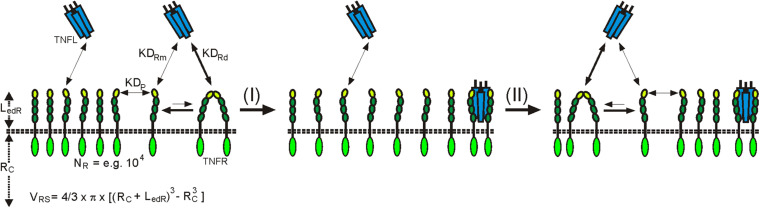
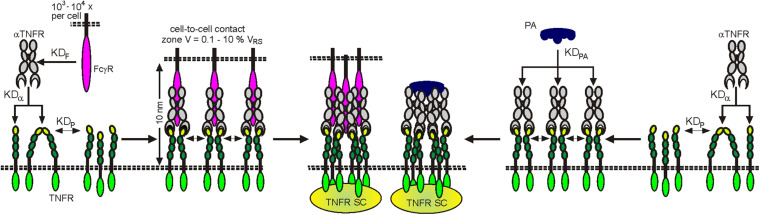
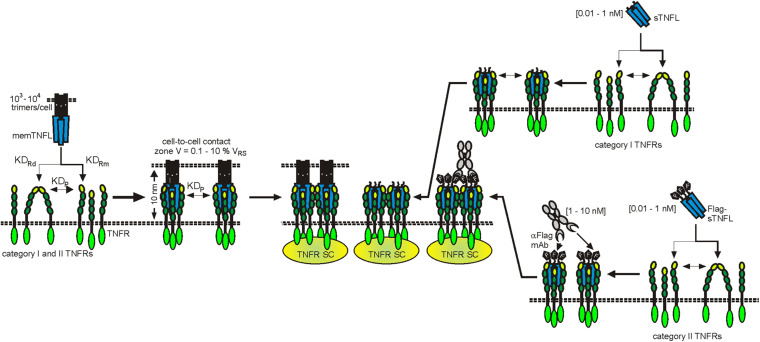
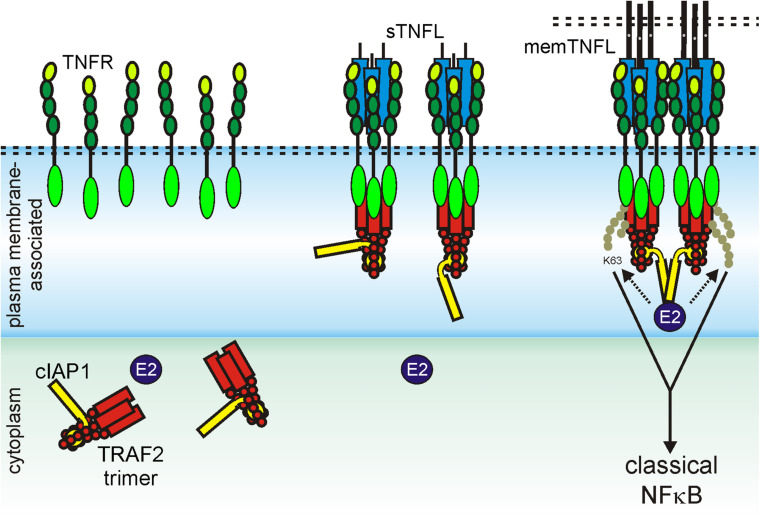
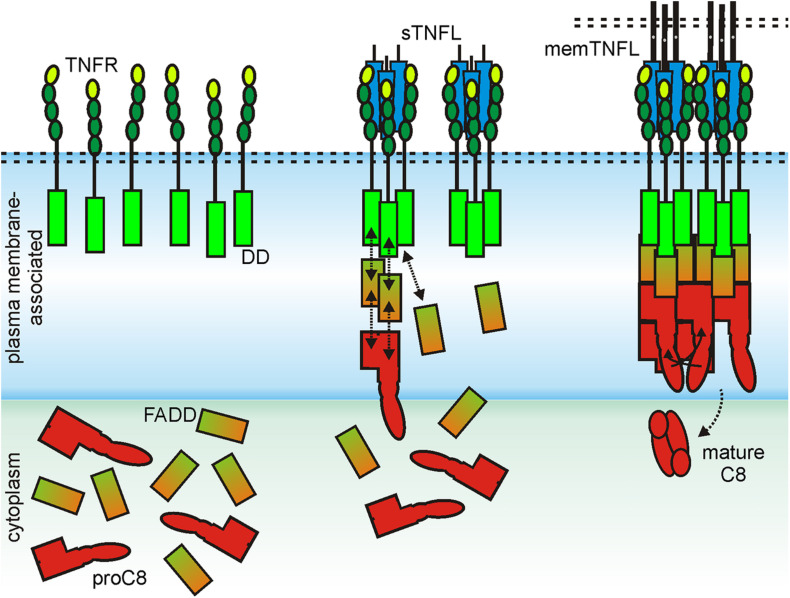
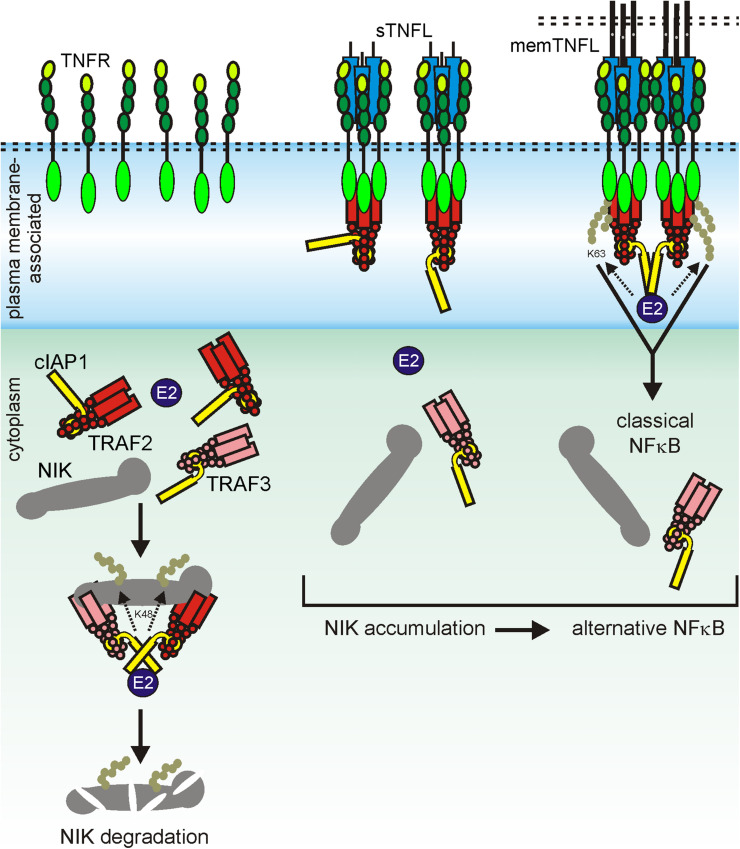
With the exception of a few signaling incompetent decoy receptors, the receptors of the tumor necrosis factor receptor superfamily (TNFRSF) are signaling competent and engage in signaling pathways resulting in inflammation, proliferation, differentiation, and cell migration and also in cell death induction. TNFRSF receptors (TNFRs) become activated by ligands of the TNF superfamily (TNFSF). TNFSF ligands (TNFLs) occur as trimeric type II transmembrane proteins but often also as soluble ligand trimers released from the membrane-bound form by proteolysis. The signaling competent TNFRs are efficiently activated by the membrane-bound TNFLs. The latter recruit three TNFR molecules, but there is growing evidence that this is not sufficient to trigger all aspects of TNFR signaling; rather, the formed trimeric TNFL-TNFR complexes have to cluster secondarily in the cell-to-cell contact zone for full TNFR activation. With respect to their response to soluble ligand trimers, the signaling competent TNFRs can be subdivided into two groups. TNFRs of one group, designated as category I TNFRs, are robustly activated by soluble ligand trimers. The receptors of a second group (category II TNFRs), however, failed to become properly activated by soluble ligand trimers despite high affinity binding. The limited responsiveness of category II TNFRs to soluble TNFLs can be overcome by physical linkage of two or more soluble ligand trimers or, alternatively, by anchoring the soluble ligand molecules to the cell surface or extracellular matrix. This suggests that category II TNFRs have a limited ability to promote clustering of trimeric TNFL-TNFR complexes outside the context of cell-cell contacts. In this review, we will focus on three aspects on the relevance of receptor oligomerization for TNFR signaling: (i) the structural factors which promote clustering of free and liganded TNFRs, (ii) the signaling pathway specificity of the receptor oligomerization requirement, and (iii) the consequences for the design and development of TNFR agonists.
除少数无信号传导能力的诱饵受体外,肿瘤坏死因子受体超家族(TNFRSF)的受体具有信号传导能力,并参与导致炎症、增殖、分化、细胞迁移以及诱导细胞死亡的信号通路。TNFRSF受体(TNFRs)由肿瘤坏死因子超家族(TNFSF)的配体激活。TNFSF配体(TNFLs)以三聚体II型跨膜蛋白形式存在,但通常也以通过蛋白水解从膜结合形式释放的可溶性配体三聚体形式存在。具有信号传导能力的TNFRs可被膜结合的TNFLs有效激活。后者募集三个TNFR分子,但越来越多的证据表明,这不足以触发TNFR信号传导的所有方面;相反,形成的三聚体TNFL-TNFR复合物必须在细胞间接触区域进行二次聚集才能实现TNFR的完全激活。就其对可溶性配体三聚体的反应而言,具有信号传导能力的TNFRs可分为两组。一组TNFRs,称为I类TNFRs,可被可溶性配体三聚体强烈激活。然而,第二组受体(II类TNFRs)尽管具有高亲和力结合,但未能被可溶性配体三聚体正确激活。通过将两个或更多可溶性配体三聚体进行物理连接,或者将可溶性配体分子锚定到细胞表面或细胞外基质,可以克服II类TNFRs对可溶性TNFLs的有限反应性。这表明II类TNFRs在细胞间接触背景之外促进三聚体TNFL-TNFR复合物聚集的能力有限。在本综述中,我们将关注受体寡聚化与TNFR信号传导相关性的三个方面:(i)促进游离和配体化TNFRs聚集的结构因素,(ii)受体寡聚化需求的信号通路特异性,以及(iii)对TNFR激动剂设计和开发的影响。