Huang Ruoyu, Liu Yanwei, Wang Kuanyu, Wang Zheng, Zhang Chuanbao, Zhang Wei, Zhao Zheng, Li Guanzhang, Huang Lijie, Chang Yuanhao, Zeng Fan, Jiang Tao, Hu Huimin
Department of Molecular Neuropathology, Beijing Neurosurgical Institute, Capital Medical University, Beijing, China.
Department of Neurosurgery, Beijing Tiantan Hospital, Capital Medical University, Beijing, China.
CNS Neurosci Ther. 2021 May;27(5):617-628. doi: 10.1111/cns.13627. Epub 2021 Feb 28.
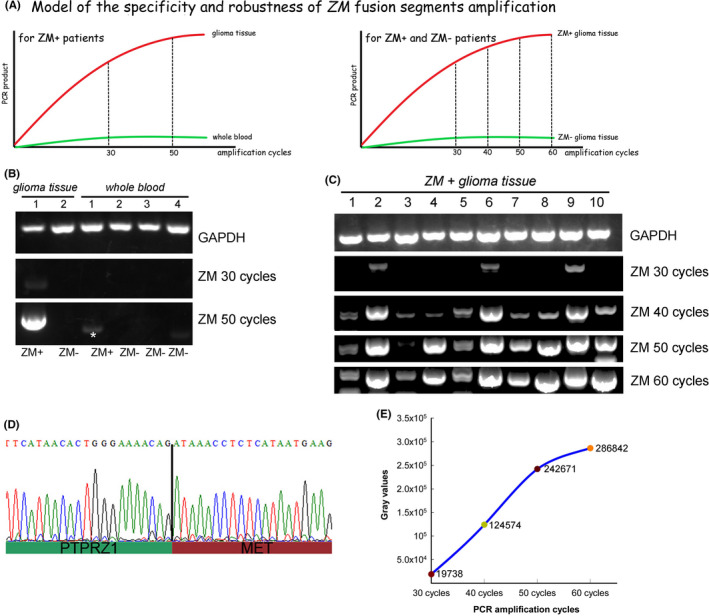
PTPRZ1-MET (ZM) is a critical genetic alteration driving the progression of lower-grade glioma. Glioma patients harboring ZM could benefit from MET inhibitors. According to the remarkable role of ZM as a driver of glioma progression and indicator of MET inhibitor sensitivity, it is necessary to detect this alteration even when it presents in glioma with relatively fewer copies.
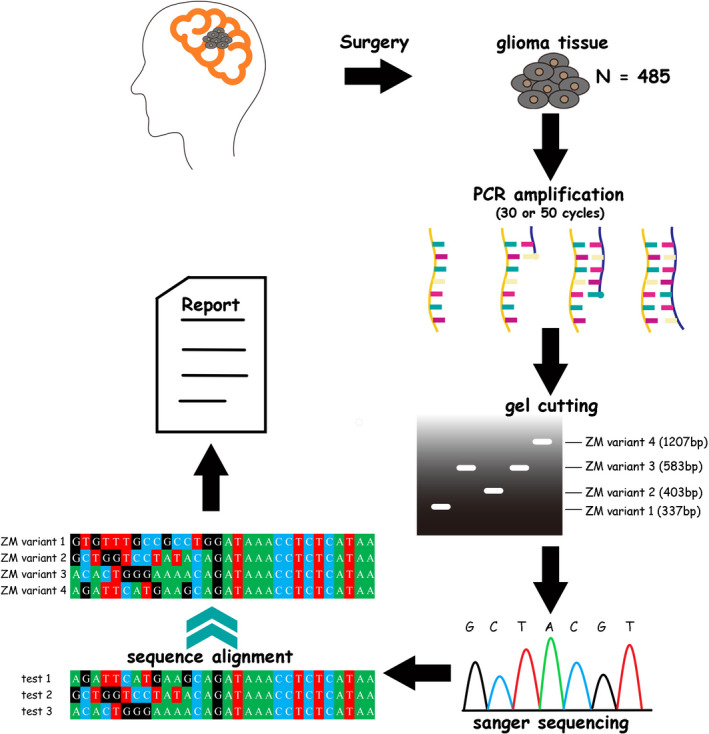
Herein, we proposed that ZM could be detected with a high-sensitive method of reverse transcriptase PCR with 50 amplification cycles. Via this newly proposed detection method, we depicted the incidence preference of ZM fusion in a cohort of 485 glioma patients. To further explore the oncogenic nature of ZM, we predicated the protein structure alteration of MET kinase brought by its fusion partner.
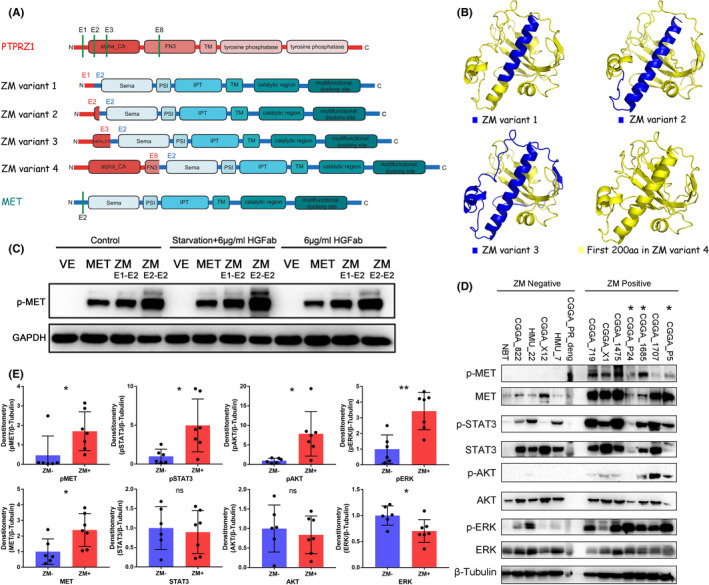
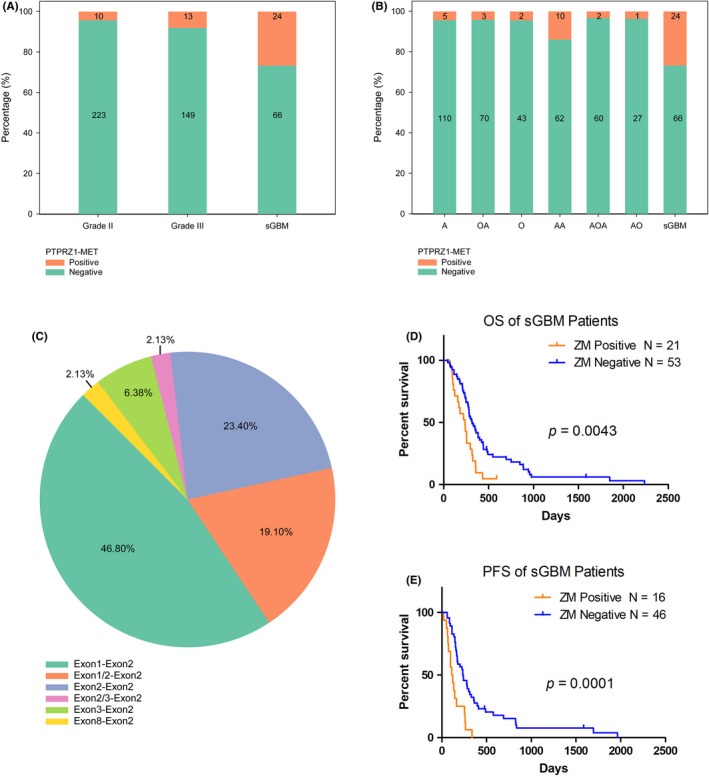
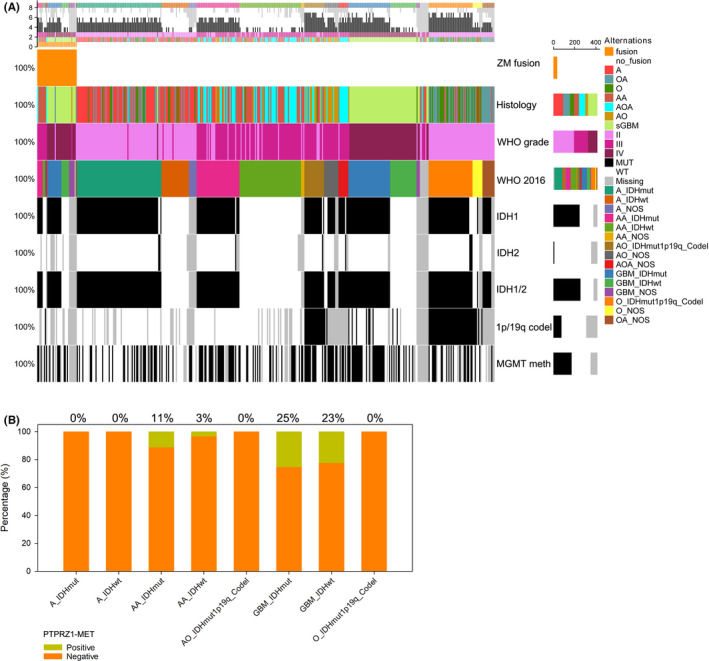
The incidence of ZM fusions was much higher than previous report. ZM fusions exhibited a striking preference in lower-grade glioma and secondary glioblastoma. By contrast, none of patients with primary glioblastoma was detected harboring ZM fusion. In each of the four variants of ZM, the fusion partner segment of MET contained a remarkable coiled-coil motif. In glioma cells expressing ZM, MET kinase could be activated in a ligand-independent manner, which might be contributed by the special coiled-coil structure brought by the fusion partner. Corresponding to the 3D structural analysis and cell line experiment, the ZM positive clinical specimens showed hyperactivations of MET signaling.
ZM fusions are critical drivers of glioma progression and effective target of MET inhibitor. Early detection could be performed with a high-sensitive method of reverse transcriptase PCR. The hyperactivations of MET signaling driving glioma progression might be contributed by a ligand-independent activation enabled by the protein structure modification of extracellular domain of MET in ZM fusions.
PTPRZ1-MET(ZM)是驱动低级别胶质瘤进展的关键基因改变。携带ZM的胶质瘤患者可从MET抑制剂中获益。鉴于ZM作为胶质瘤进展驱动因素和MET抑制剂敏感性指标的显著作用,即使在胶质瘤中其拷贝数相对较少时,检测这种改变也是必要的。
在此,我们提出可通过一种50个扩增循环的高灵敏度逆转录聚合酶链反应方法检测ZM。通过这种新提出的检测方法,我们描绘了485例胶质瘤患者队列中ZM融合的发生率偏好。为进一步探究ZM的致癌本质,我们预测了其融合伴侣导致的MET激酶蛋白结构改变。
ZM融合的发生率远高于先前报道。ZM融合在低级别胶质瘤和继发性胶质母细胞瘤中表现出显著偏好。相比之下,未检测到原发性胶质母细胞瘤患者携带ZM融合。在ZM的四个变体中,MET的融合伴侣片段均包含一个显著的卷曲螺旋基序。在表达ZM的胶质瘤细胞中,MET激酶可通过非配体依赖方式被激活,这可能是由融合伴侣带来的特殊卷曲螺旋结构所致。与三维结构分析和细胞系实验一致,ZM阳性临床标本显示MET信号通路过度激活。
ZM融合是胶质瘤进展的关键驱动因素及MET抑制剂的有效靶点。可通过高灵敏度逆转录聚合酶链反应方法进行早期检测。驱动胶质瘤进展的MET信号通路过度激活可能是由ZM融合中MET细胞外结构修饰使MET胞外域非配体依赖激活所致。