Himmelstein Gracie, Desmond Matthew
Office of Population Research, Princeton University, Princeton, New Jersey.
Icahn School of Medicine at Mount Sinai, New York, New York.
JAMA Pediatr. 2021 May 1;175(5):494-500. doi: 10.1001/jamapediatrics.2020.6550.
More than 2 million families face eviction annually, a number likely to increase due to the coronavirus disease 2019 pandemic. The association of eviction with newborns' health remains to be examined.
To determine the association of eviction actions during pregnancy with birth outcomes.
This case-control study compared birth outcomes of infants whose mothers were evicted during gestation with those whose mothers were evicted at other times. Participants included infants born to mothers who were evicted in Georgia from January 1, 2000, to December 31, 2016. Data were analyzed from March 1 to October 4, 2020.
Eviction actions occurring during gestation.
Five metrics of neonatal health included birth weight (in grams), gestational age (in weeks), and dichotomized outcomes for low birth weight (LBW) (<2500 g), prematurity (gestational age <37.0 weeks), and infant death.
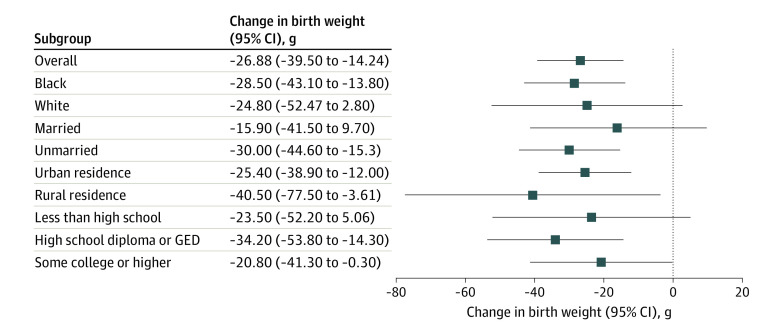
A total of 88 862 births to 45 122 mothers (mean [SD] age, 26.26 [5.76] years) who experienced 99 517 evictions were identified during the study period, including 10 135 births to women who had an eviction action during pregnancy and 78 727 births to mothers who had experienced an eviction action when not pregnant. Compared with mothers who experienced eviction actions at other times, eviction during pregnancy was associated with lower infant birth weight (difference, -26.88 [95% CI, -39.53 to 14.24] g) and gestational age (difference, -0.09 [95% CI, -0.16 to -0.03] weeks), increased rates of LBW (0.88 [95% CI, 0.23-1.54] percentage points) and prematurity (1.14 [95% CI, 0.21-2.06] percentage points), and a nonsignificant increase in mortality (1.85 [95% CI, -0.19 to 3.89] per 1000 births). The association of eviction with birth weight was strongest in the second and third trimesters of pregnancy, with birth weight reductions of 34.74 (95% CI, -57.51 to -11.97) and 35.80 (95% CI, -52.91 to -18.69) g, respectively.
These findings suggest that eviction actions during pregnancy are associated with adverse birth outcomes, which have been shown to have lifelong and multigenerational consequences. Ensuring housing, social, and medical assistance to pregnant women at risk for eviction may improve infant health.
每年有超过200万个家庭面临驱逐,由于2019年冠状病毒病大流行,这一数字可能会增加。驱逐与新生儿健康之间的关联仍有待研究。
确定孕期驱逐行为与出生结局之间的关联。
这项病例对照研究比较了母亲在孕期被驱逐的婴儿与母亲在其他时间被驱逐的婴儿的出生结局。研究对象包括2000年1月1日至2016年12月31日在佐治亚州被驱逐的母亲所生的婴儿。数据于2020年3月1日至10月4日进行分析。
孕期发生的驱逐行为。
新生儿健康的五个指标包括出生体重(克)、孕周(周),以及低出生体重(<2500克)、早产(孕周<37.0周)和婴儿死亡的二分结局。
在研究期间,共识别出45122名母亲(平均[标准差]年龄为26.26[5.76]岁)的88862例分娩,这些母亲经历了99517次驱逐,其中包括10135例母亲在孕期有驱逐行为的分娩,以及78727例母亲在非孕期有驱逐行为的分娩。与在其他时间有驱逐行为的母亲相比,孕期被驱逐与婴儿出生体重较低(差异为-26.88[95%置信区间,-39.53至-14.24]克)和孕周较短(差异为-0.09[95%置信区间,-0.16至-0.03]周)、低出生体重发生率增加(0.88[95%置信区间,0.23 - 1.54]个百分点)和早产发生率增加(1.14[95%置信区间,0.21 - 2.06]个百分点)以及死亡率无显著增加(每1000例分娩中为1.85[95%置信区间,-0.19至3.89])相关。驱逐与出生体重之间的关联在孕期的第二和第三个月最强,出生体重分别降低34.74(95%置信区间,-57.51至-11.97)克和35.80(95%置信区间,-52.91至-18.69)克。
这些发现表明,孕期的驱逐行为与不良出生结局相关,而不良出生结局已被证明会产生终身和多代影响。确保为有被驱逐风险的孕妇提供住房、社会和医疗援助可能会改善婴儿健康。