Institute of Pathology, University Hospital of RWTH Aachen, Aachen, Germany.
Medical Clinic II (Nephrology and Immunology), University Hospital of RWTH Aachen, Pauwelsstr. 30, 52074, Aachen, Germany.
Pathologe. 2021 Nov;42(Suppl 1):81-88. doi: 10.1007/s00292-021-00920-1. Epub 2021 Mar 26.
Analyses for the presence of SARS-CoV‑2 in the tissues of COVID-19 patients is important in order to improve our understanding of the disease pathophysiology for interpretation of diagnostic histopathological findings in autopsies, biopsies, or surgical specimens and to assess the potential for occupational infectious hazard.
In this review we identified 136 published studies in PubMed's curated literature database LitCovid on SARS-CoV‑2 detection methods in tissues and evaluated them regarding sources of error, specificity, and sensitivity of the methods, taking into account our own experience.
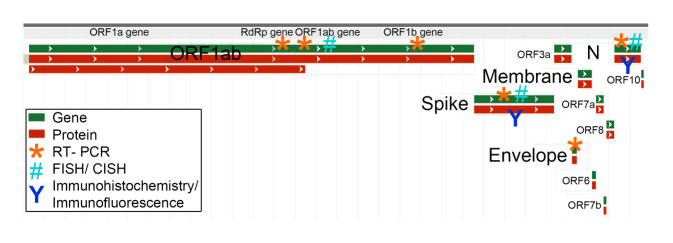
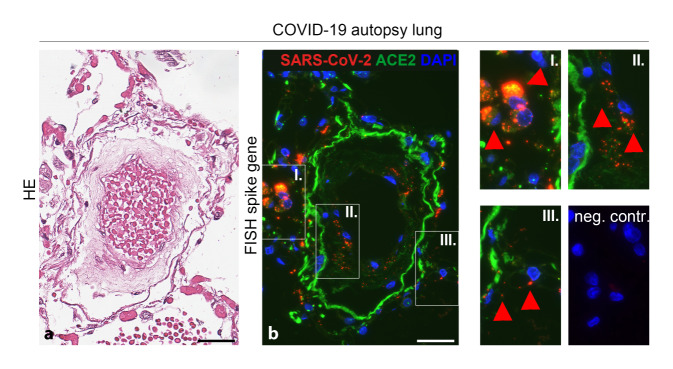
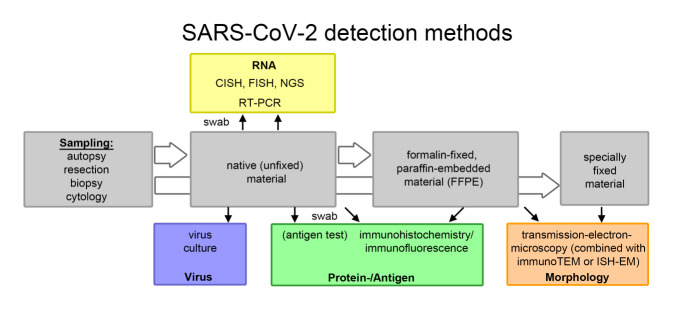
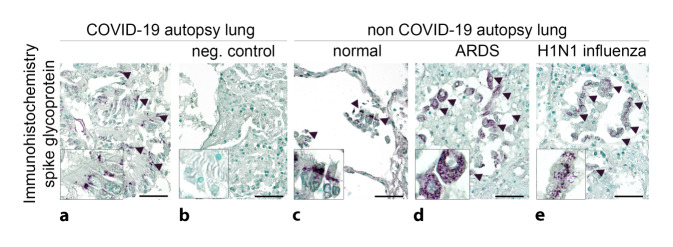
Currently, no sufficiently specific histomorphological alterations or diagnostic features for COVID-19 are known. Therefore, three approaches for SARS-CoV‑2 detection are used: RNA, proteins/antigens, or morphological detection by electron microscopy. In the preanalytical phase, the dominant source of error is tissue quality, especially the different intervals between sample collection and processing or fixation (and its duration) and specifically the interval between death and sample collection in autopsies. However, this information is found in less than half of the studies (e.g., in only 42% of autopsy studies). Our own experience and first studies prove the significantly higher sensitivity and specificity of RNA-based detection methods compared to antigen or protein detection by immunohistochemistry or immunofluorescence. Detection by electron microscopy is time consuming and difficult to interpret.
Different methods are available for the detection of SARS-CoV‑2 in tissue. Currently, RNA detection by RT-PCR is the method of choice. However, extensive validation studies and method harmonization are not available and are absolutely necessary.
分析 COVID-19 患者组织中 SARS-CoV-2 的存在对于提高我们对疾病病理生理学的理解非常重要,以便解释尸检、活检或手术标本中的诊断组织病理学发现,并评估职业感染危险的潜在性。
在本综述中,我们在 PubMed 的 curated literature database LitCovid 中确定了 136 项关于组织中 SARS-CoV-2 检测方法的已发表研究,并对其进行了评估,考虑到我们自己的经验,评估了方法的误差来源、特异性和敏感性。
目前,还不知道 COVID-19 有足够特异性的组织形态学改变或诊断特征。因此,目前有三种方法用于检测 SARS-CoV-2:RNA、蛋白质/抗原,或通过电子显微镜进行形态学检测。在分析前阶段,主要的误差来源是组织质量,特别是样本采集和处理或固定(及其持续时间)之间的不同间隔,特别是尸检中死亡和样本采集之间的间隔。然而,这方面的信息在不到一半的研究中(例如,只有 42%的尸检研究)有所体现。我们自己的经验和初步研究证明,与免疫组化或免疫荧光法检测抗原或蛋白质相比,基于 RNA 的检测方法具有更高的敏感性和特异性。电子显微镜检测既耗时又难以解释。
有多种方法可用于检测组织中的 SARS-CoV-2。目前,RT-PCR 检测 RNA 是首选方法。然而,广泛的验证研究和方法协调尚不可用,这是绝对必要的。