School of Nursing, Institute of Nursing and Health Research, Ulster University, Newtownabbey, UK.
Cancer Services and Ulster Hospital, South Eastern Health and Social Care Trust, Belfast, UK.
Support Care Cancer. 2021 Sep;29(9):4899-4909. doi: 10.1007/s00520-021-06062-7. Epub 2021 Mar 1.
Patients living with and beyond head and neck cancer (HNC) often have long-term, functional challenges as a result of treatment. A key functional challenge relates to eating and drinking; often associated with physical, emotional, and social difficulties. Eating and drinking with family members and friends can become a struggle, increasing the risk of social isolation and loneliness. This systematic review aims to identify and synthesise the literature on the experiences of social eating and drinking for patients following treatment for HNC.
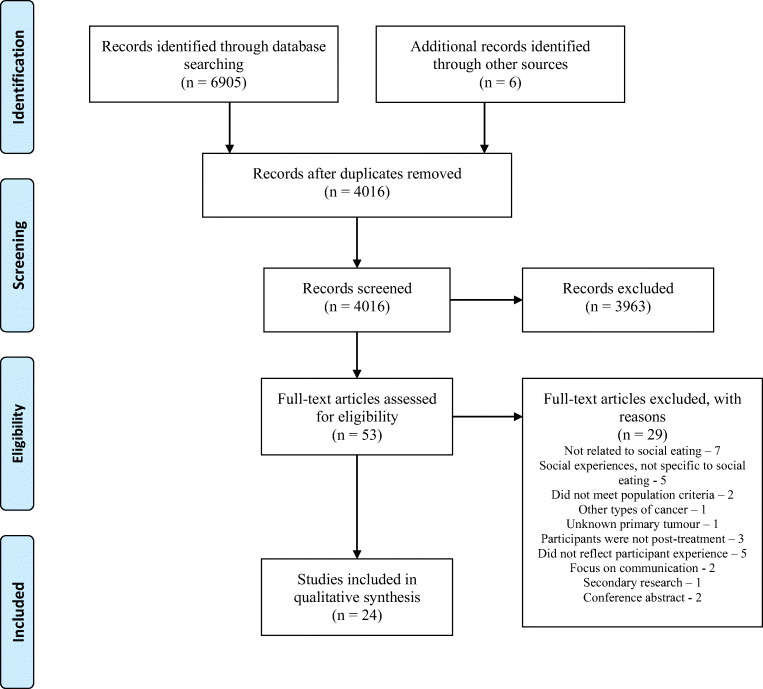
Six electronic databases (Pubmed, Web of Science, CINAHL, EMBASE, PsychINFO, and Scopus) were systematically searched using subject headings and free-text word searches in February 2020. Citation chaining and Google Scholar were used to identify grey literature. PRISMA procedures were followed.
Of 6910 records identified, 24 studies met the inclusion criteria. Synthesis of the research findings results in two major themes: (1) the experience of loss associated with social eating and drinking, and (2) adjusting and support to promote social eating and drinking.
Losses associated with social eating affect a patient's psychological and emotional well-being and impact on close relationships. To promote positive participation in social eating, patients were more likely to seek and receive support from someone within their close social network, rather than a healthcare professional. Family and friends are an essential source of support and are integral in facilitating engagement with social eating following treatment for HNC. Future interventions should promote family orientated resources, incorporating self-management strategies.
患有头颈部癌症(HNC)并已康复的患者常因治疗而面临长期的功能挑战。其中一个主要的功能挑战与进食和饮水有关,这常常与身体、情绪和社交困难有关。与家人和朋友一起进食和饮水可能会变得困难,增加社交孤立和孤独的风险。本系统评价旨在确定并综合治疗后头颈部癌症患者社交进食和饮水体验的文献。
2020 年 2 月,使用主题词和自由文本词搜索,对 6 个电子数据库(PubMed、Web of Science、CINAHL、EMBASE、PsychINFO 和 Scopus)进行了系统搜索。通过引文连锁和 Google Scholar 来识别灰色文献。遵循 PRISMA 程序。
在 6910 条记录中,有 24 项研究符合纳入标准。对研究结果的综合分析得出两个主要主题:(1)与社交进食和饮水相关的丧失体验,以及(2)调整和支持以促进社交进食和饮水。
与社交进食相关的丧失会影响患者的心理和情绪健康,并对亲密关系产生影响。为了促进患者积极参与社交进食,他们更有可能从亲密社交网络中的人那里寻求和获得支持,而不是从医疗保健专业人员那里获得支持。家人和朋友是支持的重要来源,对于促进头颈部癌症治疗后的社交进食至关重要。未来的干预措施应促进以家庭为导向的资源,并纳入自我管理策略。