Department of Anaesthesiology and Critical Care, European Georges Pompidou Hospital, Assistance Publique-Hôpitaux de Paris, AP-HP, Université de Paris, Paris, France.
INSERM UMRS-1140, Université de Paris, Paris, France.
J Thromb Thrombolysis. 2021 Jul;52(1):18-21. doi: 10.1007/s11239-021-02403-9. Epub 2021 Mar 1.
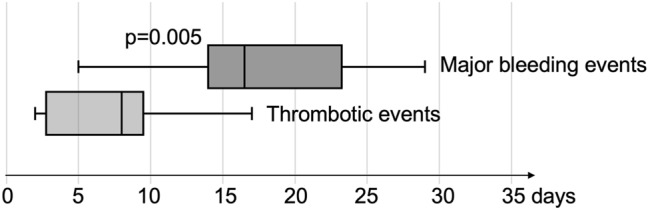
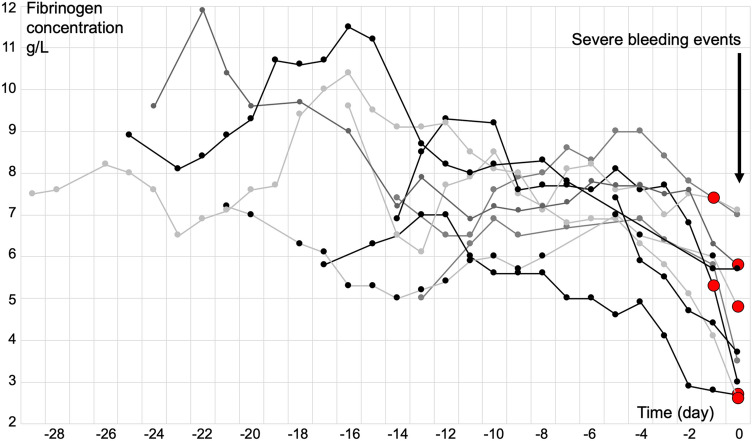
As patients with COVID-19 pneumonia admitted to intensive care unit (ICU) have high rates of thrombosis, high doses of thromboprophylaxis have been proposed. The associated bleeding risk remains unknown. We investigated major bleeding complications in ICU COVID-19 patients and we examined their relationship with inflammation and thromboprophylaxis. Retrospective monocentric study of consecutive adult patients admitted in ICU for COVID-19 pneumonia requiring mechanical ventilation. Data collected included demographics, anticoagulation status, coagulation tests and outcomes including major bleeding and thrombotic events. Among 56 ICU COVID-19 patients, 10 (18%) patients had major bleeding and 16 (29%) thrombotic events. Major bleeding occurred later than thrombosis after ICU admission [17(14-23) days versus 9(3-11) days respectively (p = 0.005)]. Fibrinogen concentration always decreased several days [4(3-5) days] before bleeding; D-dimers followed the same trend. All bleeding patients were treated with anticoagulants and anticoagulation was overdosed for 6 (60%) patients on the day of bleeding or the day before. In the whole cohort, overdose was measured in 22 and 78% of patients receiving therapeutic anticoagulation during fibrinogen increase and decrease respectively (p < 0.05). Coagulation disorders had biphasic evolution during COVID-19: first thrombotic events during initial hyperinflammation, then bleeding events once inflammation reduced, as confirmed by fibrinogen and D-dimers decrease. Most bleeding events complicated heparin overdose, promoted by inflammation decrease, suggesting to carefully monitor heparin during COVID-19. Thromboprophylaxis may be adapted to this biphasic evolution, with initial high doses reduced to standard doses once the high thrombotic risk period ends and fibrinogen decreases, to prevent bleeding events.
由于 COVID-19 肺炎患者入住重症监护病房 (ICU) 后血栓形成率较高,因此建议采用高剂量的血栓预防治疗。但与之相关的出血风险尚不清楚。本研究旨在调查 ICU 中 COVID-19 患者的主要出血并发症,并探讨其与炎症和血栓预防的关系。本研究为回顾性单中心研究,连续纳入因 COVID-19 肺炎需要机械通气而入住 ICU 的成年患者。收集的数据包括人口统计学、抗凝状态、凝血试验以及主要出血和血栓事件等结局。在 56 例 ICU COVID-19 患者中,有 10 例(18%)患者发生主要出血,16 例(29%)患者发生血栓事件。与 ICU 入住后发生血栓相比,出血发生时间更晚[分别为 17(14-23)天和 9(3-11)天(p=0.005)]。纤维蛋白原浓度在出血前几天[4(3-5)天]持续下降;D-二聚体也呈现相同的趋势。所有出血患者均接受抗凝治疗,6 例(60%)患者在出血当天或前一天抗凝治疗过量。在整个队列中,在纤维蛋白原升高和降低期间分别有 22 和 78%接受治疗性抗凝的患者出现过量(p<0.05)。COVID-19 期间凝血障碍呈双相演变:最初在高度炎症期间发生血栓事件,然后在炎症减轻后发生出血事件,这一点可通过纤维蛋白原和 D-二聚体的降低得到证实。大多数出血事件并发肝素过量,这是由炎症减轻引起的,这提示在 COVID-19 期间应仔细监测肝素。根据这种双相演变,可在高血栓风险期结束和纤维蛋白原降低后,将初始高剂量的血栓预防治疗减少至标准剂量,以预防出血事件。