Department of Medicine, Massachusetts General Hospital Cancer Center, Boston.
Department of Medicine, Memorial Sloan Kettering Cancer Center, New York, USA.
Ann Oncol. 2019 Jul 1;30(7):1121-1126. doi: 10.1093/annonc/mdz131.
In the ongoing phase I PROFILE 1001 study, crizotinib showed antitumor activity in patients with ROS1-rearranged advanced non-small-cell lung cancer (NSCLC). Here, we present updated antitumor activity, overall survival (OS) and safety data (additional 46.2 months follow-up) for patients with ROS1-rearranged advanced NSCLC from PROFILE 1001.
ROS1 status was determined by FISH or reverse transcriptase-polymerase chain reaction. All patients received crizotinib at a starting dose of 250 mg twice daily.
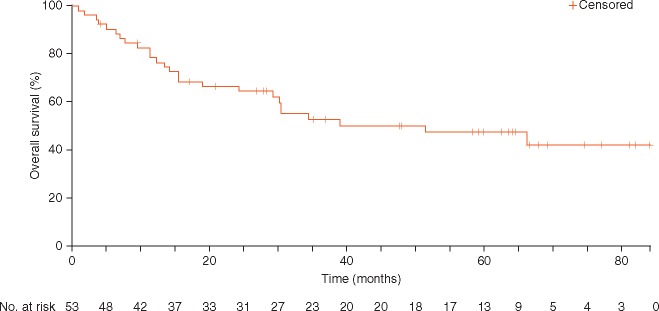
Fifty-three patients received crizotinib, with a median duration of treatment of 22.4 months. At data cut-off, treatment was ongoing in 12 patients (23%). The objective response rate (ORR) was 72% [95% confidence interval (CI), 58% to 83%], including six confirmed complete responses and 32 confirmed partial responses; 10 patients had stable disease. Responses were durable (median duration of response 24.7 months; 95% CI, 15.2-45.3). ORRs were consistent across different patient subgroups. Median progression-free survival was 19.3 months (95% CI, 15.2-39.1). A total of 26 deaths (49%) occurred (median follow-up period of 62.6 months), and of the remaining 27 patients (51%), 14 (26%) were in follow-up at data cut-off. Median OS was 51.4 months (95% CI, 29.3 to not reached) and survival probabilities at 12, 24, 36, and 48 months were 79%, 67%, 53%, and 51%, respectively. No correlation was observed between OS and specific ROS1 fusion partner. Treatment-related adverse events (TRAEs) were mainly grade 1 or 2, per CTCAE v3.0. There were no grade ≥4 TRAEs and no TRAEs associated with permanent discontinuation. No new safety signals were reported with long-term crizotinib treatment.
These findings serve as a new benchmark for OS in ROS1-rearranged advanced NSCLC, and continue to show the clinically meaningful benefit and safety of crizotinib in this molecular subgroup.
ClinicalTrials.gov identifier NCT00585195.
在正在进行的 I 期 PROFILE 1001 研究中,克唑替尼在 ROS1 重排的晚期非小细胞肺癌(NSCLC)患者中显示出抗肿瘤活性。在此,我们报告了来自 PROFILE 1001 的 ROS1 重排的晚期 NSCLC 患者的更新抗肿瘤活性、总生存期(OS)和安全性数据(额外 46.2 个月的随访)。
ROS1 状态通过 FISH 或逆转录酶-聚合酶链反应确定。所有患者均以 250mg 每日两次的起始剂量接受克唑替尼治疗。
53 名患者接受了克唑替尼治疗,中位治疗时间为 22.4 个月。截至数据截止日期,12 名患者(23%)仍在接受治疗。客观缓解率(ORR)为 72%[95%置信区间(CI),58%至 83%],包括 6 例确认的完全缓解和 32 例确认的部分缓解;10 例患者疾病稳定。缓解是持久的(缓解的中位持续时间为 24.7 个月;95%CI,15.2-45.3)。在不同的患者亚组中,ORR 是一致的。中位无进展生存期为 19.3 个月(95%CI,15.2-39.1)。共有 26 例死亡(49%)(中位随访时间为 62.6 个月),其余 27 名患者(51%)中有 14 例(26%)在数据截止日期仍在随访中。中位总生存期为 51.4 个月(95%CI,29.3 至未达到),12、24、36 和 48 个月的生存率分别为 79%、67%、53%和 51%。OS 与特定的 ROS1 融合伙伴之间无相关性。治疗相关不良事件(TRAEs)主要为 1 级或 2 级,根据 CTCAE v3.0 分级。无 3 级或 4 级 TRAE,也无因 TRAE 而永久停药的病例。长期使用克唑替尼治疗未出现新的安全性信号。
这些发现为 ROS1 重排的晚期 NSCLC 的 OS 提供了新的基准,并继续显示克唑替尼在这一分子亚组中的临床获益和安全性。
ClinicalTrials.gov 标识符 NCT00585195。