Department of Medicine, Memorial Sloan Kettering Cancer Center, New York, New York.
Department of Medicine, Weill Cornell Medical College, New York, New York.
Cancer Prev Res (Phila). 2021 May;14(5):541-550. doi: 10.1158/1940-6207.CAPR-20-0507. Epub 2021 Mar 1.
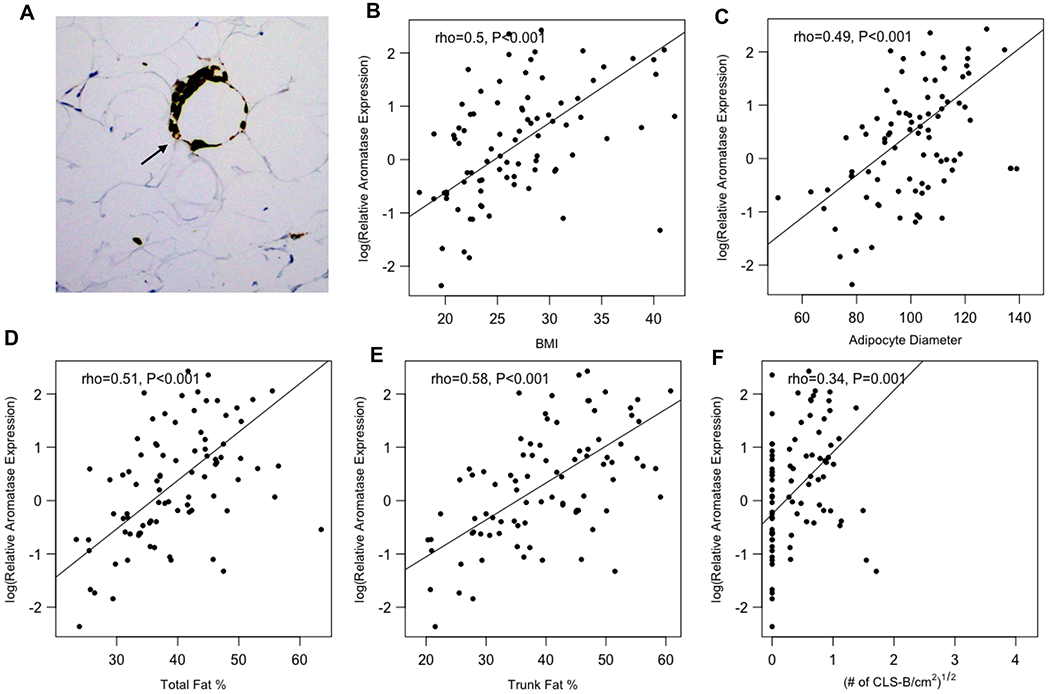
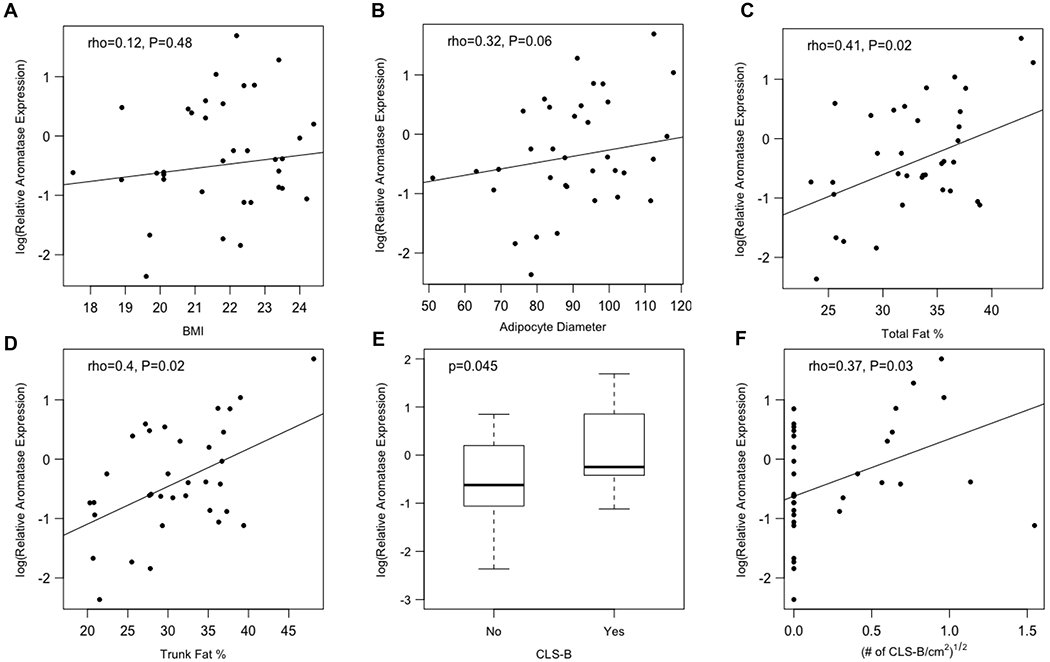
Excess body fat and sedentary behavior are associated with increased breast cancer risk and mortality, including in normal weight women. To investigate underlying mechanisms, we examined whether adiposity and exercise impact the breast microenvironment (e.g., inflammation and aromatase expression) and circulating metabo-inflammatory factors. In a cross-sectional cohort study, breast white adipose tissue (WAT) and blood were collected from 100 women undergoing mastectomy for breast cancer risk reduction or treatment. Self-reported exercise behavior, body composition measured by dual-energy x-ray absorptiometry (DXA), and waist:hip ratio were obtained prior to surgery. Breast WAT inflammation (B-WATi) was assessed by IHC and aromatase expression was assessed by quantitative PCR. Metabolic and inflammatory blood biomarkers that are predictive of breast cancer risk and progression were measured. B-WATi was present in 56 of 100 patients and was associated with older age, elevated BMI, postmenopausal status, decreased exercise, hypertension and dyslipidemia (s < 0.001). Total body fat and trunk fat correlated with B-WATi and breast aromatase levels (s < 0.001). Circulating C-reactive protein, IL6, insulin, and leptin positively correlated with body fat and breast aromatase levels, while negative correlations were observed for adiponectin and sex hormone binding globulin ( < 0.001). Inverse relationships were observed with exercise (s < 0.05). In a subgroup of 39 women with normal BMI, body fat levels positively correlated with B-WATi and aromatase expression (s < 0.05). In conclusion, elevated body fat levels and decreased exercise are associated with protumorigenic micro- and host environments in normal, overweight, and obese individuals. These findings support the development of BMI-agnostic lifestyle interventions that target adiposity. PREVENTION RELEVANCE: We report that individuals with high body fat and low exercise levels have breast inflammation, higher breast aromatase expression, and levels of circulating metabo-inflammatory factors that have been associated with increased breast cancer risk. These findings support interventions to lower adiposity, even among normal weight individuals, to prevent tumor growth.
多余的身体脂肪和久坐不动的行为与乳腺癌风险和死亡率的增加有关,包括正常体重的女性。为了探究潜在的机制,我们研究了肥胖和运动是否会影响乳房微环境(如炎症和芳香酶表达)以及循环代谢炎症因子。在一项横断面队列研究中,从 100 名因乳腺癌风险降低或治疗而接受乳房切除术的女性中采集乳房白色脂肪组织 (WAT) 和血液。手术前通过双能 X 射线吸收法 (DXA) 获得自我报告的运动行为、身体成分和腰围:臀围比。通过免疫组织化学评估乳房 WAT 炎症 (B-WATi),通过定量 PCR 评估芳香酶表达。测量了预测乳腺癌风险和进展的代谢和炎症血液生物标志物。在 100 名患者中有 56 名存在 B-WATi,并且与年龄较大、BMI 升高、绝经后状态、运动减少、高血压和血脂异常有关(s < 0.001)。全身脂肪和躯干脂肪与 B-WATi 和乳房芳香酶水平相关(s < 0.001)。循环 C 反应蛋白、IL6、胰岛素和瘦素与体脂和乳房芳香酶水平呈正相关,而与脂联素和性激素结合球蛋白呈负相关(< 0.001)。与运动呈负相关(s < 0.05)。在 39 名 BMI 正常的女性亚组中,体脂水平与 B-WATi 和芳香酶表达呈正相关(s < 0.05)。总之,高体脂水平和低运动水平与超重和肥胖个体的促肿瘤微环境和宿主环境有关。这些发现支持开发针对肥胖的 BMI 无关的生活方式干预措施。预防相关性:我们报告说,体脂水平高且运动水平低的个体有乳房炎症、更高的乳房芳香酶表达以及与乳腺癌风险增加相关的循环代谢炎症因子水平。这些发现支持降低体脂的干预措施,即使是在正常体重的个体中,也可以预防肿瘤生长。