Centre de recherche du Centre hospitalier de l'Université de Montréal, Immunopathology axis, Montreal, Quebec, Canada.
Faculté de Médecine, Université Paris-Sud, Paris, France.
Clin J Am Soc Nephrol. 2021 Mar 8;16(3):415-426. doi: 10.2215/CJN.07270520.
Animal studies suggest that microvascular rarefaction is a key factor in the acute kidney disease to CKD transition. Hence, delayed graft function appears as a unique human model of AKI to further explore the role of microvascular rarefaction in kidney transplant recipients. Here, we assessed whether delayed graft function is associated with peritubular capillary loss and evaluated the association between this loss and long-term kidney graft function.
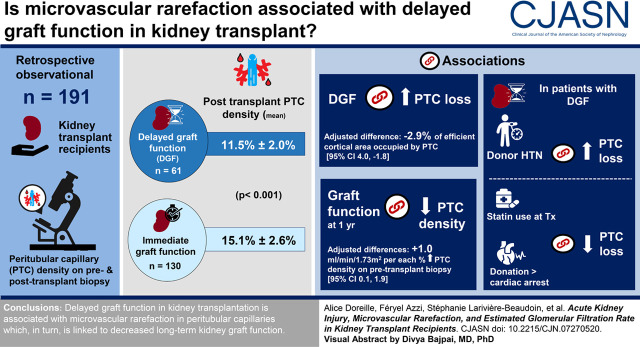
DESIGN, SETTING, PARTICIPANTS, & MEASUREMENTS: This observational, retrospective cohort study included 61 participants who experienced delayed graft function and 130 who had immediate graft function. We used linear regression models to evaluate associations between delayed graft function and peritubular capillary density expressed as the percentage of efficient cortical area occupied by peritubular capillaries in pre- and post-transplant graft biopsies. eGFRs 1 and 3 years post-transplant were secondary outcomes.
Post-transplant biopsies were performed at a median of 113 days (interquartile range, 101-128) after transplantation. Peritubular capillary density went from 15.4% to 11.5% in patients with delayed graft function (median change, -3.7%; interquartile range, -6.6% to -0.8%) and from 19.7% to 15.1% in those with immediate graft function (median change, -4.5%; interquartile range, -8.0% to -0.8%). Although the unadjusted change in peritubular capillary density was similar between patients with and without delayed graft function, delayed graft function was associated with more peritubular capillary loss in the multivariable analysis (adjusted difference in change, -2.9%; 95% confidence interval, -4.0 to -1.8). Pretransplant peritubular capillary density and change in peritubular capillary density were associated with eGFR 1 and 3 years post-transplantation.
Perioperative AKI is associated with lower density in peritubular capillaries before transplantation and with loss of peritubular capillaries following transplantation. Lower peritubular capillary density is linked to lower long-term eGFR.
动物研究表明,微血管稀疏是急性肾损伤向慢性肾脏病(CKD)转变的关键因素。因此,延迟移植物功能似乎是急性肾损伤向人类的独特模型,可进一步探讨微血管稀疏在肾移植受者中的作用。在此,我们评估延迟移植物功能是否与肾小管周毛细血管丧失有关,并评估这种丧失与长期移植物肾功能之间的关系。
设计、设置、参与者和测量:本观察性、回顾性队列研究纳入了 61 例经历延迟移植物功能和 130 例立即移植物功能的患者。我们使用线性回归模型评估了延迟移植物功能与肾小管周毛细血管密度之间的关系,肾小管周毛细血管密度用移植前和移植后活检中肾小管周毛细血管占皮质有效面积的百分比表示。移植后 1 年和 3 年的 eGFR 为次要结果。
移植后活检在移植后中位数 113 天(四分位距,101-128)进行。在延迟移植物功能患者中,肾小管周毛细血管密度从 15.4%降至 11.5%(中位数变化,-3.7%;四分位距,-6.6%至-0.8%),而在立即移植物功能患者中,从 19.7%降至 15.1%(中位数变化,-4.5%;四分位距,-8.0%至-0.8%)。尽管在调整了其他因素后,未调整的肾小管周毛细血管密度变化在有和无延迟移植物功能的患者之间相似,但延迟移植物功能与更多的肾小管周毛细血管丢失相关(调整后变化的差异,-2.9%;95%置信区间,-4.0 至-1.8)。移植前肾小管周毛细血管密度和肾小管周毛细血管密度变化与移植后 1 年和 3 年的 eGFR 相关。
围手术期 AKI 与移植前肾小管周毛细血管密度降低以及移植后肾小管周毛细血管丧失有关。较低的肾小管周毛细血管密度与较低的长期 eGFR 相关。