Charité-Universitätsmedizin Berlin, corporate member of Freie Universität Berlin, Humboldt-Universität zu Berlin, and Berlin Institute of Health, Laboratory of Chronobiology, 10117 Berlin, Germany.
Genes Dev. 2021 Mar 1;35(5-6):304-306. doi: 10.1101/gad.348305.121.
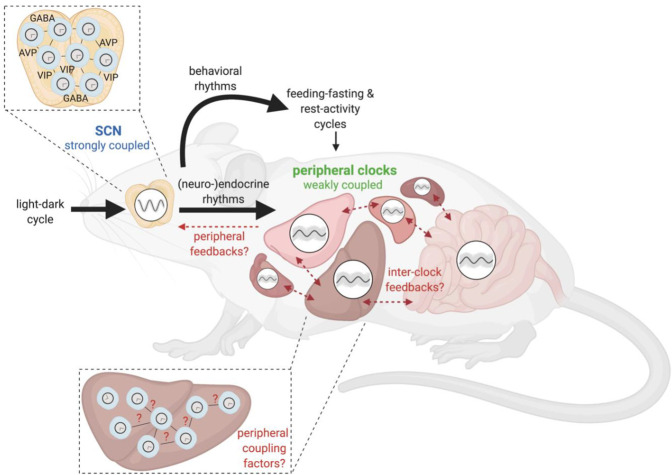
The circadian system of mammals is hierarchically organized. The suprachiasmatic nucleus (SCN) in the hypothalamus is considered the master circadian clock adapting to environmental light-dark cycles and synchronizing subsidiary oscillators in peripheral organs. While being an attractive concept, this has never been convincingly shown in vivo. New findings by Sinturel and colleagues (pp. 329-334) in this issue of now show the requirement of the SCN for temporal orchestration of the periphery in living animals. Surprisingly, this study also found that even in the absence of SCN or extra-SCN clocks, peripheral clocks remain rhythmic, indicating previously controversial circadian oscillator coupling within peripheral tissues.
哺乳动物的生物钟系统呈层级结构。位于下丘脑的视交叉上核(SCN)被认为是主生物钟,适应环境的光-暗周期,并使外周器官中的附属振荡器同步。虽然这是一个有吸引力的概念,但在体内从未令人信服地证明过。Sinturel 及其同事在本期《自然》杂志上的新发现(第 329-334 页)现在表明,SCN 对于活体动物外周组织的时间协调是必需的。令人惊讶的是,这项研究还发现,即使没有 SCN 或 SCN 以外的时钟,外周时钟仍然保持有节奏,这表明先前有争议的外周组织内的生物钟振荡器耦合。