Laboratory of Chronobiology, Charité Universitätsmedizin Berlin, Berlin, Germany.
Mol Syst Biol. 2010 Nov 30;6:438. doi: 10.1038/msb.2010.92.
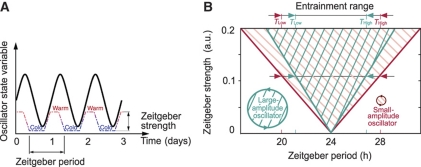
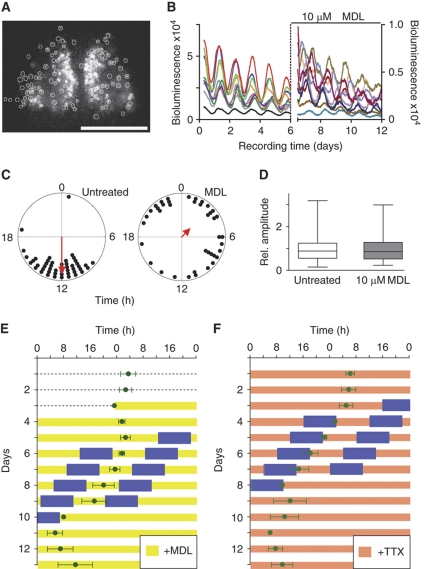
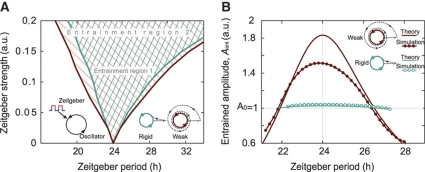
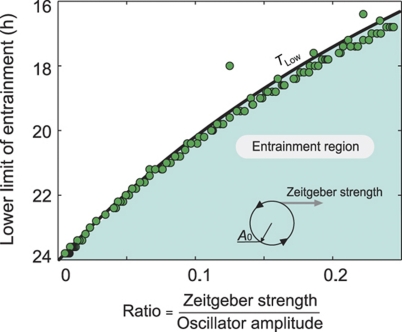
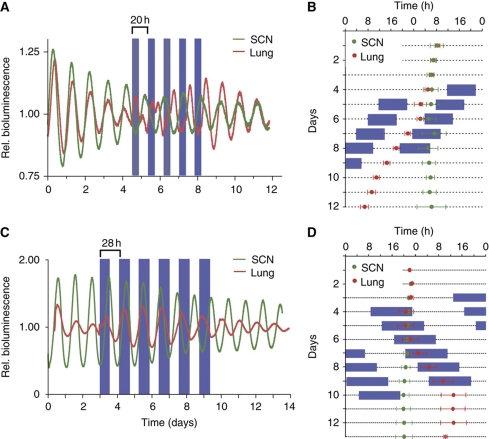
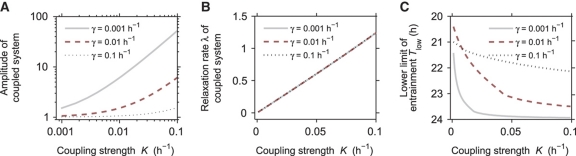
Circadian clocks are endogenous oscillators driving daily rhythms in physiology and behavior. Synchronization of these timers to environmental light-dark cycles ('entrainment') is crucial for an organism's fitness. Little is known about which oscillator qualities determine entrainment, i.e., entrainment range, phase and amplitude. In a systematic theoretical and experimental study, we uncovered these qualities for circadian oscillators in the suprachiasmatic nucleus (SCN-the master clock in mammals) and the lung (a peripheral clock): (i) the ratio between stimulus (zeitgeber) strength and oscillator amplitude and (ii) the rigidity of the oscillatory system (relaxation rate upon perturbation) determine entrainment properties. Coupling among oscillators affects both qualities resulting in increased amplitude and rigidity. These principles explain our experimental findings that lung clocks entrain to extreme zeitgeber cycles, whereas SCN clocks do not. We confirmed our theoretical predictions by showing that pharmacological inhibition of coupling in the SCN leads to larger ranges of entrainment. These differences between master and the peripheral clocks suggest that coupling-induced rigidity in the SCN filters environmental noise to create a robust circadian system.
生物钟是驱动生理和行为日常节律的内源性振荡器。这些计时器与环境光-暗周期的同步(“同步”)对于生物体的适应性至关重要。对于哪些振荡器特性决定了同步性,即同步范围、相位和幅度,我们知之甚少。在一项系统的理论和实验研究中,我们揭示了哺乳动物的视交叉上核(SCN-主时钟)和肺(外周时钟)中的生物钟振荡器的这些特性:(i)刺激(时间生物)强度与振荡器幅度之间的比率,以及(ii)振荡系统的刚性(受到干扰时的松弛速率)决定了同步特性。振荡器之间的耦合会影响这两个特性,从而导致幅度和刚性增加。这些原则解释了我们的实验发现,即肺钟可以与极端的时间生物周期同步,而 SCN 钟则不能。我们通过表明 SCN 中的耦合抑制药理学抑制证实了我们的理论预测,这导致了更大的同步范围。主时钟和外周时钟之间的这些差异表明,SCN 中的耦合诱导刚性可过滤环境噪声,从而产生稳健的生物钟系统。