Department of Life Sciences, College of Health, Medicine and Life Sciences, Brunel University London, Uxbridge UB8 3PH, UK.
Warwickshire Institute for the Study of Diabetes, Endocrinology and Metabolism (WISDEM), University Hospitals Coventry and Warwickshire NHS Trust, Coventry CV2 2DX, UK.
Int J Mol Med. 2021 Apr;47(4). doi: 10.3892/ijmm.2021.4897. Epub 2021 Mar 2.
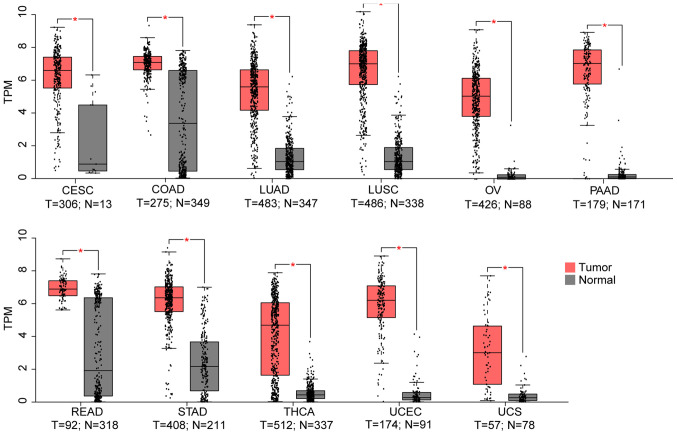
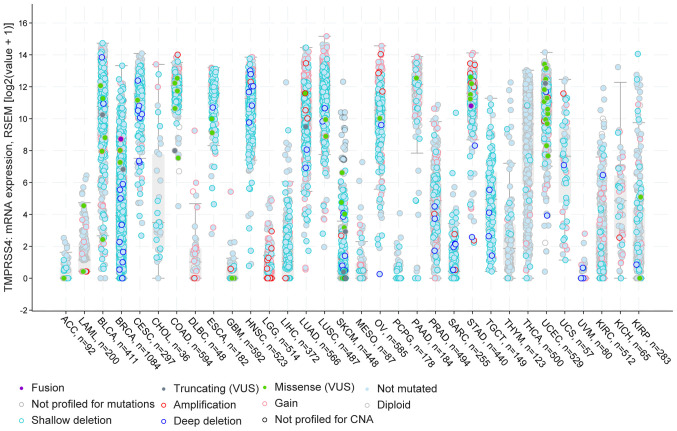
Severe acute respiratory syndrome (SARS) coronavirus‑2 (SARS‑CoV‑2), the causative viral agent for the ongoing COVID‑19 pandemic, enters its host cells primarily via the binding of the SARS‑CoV‑2 spike (S) proteins to the angiotensin‑converting enzyme 2 (ACE2). A number of other cell entry mediators have also been identified, including neuropilin‑1 (NRP1) and transmembrane protease serine 2 (TMPRSS2). More recently, it has been demonstrated that transmembrane protease serine 4 (TMPRSS4) along with TMPRSS2 activate the SARS‑CoV‑2 S proteins, and enhance the viral infection of human small intestinal enterocytes. To date, a systematic analysis of TMPRSS4 in health and disease is lacking. In the present study, using tools, the gene expression and genetic alteration of TMPRSS4 were analysed across numerous tumours and compared to controls. The observations were also expanded to the level of the central nervous system (CNS). The findings revealed that TMPRSS4 was overexpressed in 11 types of cancer, including lung adenocarcinoma, lung squamous cell carcinoma, cervical squamous cell carcinoma, thyroid carcinoma, ovarian cancer, cancer of the rectum, pancreatic cancer, colon and stomach adenocarcinoma, uterine carcinosarcoma and uterine corpus endometrial carcinoma, whilst it was significantly downregulated in kidney carcinomas, acute myeloid leukaemia, skin cutaneous melanoma and testicular germ cell tumours. Finally, a high TMPRSS4 expression was documented in the olfactory tubercle, paraolfactory gyrus and frontal operculum, all brain regions which are associated with the sense of smell and taste. Collectively, these data suggest that TMPRSS4 may play a role in COVID‑19 symptomatology as another SARS‑CoV‑2 host cell entry mediator responsible for the tropism of this coronavirus both in the periphery and the CNS.
严重急性呼吸系统综合征冠状病毒 2(SARS-CoV-2)是当前 COVID-19 大流行的致病病毒,其主要通过 SARS-CoV-2 刺突(S)蛋白与血管紧张素转化酶 2(ACE2)的结合进入宿主细胞。此外,还发现了其他一些细胞进入介质,包括神经纤毛蛋白 1(NRP1)和跨膜丝氨酸蛋白酶 2(TMPRSS2)。最近,已经证明跨膜丝氨酸蛋白酶 4(TMPRSS4)与 TMPRSS2 一起激活 SARS-CoV-2 S 蛋白,并增强病毒对人小肠肠上皮细胞的感染。迄今为止,缺乏对 TMPRSS4 在健康和疾病中的系统分析。在本研究中,使用工具对 TMPRSS4 的基因表达和遗传改变进行了分析,并与对照进行了比较。观察结果还扩展到了中枢神经系统(CNS)的水平。研究结果表明,TMPRSS4 在 11 种癌症中过表达,包括肺腺癌、肺鳞状细胞癌、宫颈鳞状细胞癌、甲状腺癌、卵巢癌、直肠癌、胰腺癌、结肠和胃腺癌、子宫癌肉瘤和子宫体子宫内膜癌,而在肾癌、急性髓系白血病、皮肤皮肤黑色素瘤和睾丸生殖细胞肿瘤中则显著下调。最后,在嗅觉结节、副嗅觉回和额盖中记录到高 TMPRSS4 表达,所有这些大脑区域都与嗅觉和味觉有关。综上所述,这些数据表明,TMPRSS4 可能在 COVID-19 症状学中发挥作用,是另一种 SARS-CoV-2 宿主细胞进入介质,负责该冠状病毒在周围和中枢神经系统中的亲嗜性。