Department of Family Medicine, Samsung Changwon Hospital, School of Medicine, Sungkyunkwan University, Changwon, Korea.
Department of Family Medicine, Pusan National University Graduate School of Medicine, Busan, Korea.
J Korean Med Sci. 2021 Mar 1;36(8):e56. doi: 10.3346/jkms.2021.36.e56.
Osteocalcin is known to regulate energy metabolism. Recently, metabolic syndrome (MetS) has been found to be associated with reduced levels of osteocalcin in men, as well as in postmenopausal women. The aim of this study was to investigate the association between serum osteocalcin and MetS in premenopausal women, compared with that in postmenopausal women.
This cross-sectional study was based on 5,896 participants who completed a health screening examination. They were classified according to their menopausal status. Each group was subdivided into non-MetS and MetS groups according to the modified National Cholesterol Education Program-Adult Treatment Panel III criteria. Serum osteocalcin levels were measured using the electrochemiluminescence immunoassay.
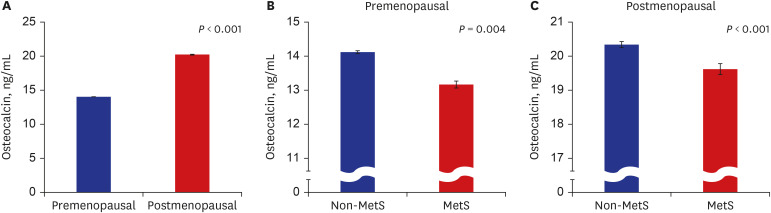
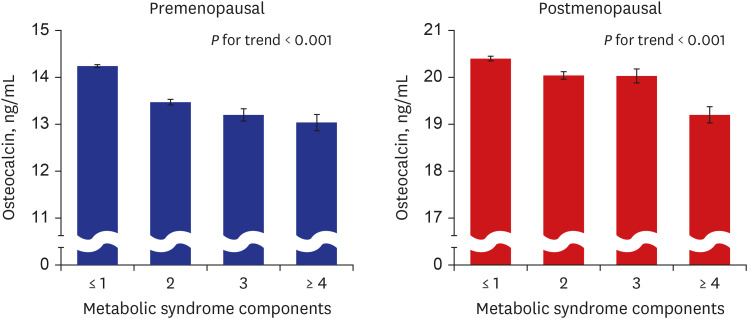
Serum osteocalcin level was significantly lower in women with MetS than in those without MetS, after adjusting for confounders (14.12 ± 0.04 vs. 13.17 ± 0.13 [ = 0.004] in premenopausal women, and 20.34 ± 0.09 vs. 19.62 ± 0.21 [ < 0.001] in postmenopausal women), regardless of their menopausal status. Serum osteocalcin levels decreased correspondingly with an increasing number of MetS elements ( for trend < 0.001). Multiple regression analysis demonstrated that waist circumference (β = -0.085 [ < 0.001] and β = -0.137 [ < 0.001]) and hemoglobin A1c (β = -0.09 [ < 0.001] and β = -0.145 [ < 0.001]) were independent predictors of osteocalcin in premenopausal and postmenopausal women. Triglyceride levels were also independently associated with osteocalcin levels in premenopausal women (β = -0.004 [ < 0.013]). The odds ratio (OR) for MetS was significantly higher in the lowest quartile than in the highest quartile of serum osteocalcin levels after adjusting for age, alkaline phosphatase, uric acid, high sensitivity C-reactive protein, and body mass index in all women (OR, 2.00; 95% confidence interval [CI], 1.49-2.68) as well as in premenopausal (OR, 2.23; 95% CI, 1.39-3.58) and postmenopausal (OR, 2.01; 95% CI, 1.26-3.23) subgroups.
Lower serum osteocalcin concentrations were significantly associated with MetS in both premenopausal and postmenopausal women and were therefore independent of menopausal status.
骨钙素已知可调节能量代谢。最近,代谢综合征(MetS)已被发现与男性以及绝经后女性的骨钙素水平降低有关。本研究旨在探讨绝经前妇女血清骨钙素与 MetS 的相关性,并与绝经后妇女进行比较。
这是一项基于 5896 名完成健康筛查检查的参与者的横断面研究。根据其绝经状态进行分类。根据改良的国家胆固醇教育计划-成人治疗小组 III 标准,每组均根据非 MetS 和 MetS 组进行细分。使用电化学发光免疫分析法测量血清骨钙素水平。
在调整混杂因素后,患有 MetS 的妇女的血清骨钙素水平明显低于未患有 MetS 的妇女(绝经前妇女为 14.12 ± 0.04 vs. 13.17 ± 0.13, = 0.004,绝经后妇女为 20.34 ± 0.09 vs. 19.62 ± 0.21, < 0.001),无论其绝经状态如何。血清骨钙素水平随着 MetS 元素数量的增加而相应降低(趋势 < 0.001)。多元回归分析表明,腰围(β = -0.085 [<0.001] 和 β = -0.137 [<0.001])和血红蛋白 A1c(β = -0.09 [<0.001] 和 β = -0.145 [<0.001])是绝经前和绝经后妇女骨钙素的独立预测因子。甘油三酯水平也与绝经前妇女的骨钙素水平独立相关(β = -0.004 [<0.013])。在所有女性(OR,2.00;95%置信区间 [CI],1.49-2.68)以及绝经前(OR,2.23;95%CI,1.39-3.58)和绝经后(OR,2.01;95%CI,1.26-3.23)亚组中,血清骨钙素水平最低四分位数的 MetS 比值比(OR)明显高于最高四分位数。
绝经前和绝经后妇女的血清骨钙素浓度较低与 MetS 显著相关,且与绝经状态无关。