Sheeley Madeline P, Andolino Chaylen, Kiesel Violet A, Teegarden Dorothy
Department of Nutrition Science, Purdue University, West Lafayette, Indiana, USA.
Br J Pharmacol. 2022 Jun;179(12):2890-2905. doi: 10.1111/bph.15424. Epub 2021 Apr 8.
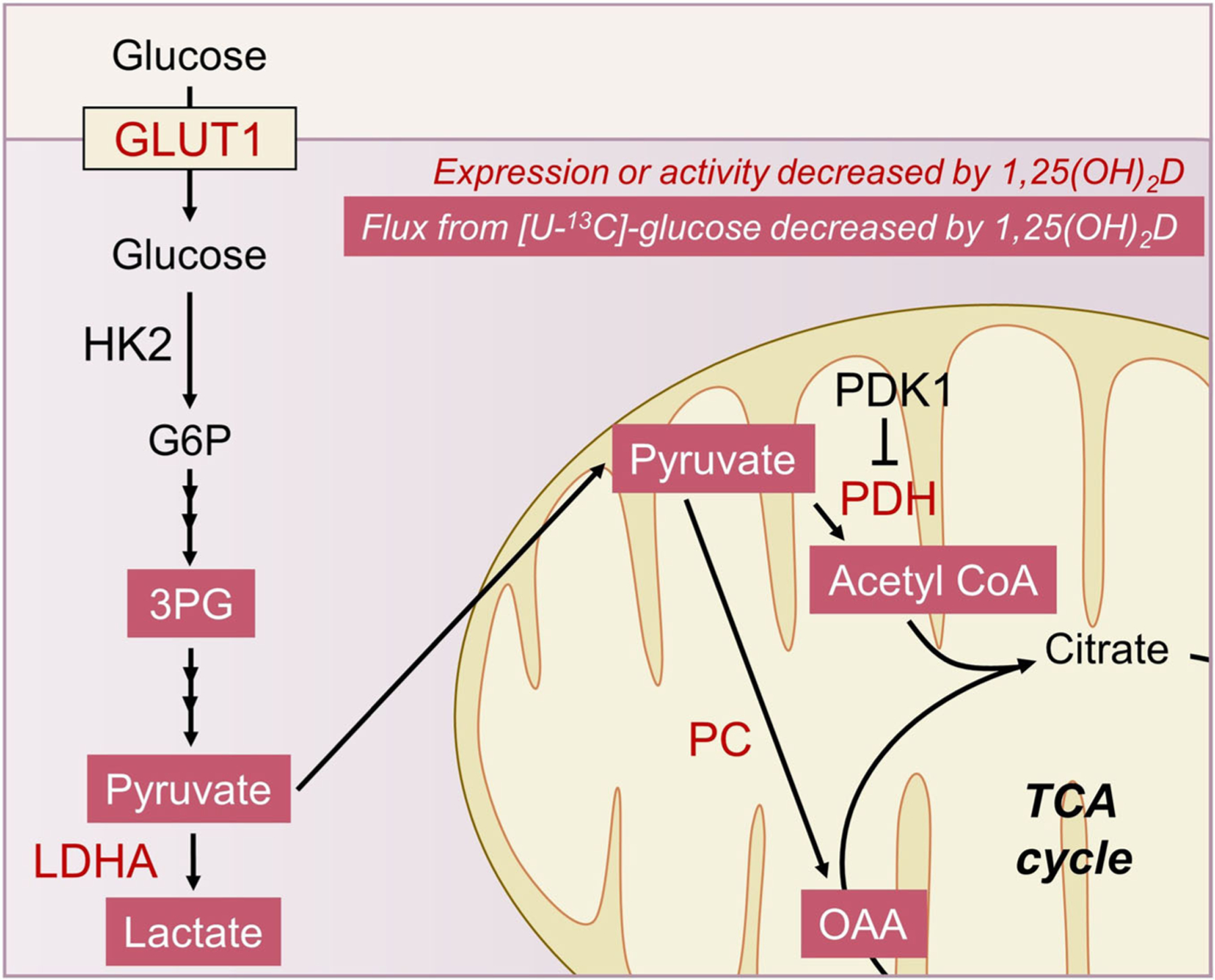
Vitamin D exerts anti-cancer effects in recent clinical trials and preclinical models. The actions of vitamin D are primarily mediated through its hormonal form, 1,25-dihydroxyvitamin D (1,25(OH) D). Previous literature describing in vitro studies has predominantly focused on the anti-tumourigenic effects of the hormone, such as proliferation and apoptosis. However, recent evidence has identified 1,25(OH) D as a regulator of energy metabolism in cancer cells, where requirements for specific energy sources at different stages of progression are dramatically altered. The literature suggests that 1,25(OH) D regulates energy metabolism, including glucose, glutamine and lipid metabolism during cancer progression, as well as oxidative stress protection, as it is closely associated with energy metabolism. Mechanisms involved in energy metabolism regulation are an emerging area in which vitamin D may inhibit multiple stages of cancer progression. LINKED ARTICLES: This article is part of a themed issue on New avenues in cancer prevention and treatment (BJP 75th Anniversary). To view the other articles in this section visit http://onlinelibrary.wiley.com/doi/10.1111/bph.v179.12/issuetoc.
在最近的临床试验和临床前模型中,维生素D发挥了抗癌作用。维生素D的作用主要通过其激素形式1,25 - 二羟基维生素D(1,25(OH)₂D)介导。以往描述体外研究的文献主要集中在该激素的抗肿瘤作用上,如增殖和凋亡。然而,最近的证据表明1,25(OH)₂D是癌细胞能量代谢的调节剂,在癌症进展的不同阶段对特定能量来源的需求会发生显著变化。文献表明,1,25(OH)₂D在癌症进展过程中调节能量代谢,包括葡萄糖、谷氨酰胺和脂质代谢,以及氧化应激保护,因为它与能量代谢密切相关。能量代谢调节所涉及的机制是一个新兴领域,维生素D可能在其中抑制癌症进展的多个阶段。相关文章:本文是关于癌症预防和治疗新途径(《英国药理学杂志》75周年)主题特刊的一部分。要查看本节中的其他文章,请访问http://onlinelibrary.wiley.com/doi/10.1111/bph.v179.12/issuetoc。