Puspitasari Ajeng J, Heredia Dagoberto, Coombes Brandon J, Geske Jennifer R, Gentry Melanie T, Moore Wendy R, Sawchuk Craig N, Schak Kathryn M
Department of Quantitative Health Sciences, Mayo Clinic, Rochester, MN, United States.
JMIR Ment Health. 2021 Mar 11;8(3):e25542. doi: 10.2196/25542.
In the context of the COVID-19 pandemic, many behavioral health services have transitioned to teletherapy to continue delivering care for patients with mental illness. Studies that evaluate the outcome of this rapid teletherapy adoption and implementation are pertinent.
This single-arm, nonrandomized pilot study aimed to assess the feasibility and initial patient-level outcomes of a psychiatric transitional day program that switched from an in-person group to a video teletherapy group during the COVID-19 pandemic.
Patients with transdiagnostic conditions who were at risk of psychiatric hospitalization were referred to the Adult Transitions Program (ATP) at a large academic medical center in the United States. ATP was a 3-week intensive outpatient program that implemented group teletherapy guided by cognitive and behavioral principles delivered daily for 3 hours per day. Feasibility was assessed via retention, attendance rate, and rate of securing aftercare appointments prior to ATP discharge. Patients completed standardized patient-reported outcome measures at admission and discharge to assess the effectiveness of the program for improving quality of mental health, depression, anxiety, and suicide risk.
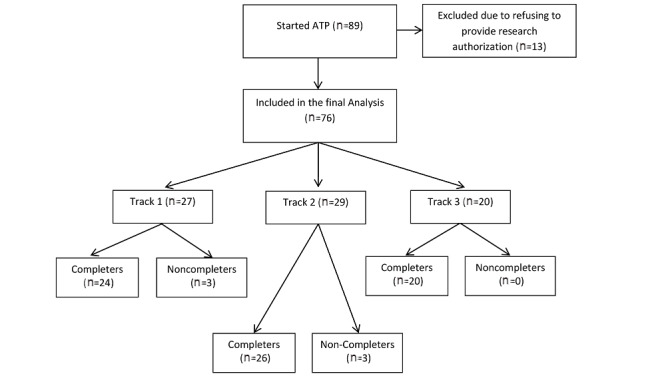
Patients (N=76) started the program between March and August of 2020. Feasibility was established, with 70 of the 76 patients (92%) completing the program and a mean attendance of 14.43 days (SD 1.22); also, 71 patients (95%) scheduled at least one behavioral health aftercare service prior to ATP discharge. All patient-level reported outcomes demonstrated significant improvements in depression (95% CI -3.6 to -6.2; Cohen d=0.77; P<.001), anxiety (95% CI -3.0 to -4.9; Cohen d=0.74; P<.001), overall suicide risk (95% CI -0.5 to -0.1; Cohen d=0.41; P=.02), wish to live (95% CI 0.3 to 1.0; Cohen d=0.39; P<.001), wish to die (95% CI -0.2 to -1.4; Cohen d=0.52; P=.01), and overall mental health (95% CI 1.5 to 4.5; Cohen d=0.39; P<.001) from admission to discharge.
Rapid adoption and implementation of a group-based teletherapy day program for adults at risk of psychiatric hospitalization appeared to be feasible and effective. Patients demonstrated high completion and attendance rates and reported significant improvements in psychosocial outcomes. Larger trials should be conducted to further evaluate the efficacy and effectiveness of the program through randomized controlled trials.
在新冠疫情背景下,许多行为健康服务已转向远程治疗,以继续为精神疾病患者提供护理。评估这种快速采用和实施远程治疗结果的研究具有重要意义。
这项单臂、非随机的试点研究旨在评估在新冠疫情期间,一个从面对面小组治疗转变为视频远程治疗小组的精神科过渡日间项目的可行性和初始患者层面的结果。
有精神科住院风险的跨诊断疾病患者被转介到美国一家大型学术医疗中心的成人过渡项目(ATP)。ATP是一个为期3周的强化门诊项目,实施以认知和行为原则为指导的小组远程治疗,每天进行3小时。通过留存率、出勤率以及在ATP出院前获得后续护理预约的比例来评估可行性。患者在入院和出院时完成标准化的患者报告结局测量,以评估该项目对改善心理健康、抑郁、焦虑和自杀风险的有效性。
患者(N = 76)于2020年3月至8月开始该项目。确定了其可行性,76名患者中有70名(92%)完成了该项目,平均出勤14.43天(标准差1.22);此外,71名患者(95%)在ATP出院前至少安排了一次行为健康后续护理服务。所有患者层面报告的结局在从入院到出院期间,抑郁(95%置信区间 -3.6至 -6.2;科恩d = 0.77;P <.001)、焦虑(95%置信区间 -3.0至 -4.9;科恩d = 0.74;P <.001)、总体自杀风险(95%置信区间 -0.5至 -0.1;科恩d =