Farm Animal Genetic Resources Exploration and Innovation Key Laboratory of Sichuan Province, Sichuan Agricultural University, Chengdu, Sichuan 611130, P.R. China.
College of Life Science, Sichuan Agricultural University, Ya'an, Sichuan 625014, P.R. China.
Poult Sci. 2021 Mar;100(3):100960. doi: 10.1016/j.psj.2020.12.057. Epub 2020 Dec 24.
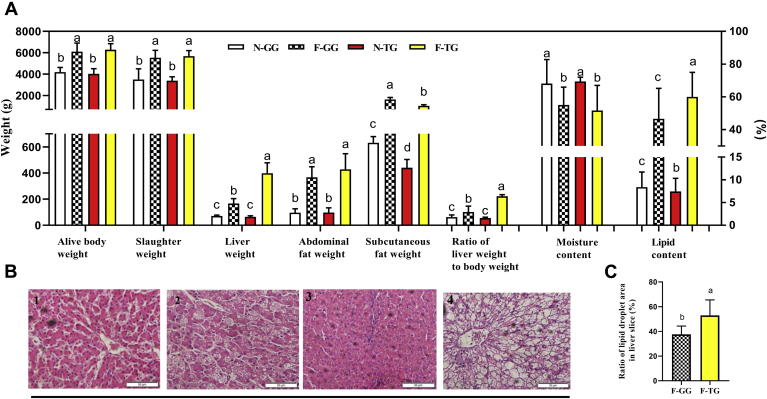
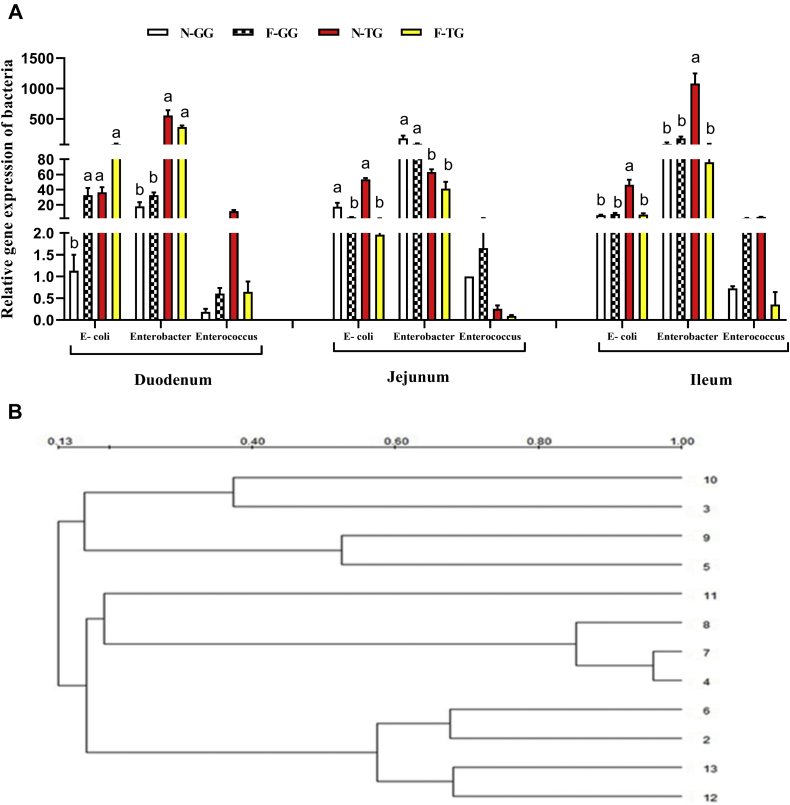
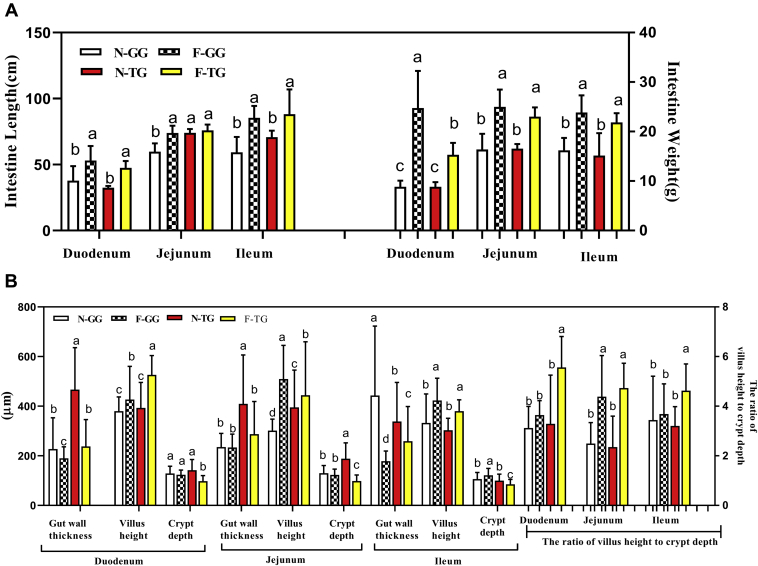
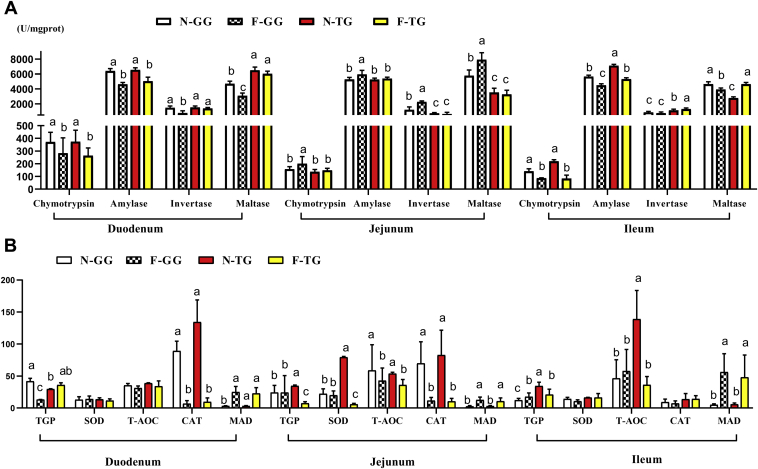
To have a better understanding of how the "gut-liver axis" mediates the lipid deposition in the liver, a comparison of overfeeding influence on intestine physiology and microbiota between Gang Goose and Tianfu Meat Goose was performed in this study. After force-feeding, compared with Gang Goose, Tianfu Meat Goose had better fat storage capacity in liver (397.94 vs. 166.54 for foie gras weight (g), P < 0.05; 6.37 vs. 2.92% for the ratio of liver to body, P < 0.05; 60.01 vs. 46.64% for fat content, P < 0.05) and the less subcutaneous adipose tissue weight (1240.96 g vs. 1440.46 g, P < 0.05). After force-feeding, the digestion-absorption capacity of Tianfu Meat Goose was higher than that of Gang Goose (5.56 vs. 3.64 and 4.63 vs. 3.68 for the ratio of villus height to crypt depth in duodenum and ileum, respectively, P < 0.05; 1394.96 vs. 782.59 and 1314.76 vs. 766.17 for the invertase activity (U/mg-prot), in duodenum and ileum, respectively, P < 0.05; 6038.36 vs. 3088.29 and 4645.29 vs. 3927.61 for the activity of maltase (U/mg-prot), in duodenum and ileum, respectively, P < 0.05). Force-feeding decreased the gene expression of Escherichia coli in the ileum of Tianfu Meat Goose; force-feeding increased the number of gut microbiota Enterobacterial Repetitive Intergenic Consensus-Polymerase Chain Reaction band in Tianfu Meat Goose and decreased the number in Gang Goose. In conclusion, compared with Gang Goose, the lipid deposition in the liver and the intestine digestion-absorption capacity and stability were higher in Tianfu Meat Goose. Thereby, Tianfu Meat Goose is the better breed for foie gras production for prolonged force-feeding; Gang Goose possesses better fat storage capacity in subcutaneous adipose tissue. However, Gang Goose has lower gut stability responding to force-feeding, so Gang Goose is suited to force-feeding in a short time to gain the body weight and subcutaneous fat as an overfed duck for roast duck.
为了更好地了解“肠-肝轴”如何介导肝脏中的脂质沉积,本研究比较了过度喂养对溆浦鹅和天府肉鹅肠道生理学和微生物群的影响。强制育肥后,与溆浦鹅相比,天府肉鹅的肝脏脂肪储存能力更好(鹅肝重量为 397.94 克比 166.54 克,P<0.05;肝体比为 6.37%比 2.92%,P<0.05;脂肪含量为 60.01%比 46.64%,P<0.05),皮下脂肪组织重量更少(1240.96 克比 1440.46 克,P<0.05)。强制育肥后,天府肉鹅的消化吸收能力高于溆浦鹅(十二指肠和回肠绒毛高度与隐窝深度比分别为 5.56 比 3.64 和 4.63 比 3.68,P<0.05;十二指肠和回肠中蔗糖酶活性(U/mg-蛋白)分别为 1394.96 比 782.59 和 1314.76 比 766.17,P<0.05;十二指肠和回肠中麦芽糖酶活性(U/mg-蛋白)分别为 6038.36 比 3088.29 和 4645.29 比 3927.61,P<0.05)。强制育肥降低了天府肉鹅回肠中大肠杆菌的基因表达;强制育肥增加了天府肉鹅肠道微生物群肠杆菌重复基因间共识-聚合酶链反应带的数量,减少了鹅的数量。总之,与溆浦鹅相比,天府肉鹅肝脏脂质沉积和肠道消化吸收能力及稳定性更高。因此,天府肉鹅是适合长期强制育肥生产鹅肝的品种;溆浦鹅在皮下脂肪组织中具有更好的脂肪储存能力。然而,鹅对强制育肥的肠道稳定性反应较低,因此鹅适合在短时间内进行强制育肥,以获得体重和皮下脂肪,作为烤鸭的过食鸭。