Center for Gastric Cancer, National Cancer Center, 323 Ilsan-ro, Ilsandong-gu, Goyang, Gyeonggi, 10408, South Korea.
Biostatistics Collaboration Team, Research Core Center, Research Institute, National Cancer Center, Goyang, 10408, Korea.
BMC Gastroenterol. 2021 Mar 2;21(1):95. doi: 10.1186/s12876-021-01680-1.
This randomized, open-label trial aimed to compare the efficacy of 10-day bismuth-containing quadruple therapy (BQT) with 7-day proton-pump inhibitor-clarithromycin containing standard triple therapy (STT) as an empirical first-line Helicobacter pylori therapy.
Participants with H. pylori infection were randomly assigned to either 10-day BQT (daily doses of bismuth 300 mg, four times; lansoprazole 30 mg, twice; metronidazole 500 mg, three times; and tetracycline 500 mg, four times) or 7-day STT (lansoprazole 30 mg; amoxicillin 1,000 mg; and clarithromycin 500 mg; each given twice daily). Participants who failed initial therapy were crossed over to the alternative treatment regimen. Primary outcome was the eradication rates of first-line treatment by intention-to-treat analysis.
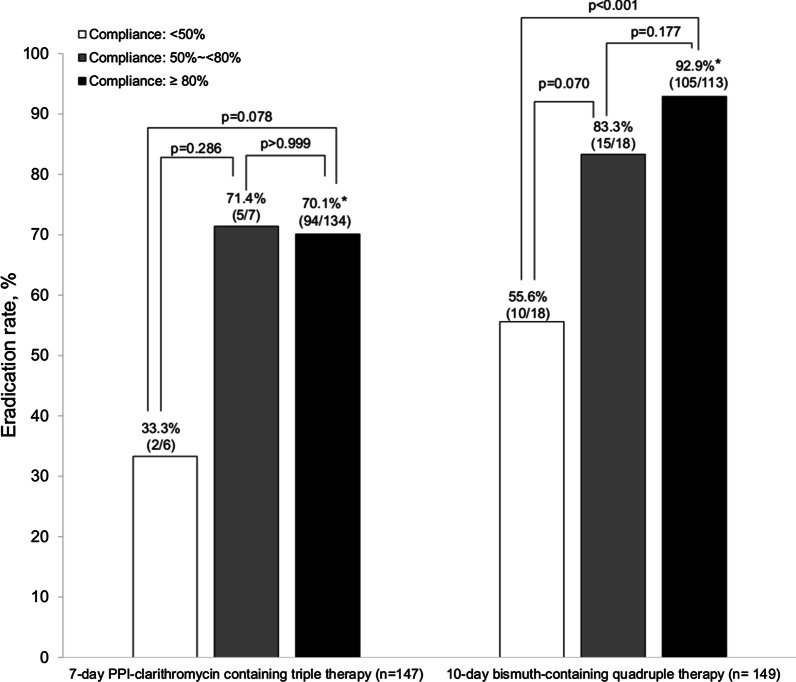
Study participants (n = 352) were randomized to receive either 10-day BQT (n = 175) or 7-day STT (n = 177). The BQT-group achieved a significantly higher eradication rate than the STT-group in the intention-to-treat analysis (74.3% vs 57.1%, respectively; P = 0.001), modified intention-to-analysis (87.2% [130/149] vs 68.7% [101/147], respectively; P < 0.001) and per-protocol analysis (92.9% [105/113] vs 70.1% [94/134], respectively; P < 0.001). Although there was no serious adverse event, the compliance was lower with BQT than STT as a higher proportion of participants in the BQT-group discontinued therapy because of adverse events than those in the STT-group (23.1% vs 9.1%, respectively; P = 0.001) CONCLUSIONS: Ten-day BQT had higher eradication rates compared to that of the 7-day STT as an empirical first-line treatment for H. pylori eradication in Korea.
ClinicalTrials.gov, NCT02557932. Registered 23 September 2015, https://clinicaltrials.gov/ct2/show/NCT02557932?term=NCT02557932&draw=2&rank=1 .
本随机、开放标签试验旨在比较 10 天铋剂四联疗法(BQT)与 7 天质子泵抑制剂-克拉霉素三联标准疗法(STT)作为经验性一线幽门螺杆菌治疗的疗效。
患有幽门螺杆菌感染的参与者被随机分配至 10 天 BQT(每日剂量铋 300mg,四次;兰索拉唑 30mg,两次;甲硝唑 500mg,三次;四环素 500mg,四次)或 7 天 STT(兰索拉唑 30mg;阿莫西林 1000mg;克拉霉素 500mg;均每日两次)。首次治疗失败的参与者交叉至替代治疗方案。主要结局为意向治疗分析的一线治疗根除率。
研究参与者(n=352)被随机分配至接受 10 天 BQT(n=175)或 7 天 STT(n=177)。意向治疗分析中,BQT 组的根除率显著高于 STT 组(分别为 74.3%和 57.1%;P=0.001),改良意向治疗分析(分别为 87.2%[130/149]和 68.7%[101/147];P<0.001)和方案分析(分别为 92.9%[105/113]和 70.1%[94/134];P<0.001)。尽管没有严重不良事件,但 BQT 的依从性低于 STT,因为 BQT 组因不良反应而停止治疗的参与者比例高于 STT 组(分别为 23.1%和 9.1%;P=0.001)。
在韩国,10 天 BQT 作为经验性一线幽门螺杆菌根除治疗,其根除率高于 7 天 STT。
ClinicalTrials.gov,NCT02557932。2015 年 9 月 23 日注册,https://clinicaltrials.gov/ct2/show/NCT02557932?term=NCT02557932&draw=2&rank=1。