Division of Hematology, Department of Internal Medicine, Mayo Clinic, Rochester, MN, USA.
Division of Hematopathology, Department of Internal Medicine, Mayo Clinic, Rochester, MN, USA.
Blood Cancer J. 2021 Mar 2;11(3):46. doi: 10.1038/s41408-021-00435-1.
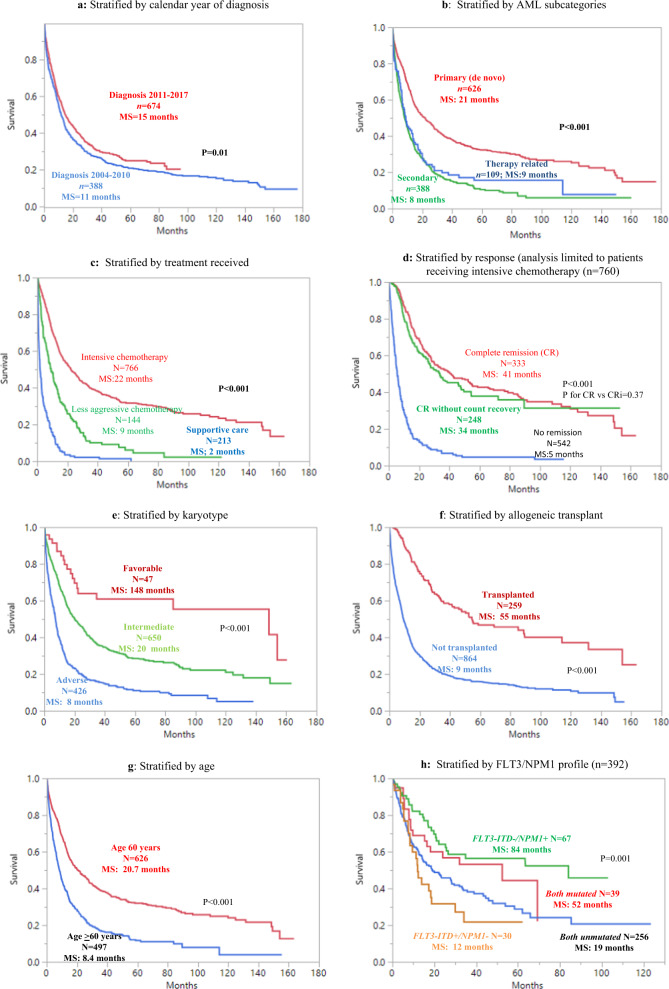
Between 2004 and 2017, a total of 1123 adult patients (median age 65 years; 61% males) with newly diagnosed acute myeloid leukemia (AML), not including acute promyelocytic leukemia, were seen at the Mayo Clinic. Treatment included intensive (n = 766) or lower intensity (n = 144) chemotherapy or supportive care (n = 213), with respective median survivals of 22, 9, and 2 months (p < 0.01). Intensive chemotherapy resulted in complete remission (CR) and CR with incomplete count recovery (CRi) rates of 44 and 33%, respectively, with no difference in survival outcome between the two (p = 0.4). Allogeneic hematopoietic stem cell transplant (AHSCT) was documented in 259 patients and provided the best survival rate (median 55 months; p < 0.01). After a median follow-up of 13 months, 841 (75%) deaths were recorded. Multivariate analysis identified age >60 years (HR 2.2, 1.9-2.6), adverse karyotype (HR 2.9, 1.9-4.9), intermediate-risk karyotype (HR 1.6, 1.02-2.6), post-myeloproliferative neoplasm AML (HR 1.9, 1.5-2.4), and other secondary AML (HR 1.3 (1.1-1.6) as risk factors for shortened survival. These risk factors retained their significance after inclusion of FLT3/NPM1 mutational status in 392 informative cases: FLT3+NPM1- (HR 2.8, 1.4-5.6), FLT3+/NPM+ (HR 2.6 (1.3-5.2), and FLT3-NPM1- (HR 1.8, 1.0-3.0).
2004 年至 2017 年间,梅奥诊所共收治了 1123 例新诊断为急性髓系白血病(AML,不包括急性早幼粒细胞白血病)的成年患者(中位年龄 65 岁,61%为男性)。治疗方法包括强化(n=766)或低强度(n=144)化疗或支持性治疗(n=213),相应的中位生存率分别为 22、9 和 2 个月(p<0.01)。强化化疗的完全缓解(CR)和不完全血细胞计数恢复的完全缓解(CRi)率分别为 44%和 33%,两种治疗方法的生存结果无差异(p=0.4)。259 例患者记录了异基因造血干细胞移植(AHSCT),并提供了最佳的生存率(中位 55 个月;p<0.01)。中位随访 13 个月后,记录了 841 例(75%)死亡。多变量分析确定年龄>60 岁(HR 2.2,1.9-2.6)、不良核型(HR 2.9,1.9-4.9)、中危核型(HR 1.6,1.02-2.6)、骨髓增生性肿瘤后 AML(HR 1.9,1.5-2.4)和其他继发性 AML(HR 1.3(1.1-1.6)是缩短生存的危险因素。在纳入 392 例有信息的病例中,这些危险因素在包括 FLT3/NPM1 突变状态后仍然具有重要意义:FLT3+NPM1-(HR 2.8,1.4-5.6)、FLT3+/NPM+(HR 2.6(1.3-5.2)和 FLT3-NPM1-(HR 1.8,1.0-3.0)。