Nguyen Long H, Joshi Amit D, Drew David A, Merino Jordi, Ma Wenjie, Lo Chun-Han, Kwon Sohee, Wang Kai, Graham Mark S, Polidori Lorenzo, Menni Cristina, Sudre Carole H, Anyane-Yeboa Adjoa, Astley Christina M, Warner Erica T, Hu Christina Y, Selvachandran Somesh, Davies Richard, Nash Denis, Franks Paul W, Wolf Jonathan, Ourselin Sebastien, Steves Claire J, Spector Tim D, Chan Andrew T
Clinical and Translational Epidemiology Unit, Massachusetts General Hospital and Harvard Medical School, Boston, MA, USA.
Division of Gastroenterology, Massachusetts General Hospital and Harvard Medical School, Boston, MA, USA.
medRxiv. 2021 Feb 28:2021.02.25.21252402. doi: 10.1101/2021.02.25.21252402.
Racial and ethnic minorities have been disproportionately impacted by COVID-19. In the initial phase of population-based vaccination in the United States (U.S.) and United Kingdom (U.K.), vaccine hesitancy and limited access may result in disparities in uptake.
We performed a cohort study among U.S. and U.K. participants in the smartphone-based COVID Symptom Study (March 24, 2020-February 16, 2021). We used logistic regression to estimate odds ratios (ORs) of COVID-19 vaccine hesitancy (unsure/not willing) and receipt.
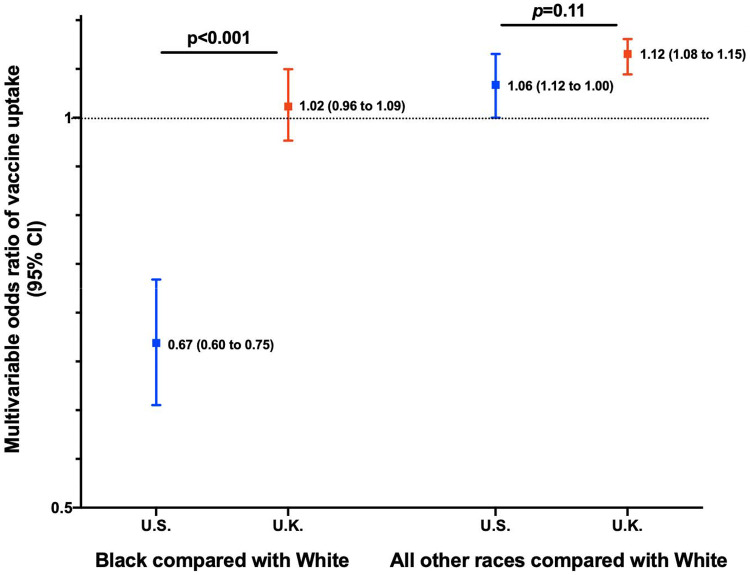
In the U.S. ( =87,388), compared to White non-Hispanic participants, the multivariable ORs of vaccine hesitancy were 3.15 (95% CI: 2.86 to 3.47) for Black participants, 1.42 (1.28 to 1.58) for Hispanic participants, 1.34 (1.18 to 1.52) for Asian participants, and 2.02 (1.70 to 2.39) for participants reporting more than one race/other. In the U.K. ( =1,254,294), racial and ethnic minorities had similarly elevated hesitancy: compared to White participants, their corresponding ORs were 2.84 (95% CI: 2.69 to 2.99) for Black participants, 1.66 (1.57 to 1.76) for South Asian participants, 1.84 (1.70 to 1.98) for Middle East/East Asian participants, and 1.48 (1.39 to 1.57) for participants reporting more than one race/other. Among U.S. participants, the OR of vaccine receipt was 0.71 (0.64 to 0.79) for Black participants, a disparity that persisted among individuals who specifically endorsed a willingness to obtain a vaccine. In contrast, disparities in uptake were not observed in the U.K.
COVID-19 vaccine hesitancy was greater among racial and ethnic minorities, and Black participants living in the U.S. were less likely to receive a vaccine than White participants. Lower uptake among Black participants in the U.S. during the initial vaccine rollout is attributable to both hesitancy and disparities in access.
种族和少数族裔群体受新冠病毒病(COVID-19)的影响尤为严重。在美国和英国基于人群的疫苗接种初始阶段,疫苗犹豫和获取机会有限可能导致疫苗接种率出现差异。
我们对参与基于智能手机的新冠症状研究的美国和英国参与者开展了一项队列研究(2020年3月24日至2021年2月16日)。我们使用逻辑回归来估计新冠疫苗犹豫(不确定/不愿意)和接种的比值比(OR)。
在美国(n = 87,388),与非西班牙裔白人参与者相比,黑人参与者疫苗犹豫态度的多变量OR为3.15(95%CI:2.86至3.47),西班牙裔参与者为1.42(1.28至1.58),亚裔参与者为1.34(1.18至1.52),报告属于多个种族/其他种族的参与者为2.02(1.70至2.39)。在英国(n = 1,254,294),少数族裔的疫苗犹豫态度同样较高:与白人参与者相比,黑人参与者的相应OR为2.84(95%CI:2.69至2.99),南亚参与者为1.66(1.57至1.76),中东/东亚参与者为1.84(1.70至1.98),报告属于多个种族/其他种族的参与者为1.48(1.39至1.57)。在美国参与者中,黑人参与者接种疫苗的OR为0.71(0.64至0.79),这种差异在明确表示愿意接种疫苗的个体中依然存在。相比之下,在英国未观察到接种率存在差异。
种族和少数族裔群体中新冠疫苗犹豫态度更为普遍,居住在美国的黑人参与者比白人参与者接种疫苗的可能性更低。在美国疫苗推出初期,黑人参与者接种率较低是由犹豫态度和获取机会差异共同导致的。