Meyers Primary Care Institute and University of Massachusetts Medical School, Worcester, Massachusetts (K.A.F., S.C., K.M.M.).
Meyers Primary Care Institute, Worcester, Massachusetts (S.J.B., H.F.).
Ann Intern Med. 2020 Dec 15;173(12):964-973. doi: 10.7326/M20-3569. Epub 2020 Sep 4.
Coronavirus disease 2019 (COVID-19) has rapidly instigated a global pandemic. Vaccine development is proceeding at an unprecedented pace. Once available, it will be important to maximize vaccine uptake and coverage.
To assess intent to be vaccinated against COVID-19 among a representative sample of adults in the United States and identify predictors of and reasons for vaccine hesitancy.
Cross-sectional survey, fielded from 16 through 20 April 2020.
Representative sample of adults residing in the United States.
Approximately 1000 adults drawn from the AmeriSpeak probability-based research panel, covering approximately 97% of the U.S. household population.
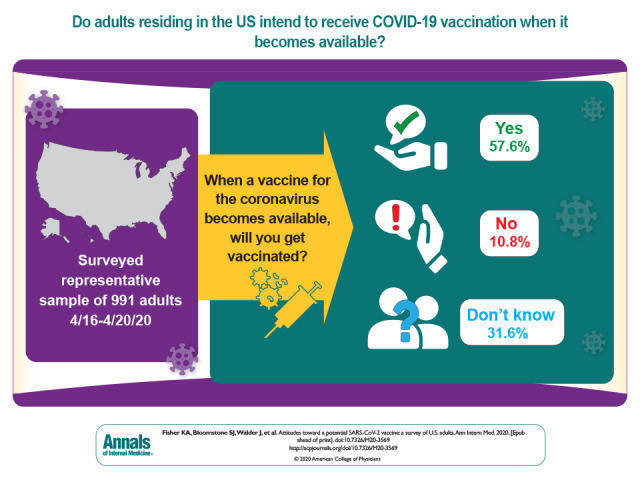
Intent to be vaccinated against COVID-19 was measured with the question, "When a vaccine for the coronavirus becomes available, will you get vaccinated?" Response options were "yes," "no," and "not sure." Participants who responded "no" or "not sure" were asked to provide a reason.
A total of 991 AmeriSpeak panel members responded. Overall, 57.6% of participants ( = 571) intended to be vaccinated, 31.6% ( = 313) were not sure, and 10.8% ( = 107) did not intend to be vaccinated. Factors independently associated with vaccine hesitancy (a response of "no" or "not sure") included younger age, Black race, lower educational attainment, and not having received the influenza vaccine in the prior year. Reasons for vaccine hesitancy included vaccine-specific concerns, a need for more information, antivaccine attitudes or beliefs, and a lack of trust.
Participants' intent to be vaccinated was explored before a vaccine was available and when the pandemic was affecting a narrower swath of the United States. Questions about specific information or factors that might increase vaccination acceptance were not included. The survey response rate was 16.1%.
This national survey, conducted during the coronavirus pandemic, revealed that approximately 3 in 10 adults were not sure they would accept vaccination and 1 in 10 did not intend to be vaccinated against COVID-19. Targeted and multipronged efforts will be needed to increase acceptance of a COVID-19 vaccine when one becomes available.
Agency for Healthcare Research and Quality.
2019 年冠状病毒病(COVID-19)迅速引发了全球大流行。疫苗的开发正在以前所未有的速度进行。一旦可用,重要的是要最大限度地提高疫苗的接种率和覆盖率。
评估美国代表性成年人样本中对 COVID-19 疫苗的接种意愿,并确定疫苗犹豫的预测因素和原因。
横断面调查,于 2020 年 4 月 16 日至 20 日进行。
美国居住的代表性成年人样本。
从 AmeriSpeak 基于概率的研究小组中抽取了约 1000 名成年人,涵盖了美国约 97%的家庭人口。
对 COVID-19 疫苗的接种意愿通过以下问题进行测量:“当冠状病毒疫苗可用时,您是否会接种疫苗?”答案选项为“是”、“否”和“不确定”。回答“否”或“不确定”的参与者被要求提供原因。
共有 991 名 AmeriSpeak 小组的成员做出了回应。总体而言,57.6%的参与者(571 人)表示打算接种疫苗,31.6%(313 人)不确定,10.8%(107 人)表示不打算接种疫苗。与疫苗犹豫(回答“否”或“不确定”)相关的独立因素包括年龄较小、黑人种族、较低的教育程度以及前一年未接种流感疫苗。疫苗犹豫的原因包括疫苗特定的担忧、需要更多信息、反疫苗态度或信念以及缺乏信任。
参与者的接种意愿是在疫苗可用之前和大流行影响范围较窄的美国时进行的探索。未包括有关特定信息或可能增加疫苗接种接受度的因素的问题。调查的回复率为 16.1%。
这项在冠状病毒大流行期间进行的全国性调查显示,约有 3 成人不确定他们是否会接受疫苗接种,而 1 成人表示不打算接种 COVID-19 疫苗。当 COVID-19 疫苗可用时,需要采取有针对性和多管齐下的措施来提高疫苗的接受度。
医疗保健研究与质量局。