Department of Cardiovascular Surgery, Erciyes Universitesi Tip Fakultesi, Kayseri, Turkey.
Department of Cardiovascular Surgery, Kayseri Egitim ve Arastirma Hastanesi, Kayseri, Turkey.
Braz J Cardiovasc Surg. 2022 Mar 10;37(1):55-64. doi: 10.21470/1678-9741-2020-0025.
Cardiopulmonary bypass (CPB) is associated with hyperlactatemia, which leads to adverse clinical outcomes. No study has examined the effect of different clamping techniques on postoperative hyperlactatemia (PHL). Thus, we aimed to evaluate the impact of two different techniques on PHL and the clinical outcomes in patients undergoing isolated coronary artery bypass surgery.
This retrospective study included 100 patients who underwent isolated CPB either with single clamp technique (SCT, n=47) or double clamp technique (DCT, n=53). Demographic and preoperative laboratory data, as well as operative features and arterial blood lactate levels at the onset and at the end of CPB, were collected from patient charts.
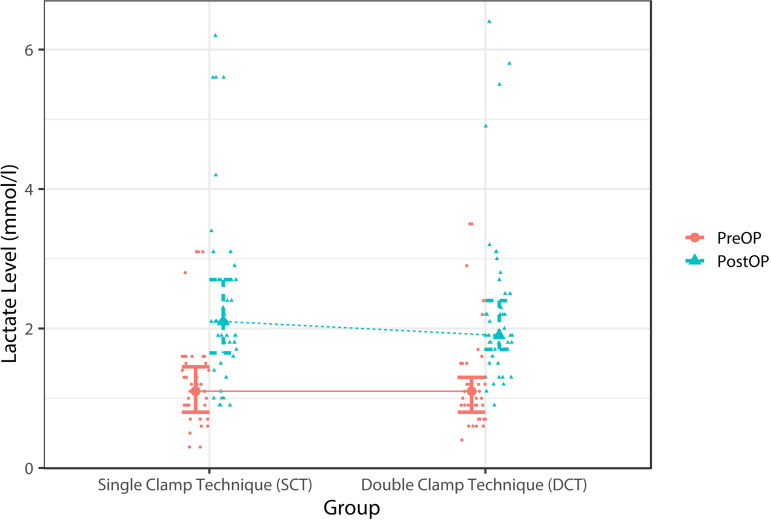
Blood lactate levels collected at the end of CPB did not differ significantly between groups whereas intraoperative lactate increased significantly in both groups (P<0.005). PHL developed in 16 patients (32%). There was no meaningful difference in SCT and DCT in this regard. Left internal mammary artery was used more frequently in the DCT group than in the SCT group. While the cross-clamp time was significantly longer in the SCT group, there was no difference regarding CPB time. Among postoperative complications, only the incidence of stroke was significantly higher in the DCT group than in the SCT group (10.6% vs. 0%, P=0.020). CPB time, cross-clamp time and numbers of proximal saphenous graft and distal anastomosis showed a significant positive correlation with the postoperative lactate level. In the regression analysis, CPB time emerged as the only independent predictor of PHL (OR 1.04, CI 95% 1.01-1.07, P=0.011).
There was no difference in postoperative blood lactate levels between SCT and DCT groups.
体外循环(CPB)与高乳酸血症有关,后者导致不良的临床结局。尚无研究探讨不同夹闭技术对术后高乳酸血症(PHL)的影响。因此,我们旨在评估两种不同技术对行单纯冠状动脉旁路移植术患者的 PHL 及临床结局的影响。
本回顾性研究纳入了 100 例行 CPB 的患者,分别采用单钳夹技术(SCT,n=47)或双钳夹技术(DCT,n=53)。从病历中收集了患者的人口统计学和术前实验室数据,以及手术特征和 CPB 开始和结束时的动脉血乳酸水平。
CPB 结束时两组间的血乳酸水平无显著差异,而两组的术中乳酸均显著升高(P<0.005)。16 例患者(32%)发生 PHL。在这方面,SCT 和 DCT 之间无明显差异。DCT 组比 SCT 组更频繁地使用左内乳动脉。虽然 SCT 组的体外循环时间显著延长,但 CPB 时间无差异。术后并发症中,只有 DCT 组的卒中发生率显著高于 SCT 组(10.6% vs. 0%,P=0.020)。CPB 时间、体外循环时间以及近端大隐静脉移植物和远端吻合口的数量与术后乳酸水平呈显著正相关。在回归分析中,CPB 时间是 PHL 的唯一独立预测因子(OR 1.04,95%CI 1.01-1.07,P=0.011)。
SCT 和 DCT 组间术后血乳酸水平无差异。