Chen Shiqi, Wang Kan, Wang Chen, Fan Zhengfeng, Yan Lizhao, Wang Yixuan, Liu Fayuan, Shi JiaWei, Guo QianNan, Dong NianGuo
Department of Cardiovascular Surgery, Union Hospital, Tongji Medical College, Huazhong University of Science and Technology, Wuhan, Hubei, China.
Department of Hand Surgery, Union Hospital, Tongji Medical College, Huazhong University of Science and Technology, Wuhan, Hubei, China.
Front Cardiovasc Med. 2024 Dec 13;11:1448740. doi: 10.3389/fcvm.2024.1448740. eCollection 2024.
Coronary artery bypass grafting (CABG) surgery has been a widely accepted method for treating coronary artery disease. However, its postoperative complications can have a significant effect on long-term patient outcomes. A retrospective study was conducted to identify before and after surgery that contribute to postoperative stroke in patients undergoing CABG, and to develop predictive models and recommendations for single-factor thresholds.
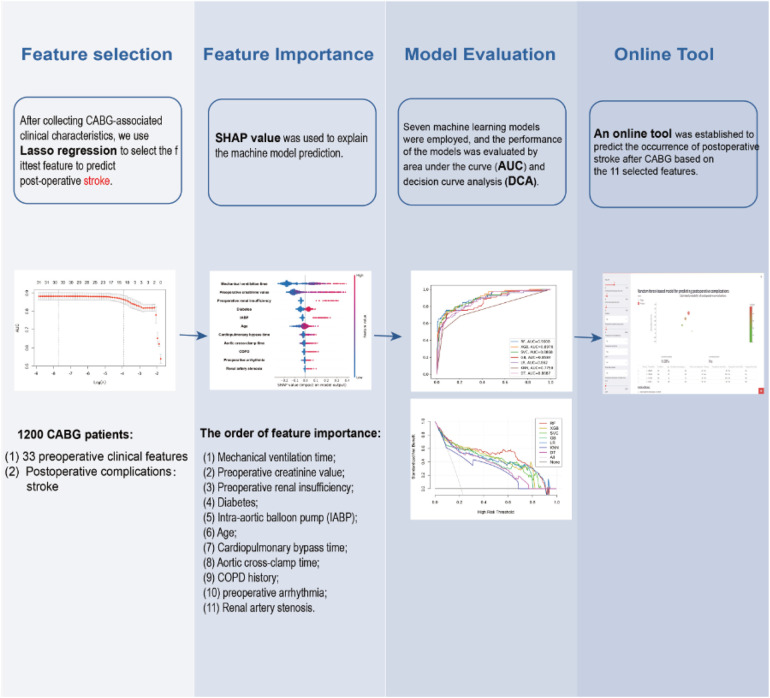
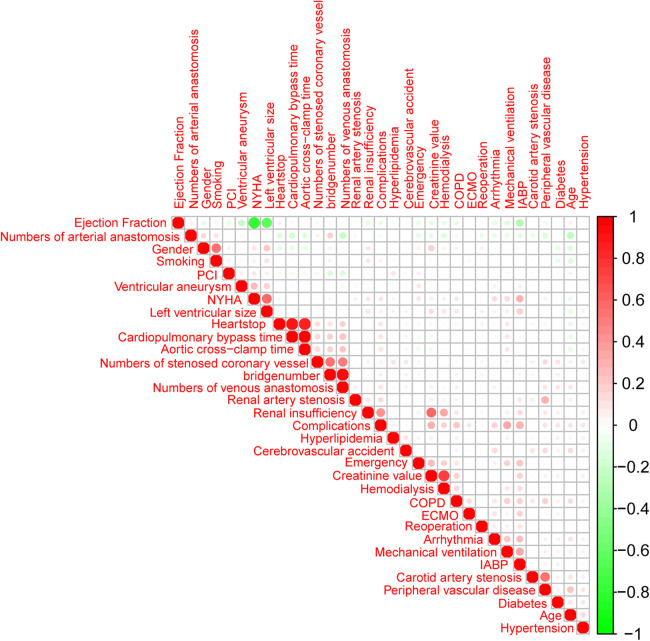
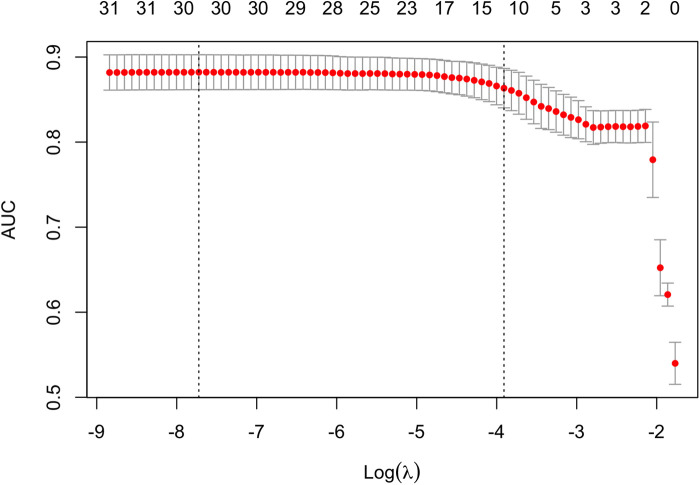
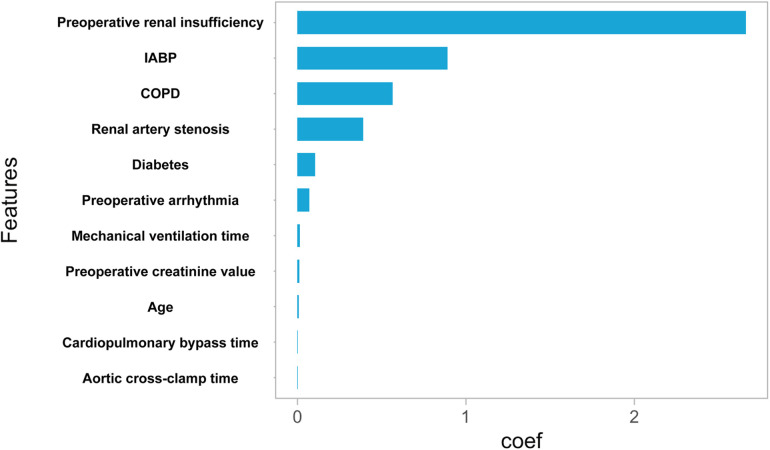
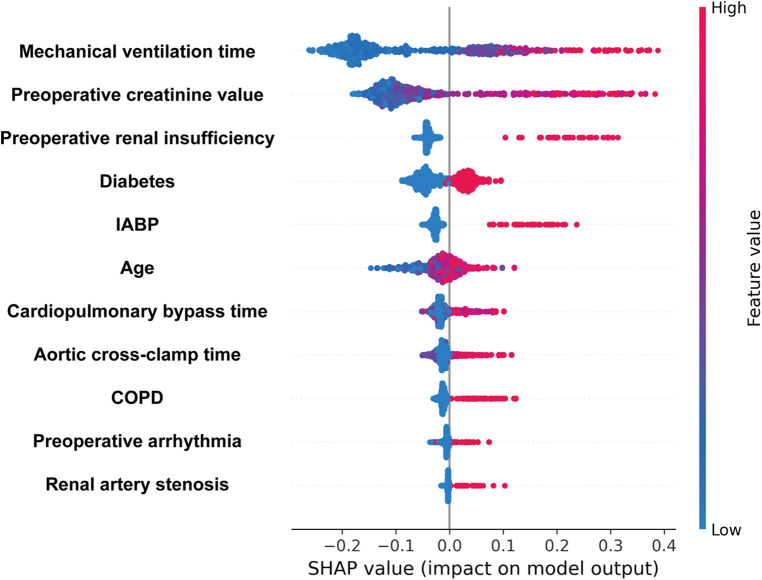
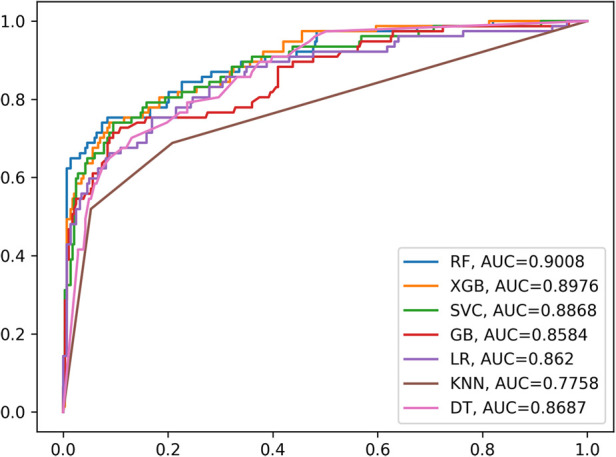
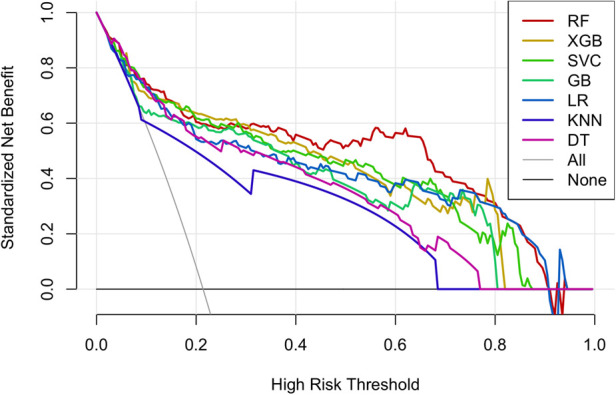
We utilized data from 1,200 patients who undergone CABG surgery at the Wuhan Union Hospital from 2016 to 2022, which was divided into a training group ( = 841) and a test group ( = 359). 33 preoperative clinical features and 4 postoperative complications were collected in each group. LASSO is a regression analysis method that performs both variable selection and regularization to enhance model prediction accuracy and interpretability. The LASSO method was used to verify the collected features, and the SHAP value was used to explain the machine model prediction. Six machine learning models were employed, and the performance of the models was evaluated by area under the curve (AUC) and decision curve analysis (DCA). AUC, or area under the receiver operating characteristic curve, quantifies the ability of a model to distinguish between positive and negative outcomes. Finally, this study provided a convenient online tool for predicting CABG patient post-operative stroke.
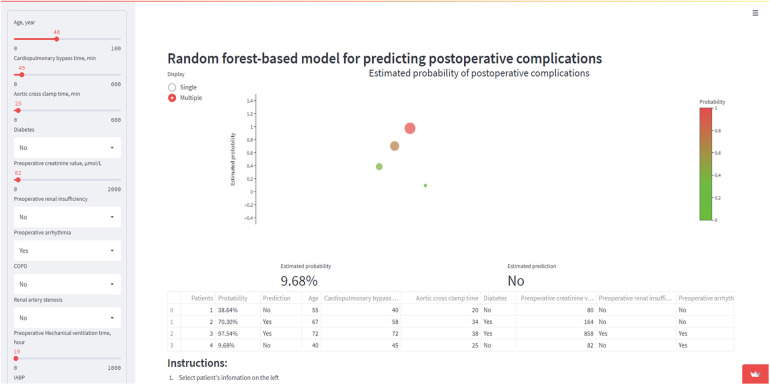
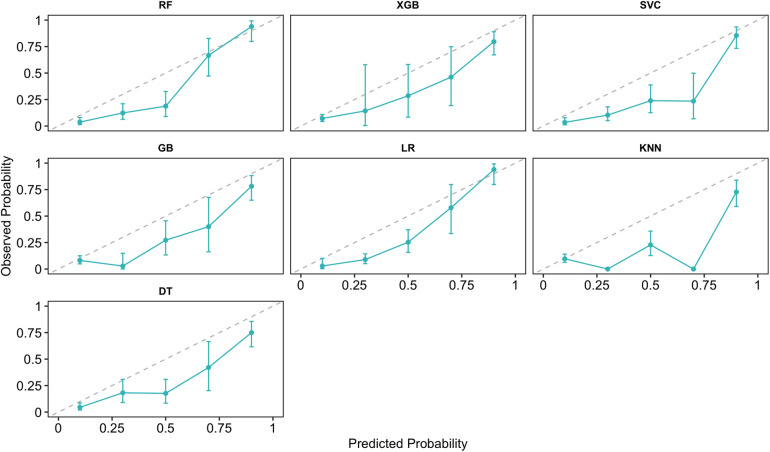
The study included a combined total of 1,200 patients in both the development and validation cohorts. The average age of the participants in the study was 60.26 years. 910 (75.8%) of the patients were men, and 153 (12.8%) patients were in NYHA class III and IV. Subsequently, LASSO model was used to identify 11 important features, which were mechanical ventilation time, preoperative creatinine value, preoperative renal insufficiency, diabetes, the use of an intra-aortic balloon pump (IABP), age, Cardiopulmonary bypass time, Aortic cross-clamp time, Chronic Obstructive Pulmonary Disease (COPD) history, preoperative arrhythmia and Renal artery stenosis in descending order of importance according to the SHAP value. According to the analysis of receiver operating characteristic (ROC) curve, AUC, DCA and sensitivity, all seven machine learning models perform well and random forest (RF) machine model was found to perform best (AUC-ROC = 0.9008, Accuracy: 0.9008, Precision: 0.6905; Recall: 0.7532, F1: 0.7205). Finally, an online tool was established to predict the occurrence of stroke after CABG based on the 11 selected features.
Mechanical ventilation time, preoperative creatinine value, preoperative renal insufficiency, diabetes, the use of an intra-aortic balloon pump (IABP), age, Cardiopulmonary bypass time, Aortic cross-clamp time, Chronic Obstructive Pulmonary Disease (COPD) history, preoperative arrhythmia and Renal artery stenosis in the preoperative and intraoperative period was associated with significant postoperative stroke risk, and these factors can be identified and modeled to assist in implementing proactive measures to protect the brain in high-risk patients after surgery.
冠状动脉旁路移植术(CABG)一直是治疗冠状动脉疾病广泛接受的方法。然而,其术后并发症会对患者长期预后产生重大影响。进行了一项回顾性研究,以确定冠状动脉旁路移植术患者术前和术后导致术后中风的因素,并建立单因素阈值的预测模型和建议。
我们利用了2016年至2022年在武汉协和医院接受冠状动脉旁路移植术的1200例患者的数据,分为训练组(n = 841)和测试组(n = 359)。每组收集了33项术前临床特征和4项术后并发症。LASSO是一种回归分析方法,它同时进行变量选择和正则化,以提高模型预测准确性和可解释性。使用LASSO方法验证收集到的特征,并使用SHAP值解释机器模型预测。采用了六种机器学习模型,并通过曲线下面积(AUC)和决策曲线分析(DCA)评估模型性能。AUC,即受试者工作特征曲线下面积,量化了模型区分阳性和阴性结果的能力。最后,本研究提供了一个方便的在线工具来预测冠状动脉旁路移植术患者术后中风。
该研究在开发和验证队列中总共纳入了1200例患者。研究参与者的平均年龄为60.26岁。910例(75.8%)患者为男性,153例(12.8%)患者为纽约心脏协会III级和IV级。随后,使用LASSO模型识别出11个重要特征,根据SHAP值按重要性降序排列依次为机械通气时间、术前肌酐值、术前肾功能不全、糖尿病、主动脉内球囊反搏(IABP)的使用、年龄、体外循环时间、主动脉阻断时间、慢性阻塞性肺疾病(COPD)病史、术前心律失常和肾动脉狭窄。根据受试者工作特征(ROC)曲线、AUC、DCA和敏感性分析,所有七个机器学习模型表现良好,发现随机森林(RF)机器模型表现最佳(AUC-ROC = 0.9008,准确性:0.9008,精确率:0.6905;召回率:0.7532,F1:0.7205)。最后,基于选定的11个特征建立了一个在线工具来预测冠状动脉旁路移植术后中风的发生。
术前和术中的机械通气时间、术前肌酐值、术前肾功能不全、糖尿病、主动脉内球囊反搏(IABP)的使用、年龄、体外循环时间、主动脉阻断时间、慢性阻塞性肺疾病(COPD)病史、术前心律失常和肾动脉狭窄与术后中风风险显著相关,这些因素可以被识别并建模,以协助对术后高危患者实施保护大脑的积极措施。