From the Department of Psychology (Radin, Stanton, Bower), Schools of Medicine and Public Health (Ganz), Jonsson Comprehensive Cancer Center (Ganz, Van Dyk, Stanton, Bower), Department of Psychiatry and Biobehavioral Sciences (Van Dyk, Stanton, Bower), and Cousins Center for Psychoneuroimmunology, Semel Institute for Neuroscience and Human Behavior (Stanton, Bower), University of California, Los Angeles, Los Angeles, California.
Psychosom Med. 2021 Apr 1;83(3):291-299. doi: 10.1097/PSY.0000000000000926.
Cognitive difficulties are a common complaint among patients with breast cancer and may adversely affect psychological well-being. In particular, problems with executive functioning (EF) may interfere with coping, which is known to influence depressive symptoms. The current study was designed to examine correlations between EF, coping, and depressive symptoms in breast cancer survivors and to longitudinally test the hypothesis that coping mediates the relationship between EF and depressive symptoms.
Participants included 171 women with early-stage breast cancer assessed at the end of primary treatment with surgery, radiation, and/or chemotherapy and at 6 months, 1 year, and 2 years after treatment follow-ups as part of the Mind-Body Study. Participants completed questionnaires to assess subjective EF, approach and avoidant coping, and depressive symptoms, and neuropsychological testing was conducted to assess objective EF. Bivariate correlations were used to examine associations between EF, coping, and depressive symptoms. Mediation analyses were conducted using a bootstrapping approach (PROCESS).
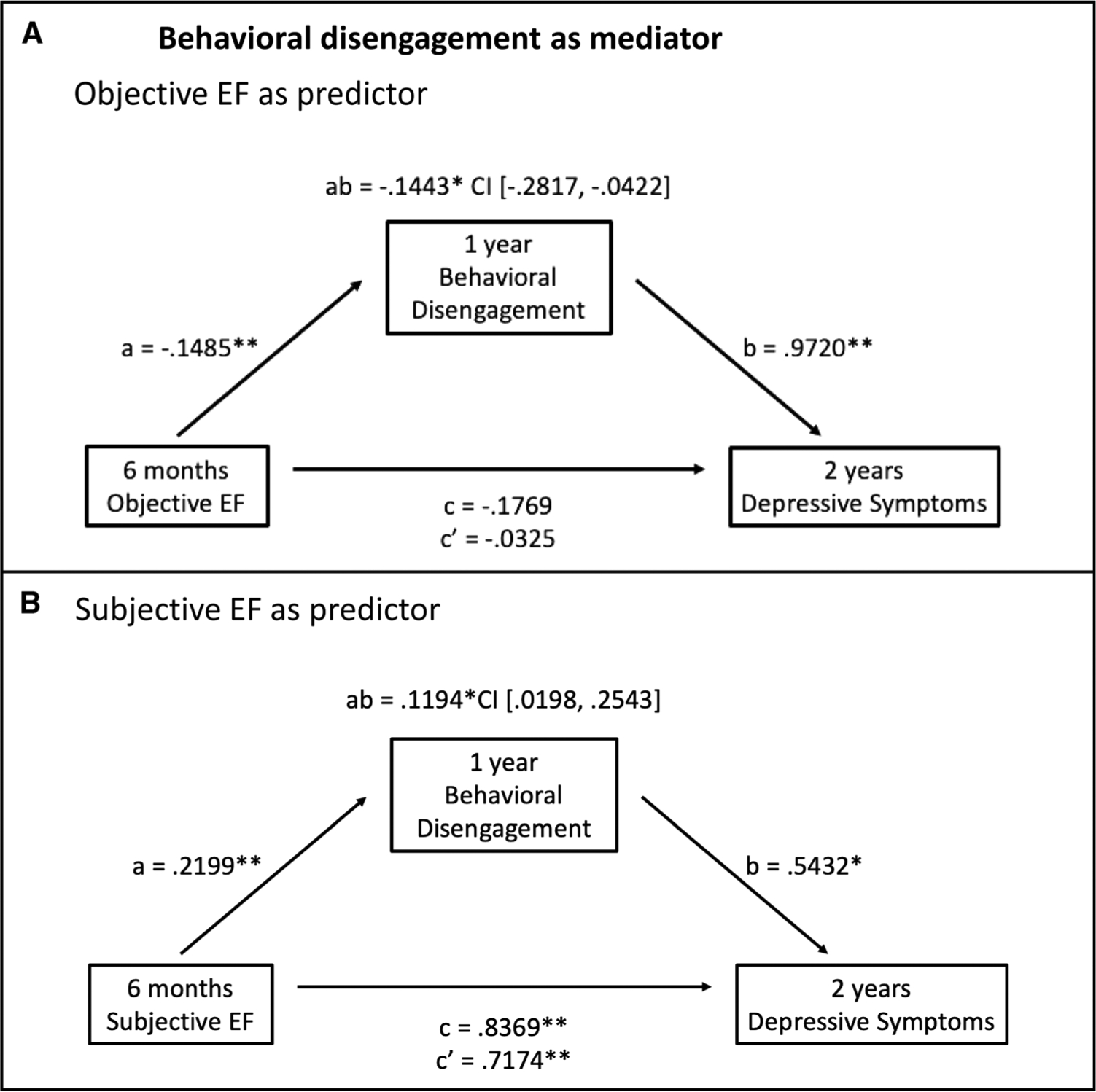
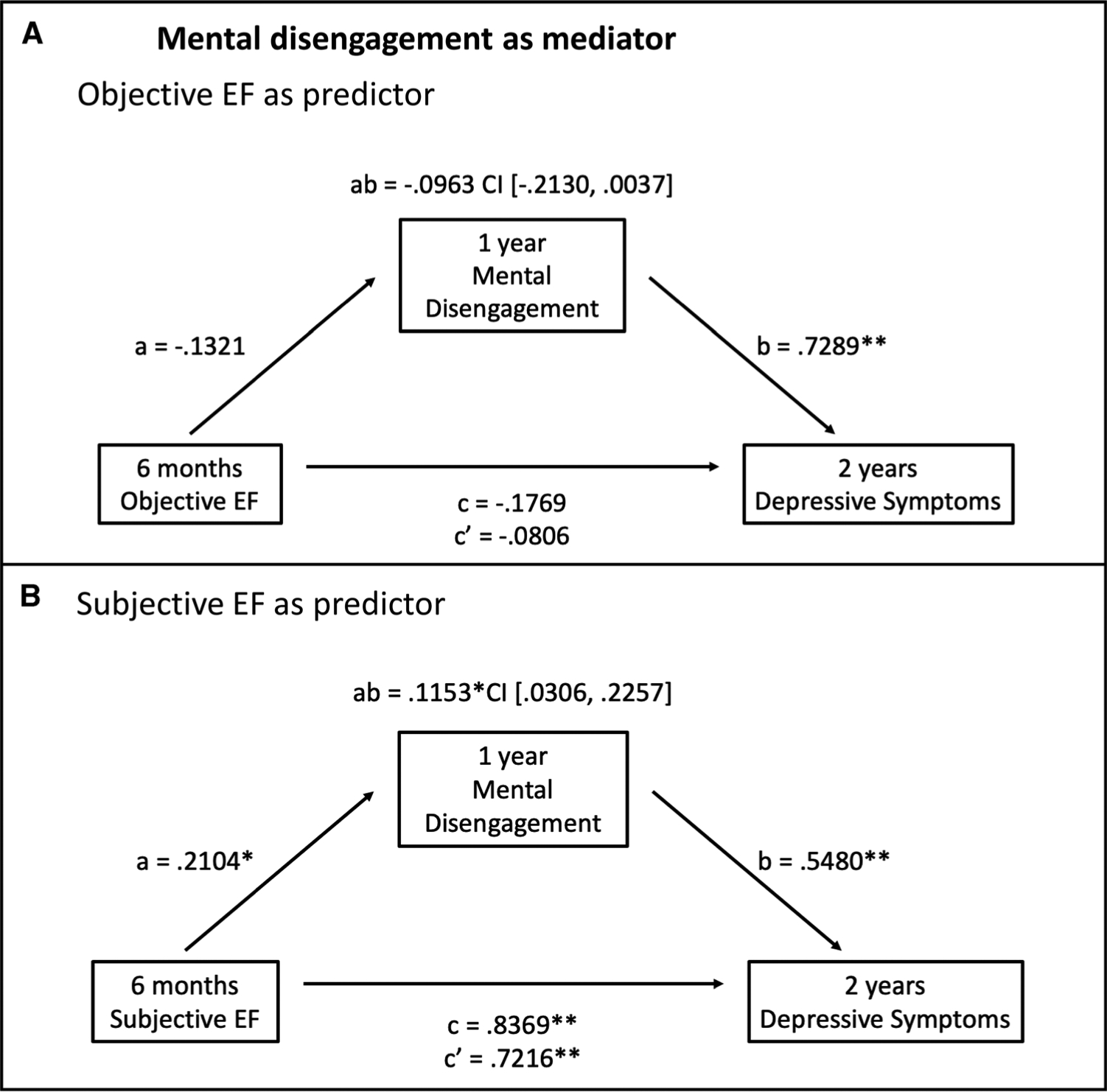
At 1 year after treatment, objective and subjective EFs were correlated with avoidant coping (r = -0.172 [p = .024] and r = 0.297 [p < .001], respectively). In longitudinal analyses, use of the avoidant strategy behavioral disengagement at 1 year mediated the association between objective (95% bootstrap confidence interval = -0.282 to -0.042) and subjective (95% bootstrap confidence interval = 0.020 to 0.254) EFs at 6 months and depressive symptoms at 2 years.
This study highlights how problems with EF during survivorship are associated with avoidant coping and depressive symptoms. Thus, these findings identify potential cognitive and affective targets for depression intervention in this population.
认知困难是乳腺癌患者常见的抱怨,可能会对心理健康产生不利影响。特别是,执行功能(EF)问题可能会干扰应对方式,而应对方式已知会影响抑郁症状。本研究旨在检查乳腺癌幸存者的 EF、应对方式和抑郁症状之间的相关性,并通过纵向测试假设,即应对方式在 EF 和抑郁症状之间的关系中起中介作用。
参与者包括 171 名早期乳腺癌患者,在主要治疗(手术、放疗和/或化疗)结束时以及治疗后 6 个月、1 年和 2 年作为 Mind-Body 研究的一部分进行评估。参与者完成了问卷,以评估主观 EF、趋近和回避应对以及抑郁症状,并且进行了神经心理测试以评估客观 EF。使用双变量相关分析来检查 EF、应对方式和抑郁症状之间的关联。使用 bootstrap 方法(PROCESS)进行中介分析。
在治疗后 1 年,客观和主观 EF 与回避应对相关(r = -0.172,p =.024 和 r = 0.297,p <.001)。在纵向分析中,1 年时回避策略行为脱离的使用在客观(95% bootstrap 置信区间 = -0.282 至 -0.042)和主观 EF(95% bootstrap 置信区间 = 0.020 至 0.254)与 6 个月时的抑郁症状以及 2 年时的抑郁症状之间存在关联。
这项研究强调了生存期间 EF 问题如何与回避应对和抑郁症状相关。因此,这些发现确定了在该人群中针对抑郁干预的潜在认知和情感目标。