• 文献检索
  • 文档翻译
  • 深度研究
  • 学术资讯
  • Suppr Zotero 插件Zotero 插件
  • 邀请有礼
  • 套餐&价格
  • 历史记录
应用&插件
Suppr Zotero 插件Zotero 插件浏览器插件Mac 客户端Windows 客户端微信小程序
定价
高级版会员购买积分包购买API积分包
服务
文献检索文档翻译深度研究API 文档MCP 服务
关于我们
关于 Suppr公司介绍联系我们用户协议隐私条款
关注我们

Suppr 超能文献

核心技术专利:CN118964589B侵权必究
粤ICP备2023148730 号-1Suppr @ 2026

文献检索

告别复杂PubMed语法,用中文像聊天一样搜索,搜遍4000万医学文献。AI智能推荐,让科研检索更轻松。

立即免费搜索

文件翻译

保留排版,准确专业,支持PDF/Word/PPT等文件格式,支持 12+语言互译。

免费翻译文档

深度研究

AI帮你快速写综述,25分钟生成高质量综述,智能提取关键信息,辅助科研写作。

立即免费体验

miR-144/451a 簇的表观遗传沉默通过旁分泌 HGF/MIF 介导的 TAM 重塑促进 HCC 进展。

Epigenetic silencing of miR-144/451a cluster contributes to HCC progression via paracrine HGF/MIF-mediated TAM remodeling.

机构信息

State Key Laboratory of Cancer Biology, Department of Medical Genetics and Development Biology, Fourth Military Medical University, Xi'an, 710032, China.

State Key Laboratory of Cancer Biology, Department of Biochemistry and Molecular Biology, School of Basic Medicine, Fourth Military Medical University, No.169 Changlexi Road, Xi'an, 710032, China.

出版信息

Mol Cancer. 2021 Mar 3;20(1):46. doi: 10.1186/s12943-021-01343-5.

DOI:10.1186/s12943-021-01343-5
PMID:33658044
原文链接:https://pmc.ncbi.nlm.nih.gov/articles/PMC7927270/
Abstract

BACKGROUND & AIMS: Hepatocellular carcinoma (HCC) is among the malignancies with the highest mortality. The key regulators and their interactive network in HCC pathogenesis remain unclear. Along with genetic mutations, aberrant epigenetic paradigms, including deregulated microRNAs (miRNAs), exert profound impacts on hepatocyte transformation and tumor microenvironment remodeling; however, the underlying mechanisms are largely uncharacterized.

METHODS

We performed RNA sequencing on HCC specimens and bioinformatic analyses to identify tumor-associated miRNAs. The miRNA functional targets and their effects on tumor-infiltrating immune cells were investigated. The upstream events, particularly the epigenetic mechanisms responsible for miRNA deregulation in HCC, were explored.

RESULTS

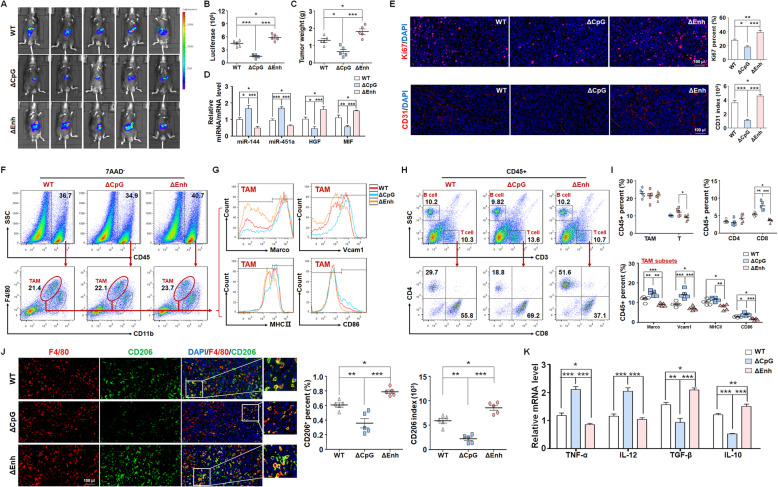
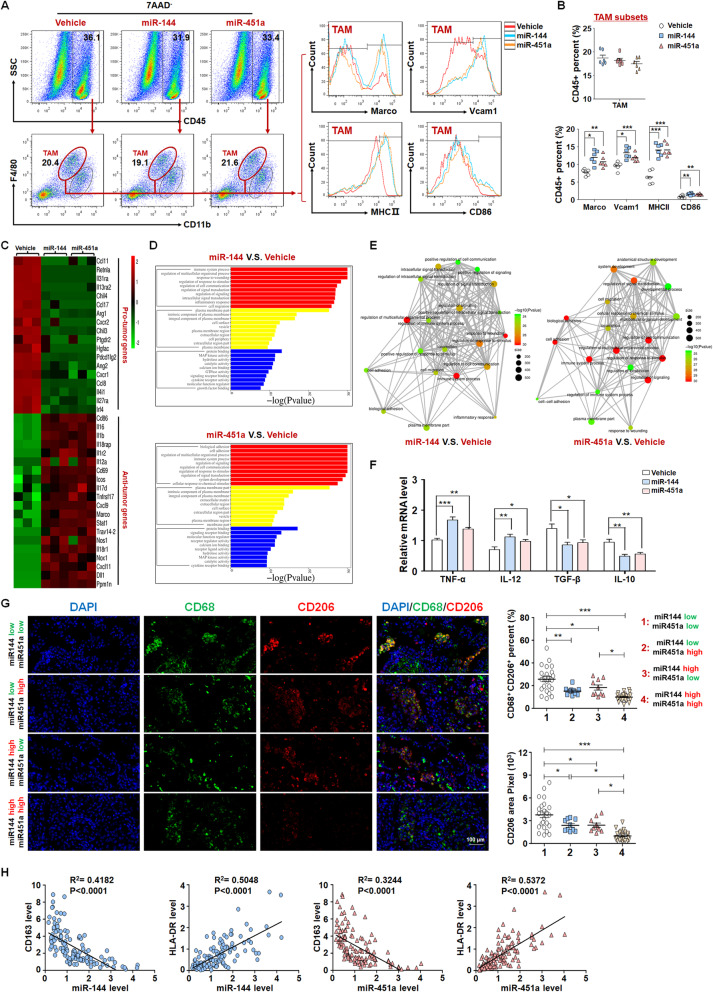
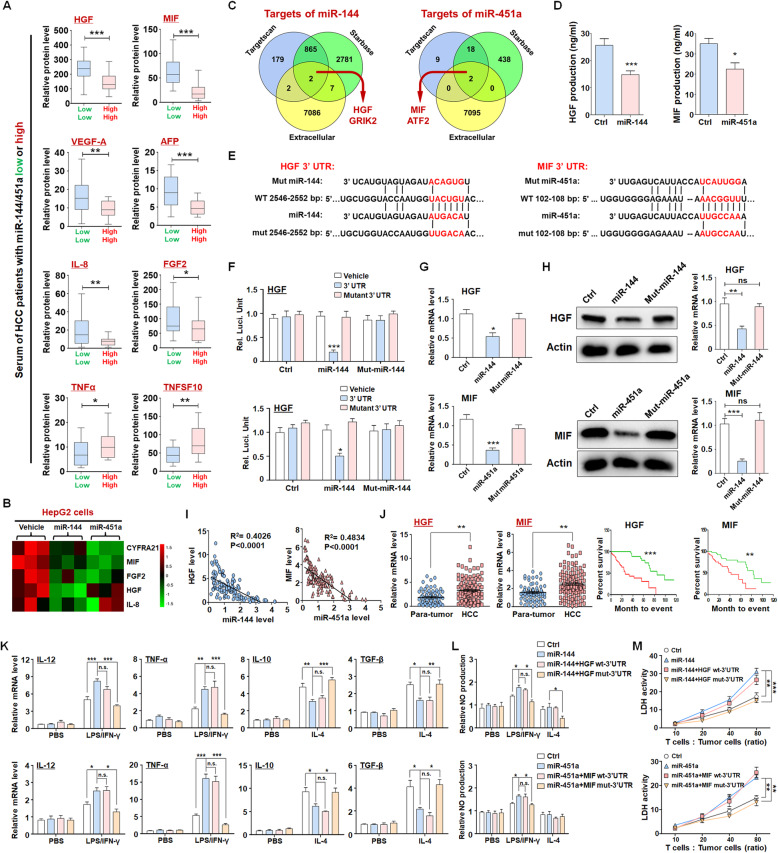
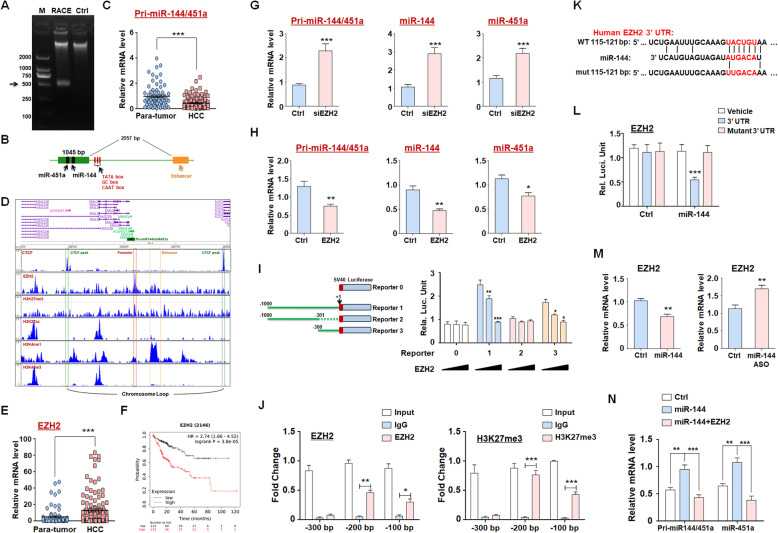
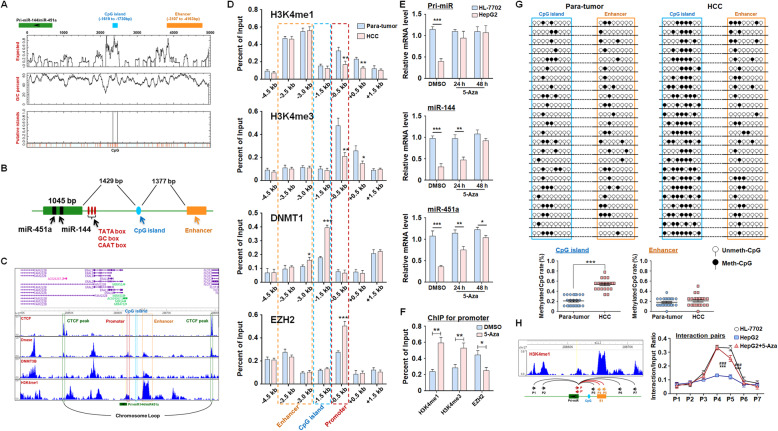
The miR-144/miR-451a cluster was downregulated in HCC and predicted a better HCC patient prognosis. These miRNAs promoted macrophage M1 polarization and antitumor activity by targeting hepatocyte growth factor (HGF) and macrophage migration inhibitory factor (MIF). The miR-144/miR-451a cluster and EZH2, the catalytic subunit of polycomb repressive complex (PRC2), formed a feedback circuit in which miR-144 targeted EZH2 and PRC2 epigenetically repressed the miRNA genes via histone H3K27 methylation of the promoter. The miRNA cluster was coordinately silenced by distal enhancer hypermethylation, disrupting chromatin loop formation and enhancer-promoter interactions. Clinical examinations indicated that methylation of this chromatin region is a potential HCC biomarker.

CONCLUSIONS

Our study revealed novel mechanisms underlying miR-144/miR-451a cluster deregulation and the crosstalk between malignant cells and tumor-associated macrophages (TAMs) in HCC, providing new insights into HCC pathogenesis and diagnostic strategies.

摘要

背景与目的

肝细胞癌(HCC)是死亡率最高的恶性肿瘤之一。HCC 发病机制中的关键调控因子及其相互作用网络仍不清楚。除了遗传突变,异常的表观遗传模式,包括失调的 microRNAs(miRNAs),对肝细胞转化和肿瘤微环境重塑有深远影响;然而,其潜在机制在很大程度上仍未被阐明。

方法

我们对 HCC 标本进行了 RNA 测序和生物信息学分析,以鉴定肿瘤相关的 miRNAs。研究了 miRNA 的功能靶标及其对肿瘤浸润免疫细胞的影响。探讨了上游事件,特别是负责 HCC 中 miRNA 失调的表观遗传机制。

结果

miR-144/miR-451a 簇在 HCC 中下调,预测 HCC 患者预后较好。这些 miRNA 通过靶向肝细胞生长因子(HGF)和巨噬细胞迁移抑制因子(MIF)促进巨噬细胞 M1 极化和抗肿瘤活性。miR-144/miR-451a 簇和 EZH2(多梳抑制复合物(PRC2)的催化亚基)形成了一个反馈回路,其中 miR-144 靶向 EZH2 和 PRC2,通过启动子上组蛋白 H3K27 的甲基化来表观遗传抑制 miRNA 基因。miRNA 簇通过远端增强子超甲基化被协调沉默,破坏染色质环形成和增强子-启动子相互作用。临床检查表明,该染色质区域的甲基化是 HCC 的一个潜在生物标志物。

结论

本研究揭示了 miR-144/miR-451a 簇失调的新机制以及 HCC 中恶性细胞与肿瘤相关巨噬细胞(TAMs)之间的串扰,为 HCC 的发病机制和诊断策略提供了新的见解。

https://cdn.ncbi.nlm.nih.gov/pmc/blobs/bbc3/7927270/471896fd09e0/12943_2021_1343_Fig6_HTML.jpg
https://cdn.ncbi.nlm.nih.gov/pmc/blobs/bbc3/7927270/3d6e203d06d9/12943_2021_1343_Fig1_HTML.jpg
https://cdn.ncbi.nlm.nih.gov/pmc/blobs/bbc3/7927270/0990d4626709/12943_2021_1343_Fig2_HTML.jpg
https://cdn.ncbi.nlm.nih.gov/pmc/blobs/bbc3/7927270/ca175cf5239a/12943_2021_1343_Fig3_HTML.jpg
https://cdn.ncbi.nlm.nih.gov/pmc/blobs/bbc3/7927270/8cc64c0f9bbd/12943_2021_1343_Fig4_HTML.jpg
https://cdn.ncbi.nlm.nih.gov/pmc/blobs/bbc3/7927270/c7a30a81b398/12943_2021_1343_Fig5_HTML.jpg
https://cdn.ncbi.nlm.nih.gov/pmc/blobs/bbc3/7927270/471896fd09e0/12943_2021_1343_Fig6_HTML.jpg
https://cdn.ncbi.nlm.nih.gov/pmc/blobs/bbc3/7927270/3d6e203d06d9/12943_2021_1343_Fig1_HTML.jpg
https://cdn.ncbi.nlm.nih.gov/pmc/blobs/bbc3/7927270/0990d4626709/12943_2021_1343_Fig2_HTML.jpg
https://cdn.ncbi.nlm.nih.gov/pmc/blobs/bbc3/7927270/ca175cf5239a/12943_2021_1343_Fig3_HTML.jpg
https://cdn.ncbi.nlm.nih.gov/pmc/blobs/bbc3/7927270/8cc64c0f9bbd/12943_2021_1343_Fig4_HTML.jpg
https://cdn.ncbi.nlm.nih.gov/pmc/blobs/bbc3/7927270/c7a30a81b398/12943_2021_1343_Fig5_HTML.jpg
https://cdn.ncbi.nlm.nih.gov/pmc/blobs/bbc3/7927270/471896fd09e0/12943_2021_1343_Fig6_HTML.jpg

相似文献

1
Epigenetic silencing of miR-144/451a cluster contributes to HCC progression via paracrine HGF/MIF-mediated TAM remodeling.miR-144/451a 簇的表观遗传沉默通过旁分泌 HGF/MIF 介导的 TAM 重塑促进 HCC 进展。
Mol Cancer. 2021 Mar 3;20(1):46. doi: 10.1186/s12943-021-01343-5.
2
Enhancer of zeste homolog 2 epigenetically silences multiple tumor suppressor microRNAs to promote liver cancer metastasis.增强子结合锌指蛋白 2 通过表观遗传沉默多个肿瘤抑制 microRNA 促进肝癌转移。
Hepatology. 2012 Aug;56(2):622-31. doi: 10.1002/hep.25679. Epub 2012 Jun 11.
3
Exosomal miR-451a Functions as a Tumor Suppressor in Hepatocellular Carcinoma by Targeting LPIN1.外泌体miR-451a通过靶向LPIN1在肝细胞癌中发挥肿瘤抑制作用。
Cell Physiol Biochem. 2019;53(1):19-35. doi: 10.33594/000000118.
4
Long noncoding RNA GIHCG promotes hepatocellular carcinoma progression through epigenetically regulating miR-200b/a/429.长链非编码RNA GIHCG通过表观遗传调控miR-200b/a/429促进肝细胞癌进展。
J Mol Med (Berl). 2016 Nov;94(11):1281-1296. doi: 10.1007/s00109-016-1442-z. Epub 2016 Jul 5.
5
MiR-451a suppresses cell proliferation, metastasis and EMT via targeting YWHAZ in hepatocellular carcinoma.微小RNA-451a通过靶向14-3-3ζ抑制肝癌细胞的增殖、转移和上皮-间质转化。
Eur Rev Med Pharmacol Sci. 2019 Jun;23(12):5158-5167. doi: 10.26355/eurrev_201906_18180.
6
MicroRNA-608 acts as a prognostic marker and inhibits the cell proliferation in hepatocellular carcinoma by macrophage migration inhibitory factor.微小RNA-608作为一种预后标志物,通过巨噬细胞移动抑制因子抑制肝细胞癌的细胞增殖。
Tumour Biol. 2016 Mar;37(3):3823-30. doi: 10.1007/s13277-015-4213-5. Epub 2015 Oct 16.
7
MicroRNA-26a is a key regulon that inhibits progression and metastasis of c-Myc/EZH2 double high advanced hepatocellular carcinoma.miRNA-26a 是一个关键的调控因子,可抑制 c-Myc/EZH2 双高的晚期肝癌的进展和转移。
Cancer Lett. 2018 Jul 10;426:98-108. doi: 10.1016/j.canlet.2018.04.005. Epub 2018 Apr 11.
8
EZH2 promotes hepatocellular carcinoma progression through modulating miR-22/galectin-9 axis.EZH2 通过调节 miR-22/galectin-9 轴促进肝癌进展。
J Exp Clin Cancer Res. 2018 Jan 9;37(1):3. doi: 10.1186/s13046-017-0670-6.
9
A double-negative feedback loop between EZH2 and miR-26a regulates tumor cell growth in hepatocellular carcinoma.EZH2 和 miR-26a 之间的负反馈环调节肝细胞癌中的肿瘤细胞生长。
Int J Oncol. 2016 Mar;48(3):1195-204. doi: 10.3892/ijo.2016.3336. Epub 2016 Jan 13.
10
MicroRNA-101 inhibits human hepatocellular carcinoma progression through EZH2 downregulation and increased cytostatic drug sensitivity.微小 RNA-101 通过下调 EZH2 并增加细胞抑制性药物敏感性抑制人肝癌进展。
J Hepatol. 2014 Mar;60(3):590-8. doi: 10.1016/j.jhep.2013.10.028. Epub 2013 Nov 6.

引用本文的文献

1
Targeting tumor-associated macrophages to overcome immune checkpoint inhibitor resistance in hepatocellular carcinoma.靶向肿瘤相关巨噬细胞以克服肝细胞癌中免疫检查点抑制剂耐药性
J Exp Clin Cancer Res. 2025 Aug 5;44(1):227. doi: 10.1186/s13046-025-03490-9.
2
Macrophage Signaling Pathways in Health and Disease: From Bench to Bedside Applications.健康与疾病中的巨噬细胞信号通路:从实验室到临床应用
MedComm (2020). 2025 Jun 16;6(7):e70256. doi: 10.1002/mco2.70256. eCollection 2025 Jul.
3
MiR-451a attenuates hepatic steatosis and hepatitis C virus replication by targeting glycerol kinase.

本文引用的文献

1
miR‑144‑3p inhibits tumor cell growth and invasion in oral squamous cell carcinoma through the downregulation of the oncogenic gene, EZH2.miR-144-3p 通过下调致癌基因 EZH2 抑制口腔鳞状细胞癌中的肿瘤细胞生长和侵袭。
Int J Mol Med. 2020 Aug;46(2):828-838. doi: 10.3892/ijmm.2020.4638. Epub 2020 Jun 11.
2
Epidemiology of Hepatocellular Carcinoma.肝细胞癌的流行病学
Hepatology. 2021 Jan;73 Suppl 1(Suppl 1):4-13. doi: 10.1002/hep.31288. Epub 2020 Nov 24.
3
The Crosstalk between Tumor Cells and the Microenvironment in Hepatocellular Carcinoma: The Role of Exosomal microRNAs and their Clinical Implications.
微小RNA-451a通过靶向甘油激酶减轻肝脂肪变性和丙型肝炎病毒复制。
J Transl Med. 2025 Mar 13;23(1):322. doi: 10.1186/s12967-025-06286-9.
4
The epigenetic basis of hepatocellular carcinoma - mechanisms and potential directions for biomarkers and therapeutics.肝细胞癌的表观遗传基础——生物标志物与治疗方法的机制及潜在方向
Br J Cancer. 2025 Jun;132(10):869-887. doi: 10.1038/s41416-025-02969-8. Epub 2025 Mar 8.
5
miRNAs in HCC, pathogenesis, and targets.肝癌中的微小RNA、发病机制及靶点。
Hepatology. 2024 Nov 29. doi: 10.1097/HEP.0000000000001177.
6
Epigenetic modifications involving ncRNAs in digestive system cancers: focus on histone modification.消化道癌症中涉及 ncRNAs 的表观遗传修饰:聚焦于组蛋白修饰。
Clin Epigenetics. 2024 Nov 19;16(1):162. doi: 10.1186/s13148-024-01773-0.
7
MicroRNAs in Hepatocellular Carcinoma: Insights into Regulatory Mechanisms, Clinical Significance, and Therapeutic Potential.肝细胞癌中的微小RNA:对调控机制、临床意义及治疗潜力的见解
Cancer Manag Res. 2024 Oct 19;16:1491-1507. doi: 10.2147/CMAR.S477698. eCollection 2024.
8
Exploring the role of EZH2 modulation in shaping the tumor microenvironment.探索EZH2调控在塑造肿瘤微环境中的作用。
Epigenomics. 2024;16(19-20):1265-1268. doi: 10.1080/17501911.2024.2410693. Epub 2024 Oct 10.
9
MicroRNAs in Hepatocellular Carcinoma Pathogenesis: Insights into Mechanisms and Therapeutic Opportunities.微小 RNA 与肝细胞癌发病机制:对机制和治疗机会的深入了解。
Int J Mol Sci. 2024 Aug 29;25(17):9393. doi: 10.3390/ijms25179393.
10
Epigenetic Modifiers in Cancer Metastasis.癌症转移中的表观遗传修饰物。
Biomolecules. 2024 Jul 27;14(8):916. doi: 10.3390/biom14080916.
肝细胞癌中肿瘤细胞与微环境之间的串扰:外泌体微小RNA的作用及其临床意义
Cancers (Basel). 2020 Mar 29;12(4):823. doi: 10.3390/cancers12040823.
4
Chromatin remodeling factor ARID2 suppresses hepatocellular carcinoma metastasis via DNMT1-Snail axis.染色质重塑因子 ARID2 通过 DNMT1-Snail 轴抑制肝细胞癌转移。
Proc Natl Acad Sci U S A. 2020 Mar 3;117(9):4770-4780. doi: 10.1073/pnas.1914937117. Epub 2020 Feb 18.
5
DNA Methylation Cancer Biomarkers: Translation to the Clinic.DNA甲基化癌症生物标志物:向临床转化
Front Genet. 2019 Nov 14;10:1150. doi: 10.3389/fgene.2019.01150. eCollection 2019.
6
Dysregulated MicroRNA Fingerprints and Methylation Patterns in Hepatocellular Carcinoma, Cancer Stem Cells, and Mesenchymal Stem Cells.肝细胞癌、癌症干细胞和间充质干细胞中失调的微小RNA指纹图谱和甲基化模式
Front Cell Dev Biol. 2019 Oct 17;7:229. doi: 10.3389/fcell.2019.00229. eCollection 2019.
7
Understanding the Origin and Diversity of Macrophages to Tailor Their Targeting in Solid Cancers.了解巨噬细胞的起源和多样性,以针对实体瘤进行靶向治疗。
Front Immunol. 2019 Sep 25;10:2215. doi: 10.3389/fimmu.2019.02215. eCollection 2019.
8
Current perspectives on the immunosuppressive tumor microenvironment in hepatocellular carcinoma: challenges and opportunities.当前对肝癌免疫抑制性肿瘤微环境的认识:挑战与机遇。
Mol Cancer. 2019 Aug 29;18(1):130. doi: 10.1186/s12943-019-1047-6.
9
A global view of hepatocellular carcinoma: trends, risk, prevention and management.全球视角下的肝细胞癌:趋势、风险、预防与管理。
Nat Rev Gastroenterol Hepatol. 2019 Oct;16(10):589-604. doi: 10.1038/s41575-019-0186-y. Epub 2019 Aug 22.
10
Hepatocyte Growth Factor Regulates Macrophage Transition to the M2 Phenotype and Promotes Murine Skeletal Muscle Regeneration.肝细胞生长因子调节巨噬细胞向M2表型转变并促进小鼠骨骼肌再生。
Front Physiol. 2019 Jul 25;10:914. doi: 10.3389/fphys.2019.00914. eCollection 2019.