Faculty of Health, University of Technology Sydney, Sydney, Australia.
Vrije Universiteit Amsterdam, Amsterdam, The Netherlands.
Mol Autism. 2021 Mar 3;12(1):22. doi: 10.1186/s13229-020-00401-x.
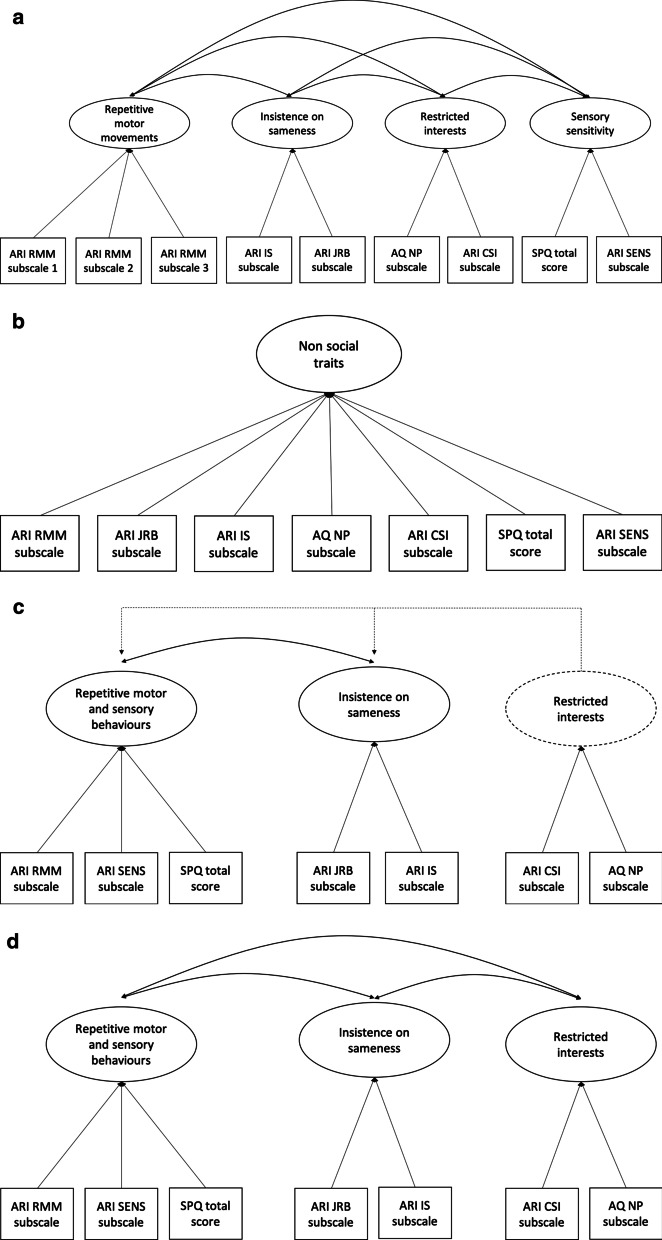
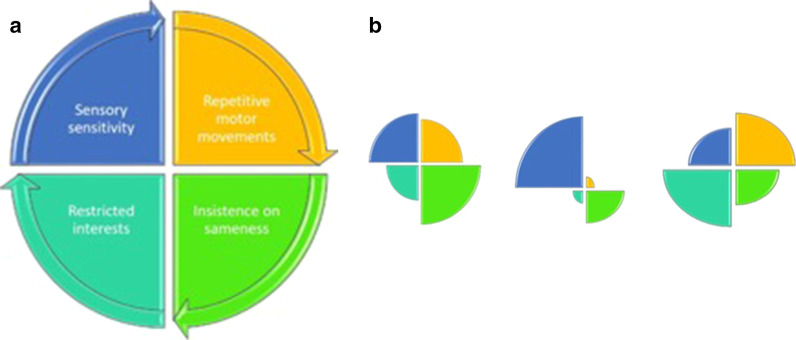
The social domain of autism has been studied in depth, but the relationship between the non-social traits of autism has received less attention. The Diagnostic and Statistical Manual of Mental Disorders (DSM-5) outlines four criteria that make up the non-social domain including repetitive motor movements, insistence on sameness, restricted interests and sensory sensitivity. There is a lack of research into the relationship between these four criteria. This study aimed to evaluate the relationship between the non-social traits of autism in a large sample of autistic adults. It explored whether these traits are best conceptualised as four distinct factors, or exist along a single dimension.
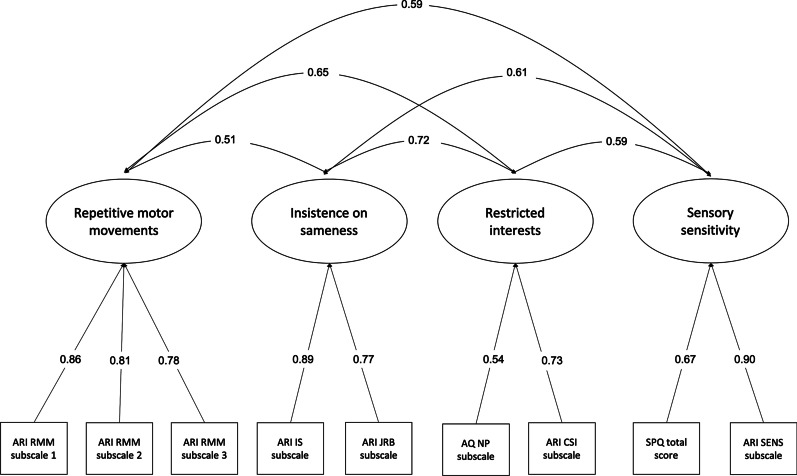
Participants included autistic adults from the Netherlands Autism Register. The four components identified within the DSM-5 non-social domain were measured by items from the Adult Routines Inventory, the Autism Spectrum Quotient short and the Sensory Perception Quotient short. Confirmatory factor analysis, as well as exploratory factor analysis and exploratory structural equation modelling, was implemented to examine the relationship between these four criteria.
Results indicated that a four-factor model provided the best fit, mapping onto the DSM-5 criteria. These four factors were moderately correlated, suggesting that four distinct, yet related factors best describe the non-social domain of autism. The one-factor model did not provide a good fit, highlighting that the non-social domain of autism is not a unitary construct.
The study included autistic adults who were cognitively able to complete the self-report measures. This may limit the generalisability of the findings to those who are less able to do so.
This study provided evidence for the multidimensional nature of the non-social domain of autism. Given only two of the four criteria within the non-social domain need to be endorsed for a diagnosis of autism, there is room for substantial variation across individuals, who will have a unique profile within the non-social domain. The results have implications for our understanding of the heterogeneous nature of autistic traits, as well as for how we conceptualise autism as a diagnostic category. This is important for the provision of diagnosis and support within research and clinical practice.
自闭症的社交领域已经得到了深入研究,但自闭症的非社交特征之间的关系却较少受到关注。《精神障碍诊断与统计手册》(DSM-5)列出了构成非社交领域的四个标准,包括重复运动、坚持一致性、受限兴趣和感官敏感性。目前,关于这四个标准之间的关系的研究还很缺乏。本研究旨在评估大量自闭症成年人中自闭症的非社交特征之间的关系。它探讨了这些特征是否最好被视为四个不同的因素,或者是否存在于单一维度上。
参与者包括来自荷兰自闭症登记处的自闭症成年人。DSM-5 非社交领域中确定的四个组成部分通过成人日常活动清单、自闭症谱系商数短版和感官知觉商数短版中的项目进行测量。采用验证性因子分析、探索性因子分析和探索性结构方程模型来检验这四个标准之间的关系。
结果表明,四因素模型提供了最佳拟合,与 DSM-5 标准相对应。这四个因素中度相关,表明四个不同但相关的因素最好地描述了自闭症的非社交领域。单因素模型拟合不佳,这突出表明自闭症的非社交领域不是一个单一的结构。
该研究包括认知能力足以完成自我报告测量的自闭症成年人。这可能会限制研究结果在认知能力较低的人群中的推广。
本研究为自闭症非社交领域的多维性质提供了证据。由于自闭症的诊断只需要在非社交领域中满足四个标准中的两个,因此个体之间存在很大的差异,他们在非社交领域中具有独特的特征。研究结果对我们理解自闭症特征的异质性以及我们如何将自闭症视为一种诊断类别具有重要意义。这对于在研究和临床实践中提供诊断和支持都很重要。