Agrawala Shilpi, Patil Jeevitha, Campbell Sukhkamal, Woodard Terri Lynn
Department of Obstetrics and Gynecology, Baylor College of Medicine, 1 Baylor Plaza, Houston, TX, 77030, USA.
Department of Gynecologic Oncology and Reproductive Medicine, M.D. Anderson Cancer Center, 1515 Holcombe Blvd, Houston, TX, 77030, USA.
Fertil Res Pract. 2021 Mar 3;7(1):5. doi: 10.1186/s40738-021-00097-4.
Adenomyosis remains an enigma for the reproductive endocrinologist. It is thought to contribute to sub-fertility, and its only curative treatment is hysterectomy. However, studies have documented increased live birth rates in women with adenomyosis who were treated with gonadotropin releasing hormone agonist (GnRHa).
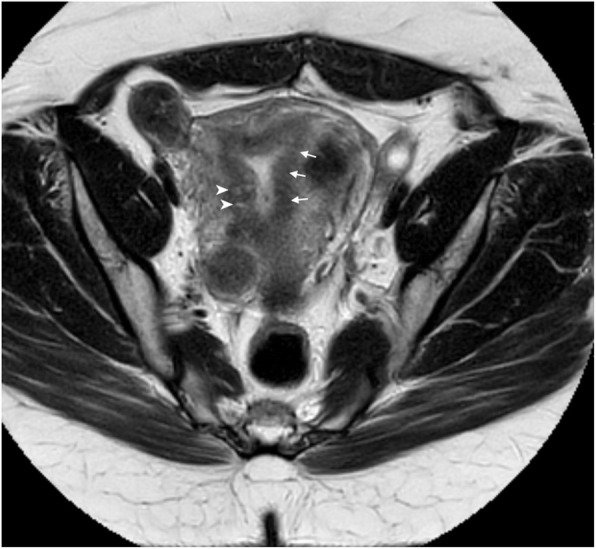
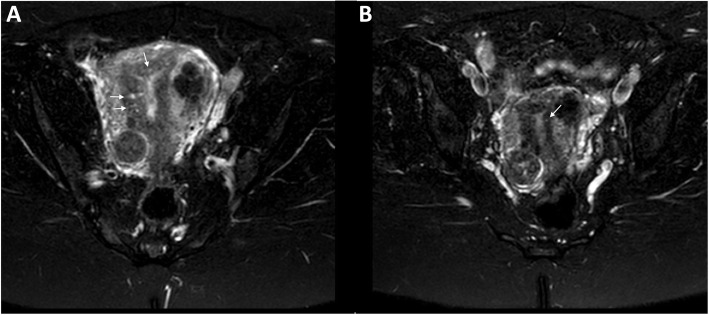
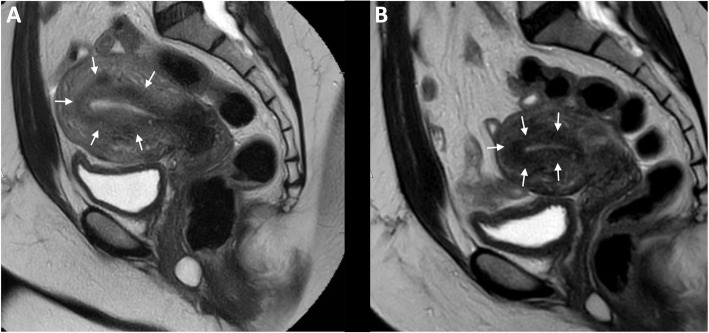
Here we present a case of a 52-year-old woman with adenomyosis who had three failed frozen embryo transfers (FETs) prior to initiating a 6-month trial of GnRHa. GnRHa therapy resulted in a decrease in uterine size from 11.5 × 7.9 × 7.0 cm to 7.8 × 6.2 × 5.9 cm and a decrease in the junctional zone (JZ) thickness from 19 to 9 mm. Subsequently, she underwent her fourth FET, which resulted in live birth of twins. The delivery was complicated by expansive accretas of both placentas requiring cesarean hysterectomy. The final pathology of the placentas demonstrated an extensive lack of decidualized endometrium that was even absent outside the basal plate.
GnRHa therapy in patients with adenomyosis may improve implantation rates after FET. Previous molecular studies indicate that genetic variance in the expression of the gonadotropin releasing hormone receptor (GnRHR) could explain the expansive lack of decidualized endometrium after GnRHa therapy. Further investigations are needed to determine if GnRHa therapy contributes to the pathologic process of placenta accreta.
子宫腺肌病对于生殖内分泌学家来说仍是一个谜。它被认为是导致生育力低下的原因之一,而其唯一的治愈性治疗方法是子宫切除术。然而,研究表明,接受促性腺激素释放激素激动剂(GnRHa)治疗的子宫腺肌病女性的活产率有所提高。
在此,我们报告一例52岁子宫腺肌病女性的病例,该患者在开始为期6个月的GnRHa试验之前,三次冻融胚胎移植(FET)均失败。GnRHa治疗使子宫大小从11.5×7.9×7.0厘米降至7.8×6.2×5.9厘米,交界区(JZ)厚度从19毫米降至9毫米。随后,她接受了第四次FET,结果产下双胞胎。分娩因两个胎盘广泛植入而复杂化,需要进行剖宫产子宫切除术。胎盘的最终病理显示广泛缺乏蜕膜化的子宫内膜,甚至在基底板外也不存在。
子宫腺肌病患者接受GnRHa治疗可能会提高FET后的着床率。先前的分子研究表明,促性腺激素释放激素受体(GnRHR)表达的基因变异可以解释GnRHa治疗后蜕膜化子宫内膜广泛缺乏的现象。需要进一步研究以确定GnRHa治疗是否会导致胎盘植入的病理过程。