Department of Epidemiology and Biostatistics, University of California, San Francisco, CA, USA.
Department of Urology, University of California, San Francisco, CA, USA.
Sci Rep. 2021 Mar 3;11(1):5040. doi: 10.1038/s41598-021-84507-z.
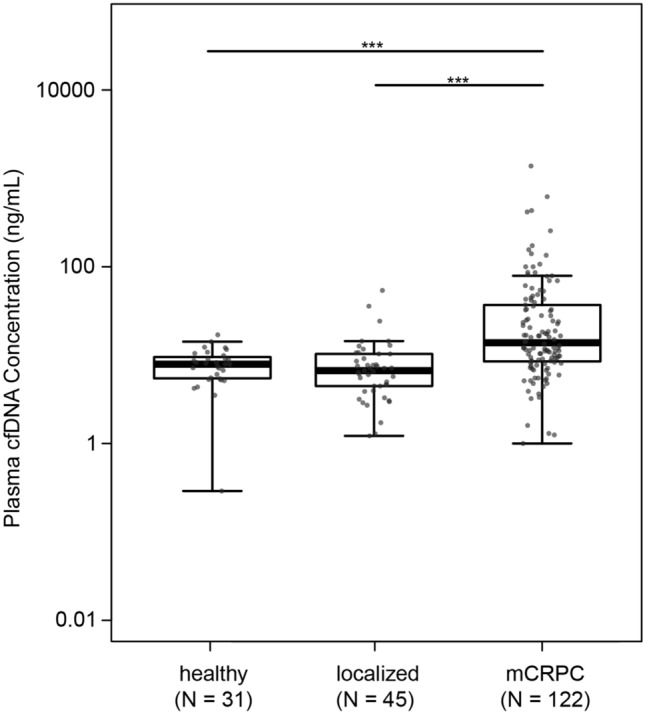
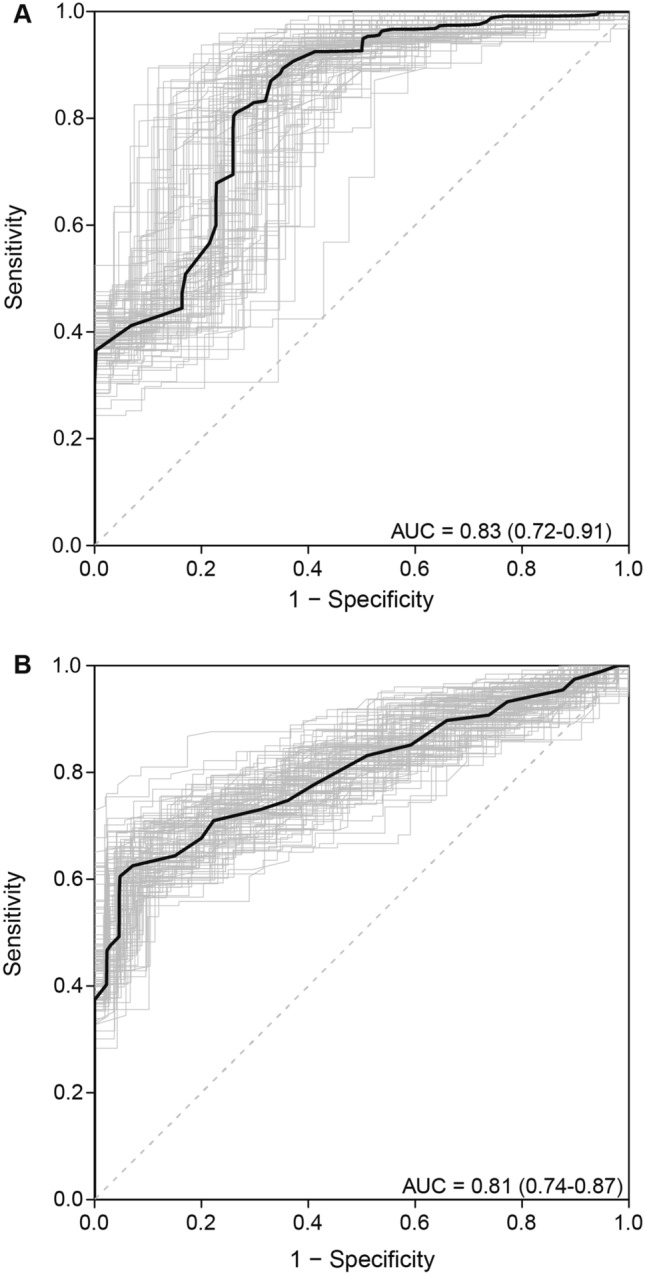
Prostate cancer is the most commonly diagnosed neoplasm in American men. Although existing biomarkers may detect localized prostate cancer, additional strategies are necessary for improving detection and identifying aggressive disease that may require further intervention. One promising, minimally invasive biomarker is cell-free DNA (cfDNA), which consist of short DNA fragments released into circulation by dying or lysed cells that may reflect underlying cancer. Here we investigated whether differences in cfDNA concentration and cfDNA fragment size could improve the sensitivity for detecting more advanced and aggressive prostate cancer. This study included 268 individuals: 34 healthy controls, 112 men with localized prostate cancer who underwent radical prostatectomy (RP), and 122 men with metastatic castration-resistant prostate cancer (mCRPC). Plasma cfDNA concentration and fragment size were quantified with the Qubit 3.0 and the 2100 Bioanalyzer. The potential relationship between cfDNA concentration or fragment size and localized or mCRPC prostate cancer was evaluated with descriptive statistics, logistic regression, and area under the curve analysis with cross-validation. Plasma cfDNA concentrations were elevated in mCRPC patients in comparison to localized disease (OR = 1.34, P = 0.027) or to being a control (OR = 1.69, P = 0.034). Decreased average fragment size was associated with an increased risk of localized disease compared to controls (OR = 0.77, P = 0.0008). This study suggests that while cfDNA concentration can identify mCRPC patients, it is unable to distinguish between healthy individuals and patients with localized prostate cancer. In addition to PSA, average cfDNA fragment size may be an alternative that can differentiate between healthy individuals and those with localized disease, but the low sensitivity and specificity results in an imperfect diagnostic marker. While quantification of cfDNA may provide a quick, cost-effective approach to help guide treatment decisions in advanced disease, its use is limited in the setting of localized prostate cancer.
前列腺癌是美国男性最常见的肿瘤。尽管现有的生物标志物可以检测局限性前列腺癌,但仍需要额外的策略来提高检测水平并识别可能需要进一步干预的侵袭性疾病。一种有前途的微创生物标志物是游离细胞 DNA(cfDNA),它由死亡或裂解细胞释放到循环中的短 DNA 片段组成,可能反映潜在的癌症。在这里,我们研究了 cfDNA 浓度和 cfDNA 片段大小的差异是否可以提高检测更高级和侵袭性前列腺癌的敏感性。本研究包括 268 人:34 名健康对照者、112 名接受根治性前列腺切除术(RP)的局限性前列腺癌患者和 122 名转移性去势抵抗性前列腺癌(mCRPC)患者。使用 Qubit 3.0 和 2100 Bioanalyzer 定量检测血浆 cfDNA 浓度和片段大小。使用描述性统计、逻辑回归和交叉验证的曲线下面积分析评估 cfDNA 浓度或片段大小与局限性或 mCRPC 前列腺癌之间的潜在关系。与局限性疾病(OR=1.34,P=0.027)或健康对照者(OR=1.69,P=0.034)相比,mCRPC 患者的血浆 cfDNA 浓度升高。与健康对照者相比,平均片段大小减小与局限性疾病的风险增加相关(OR=0.77,P=0.0008)。本研究表明,虽然 cfDNA 浓度可以识别 mCRPC 患者,但无法区分健康个体和局限性前列腺癌患者。除 PSA 外,平均 cfDNA 片段大小也可能是一种替代方法,可以区分健康个体和局限性疾病患者,但敏感性和特异性较低导致诊断标志物不完美。虽然 cfDNA 的定量分析可能提供一种快速、具有成本效益的方法来帮助指导晚期疾病的治疗决策,但在局限性前列腺癌的情况下,其应用受到限制。