Mahadevan Nikhil, Christakis Yiorgos, Di Junrui, Bruno Jonathan, Zhang Yao, Dorsey E Ray, Pigeon Wilfred R, Beck Lisa A, Thomas Kevin, Liu Yaqi, Wicker Madisen, Brooks Chris, Kabiri Nina Shaafi, Bhangu Jaspreet, Northcott Carrie, Patel Shyamal
Pfizer, Inc., Cambridge, MA, USA.
University of Rochester Medical Center, Rochester, NY, USA.
NPJ Digit Med. 2021 Mar 3;4(1):42. doi: 10.1038/s41746-021-00402-x.
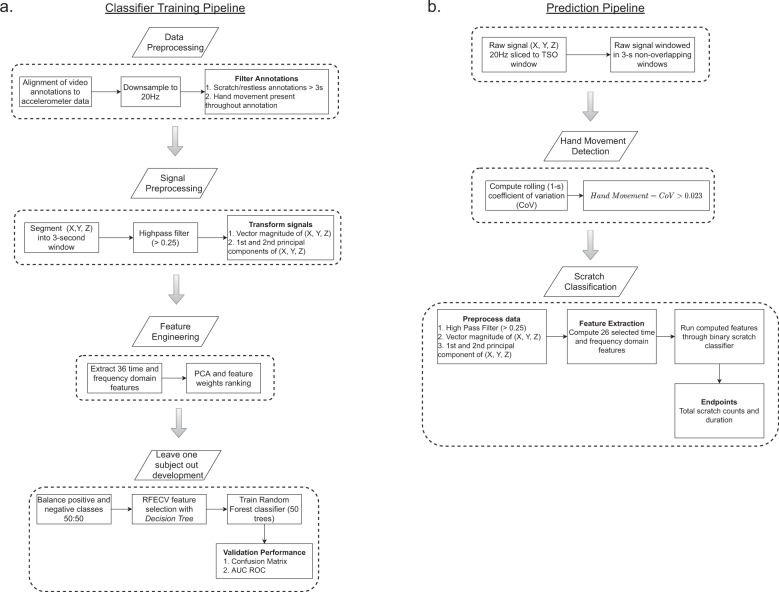
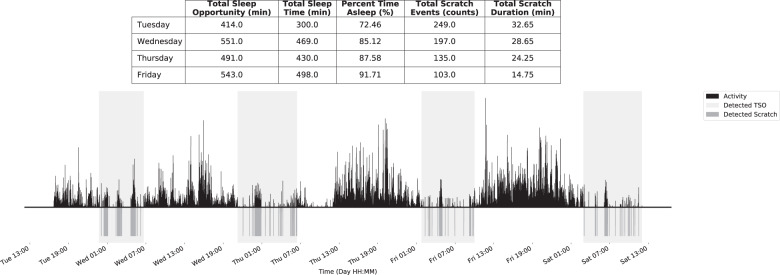
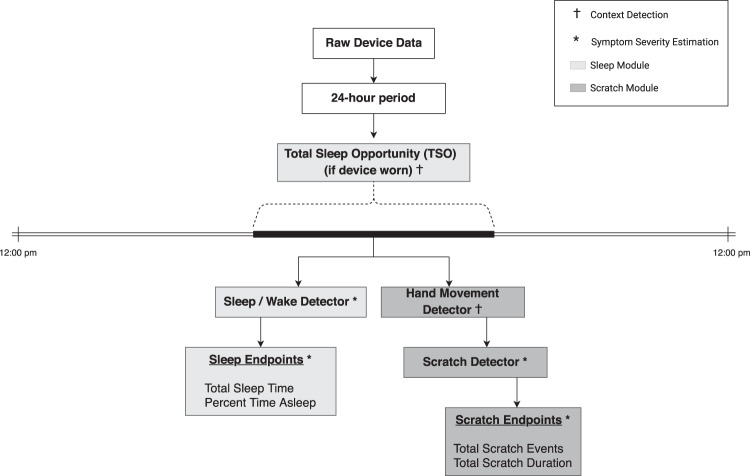
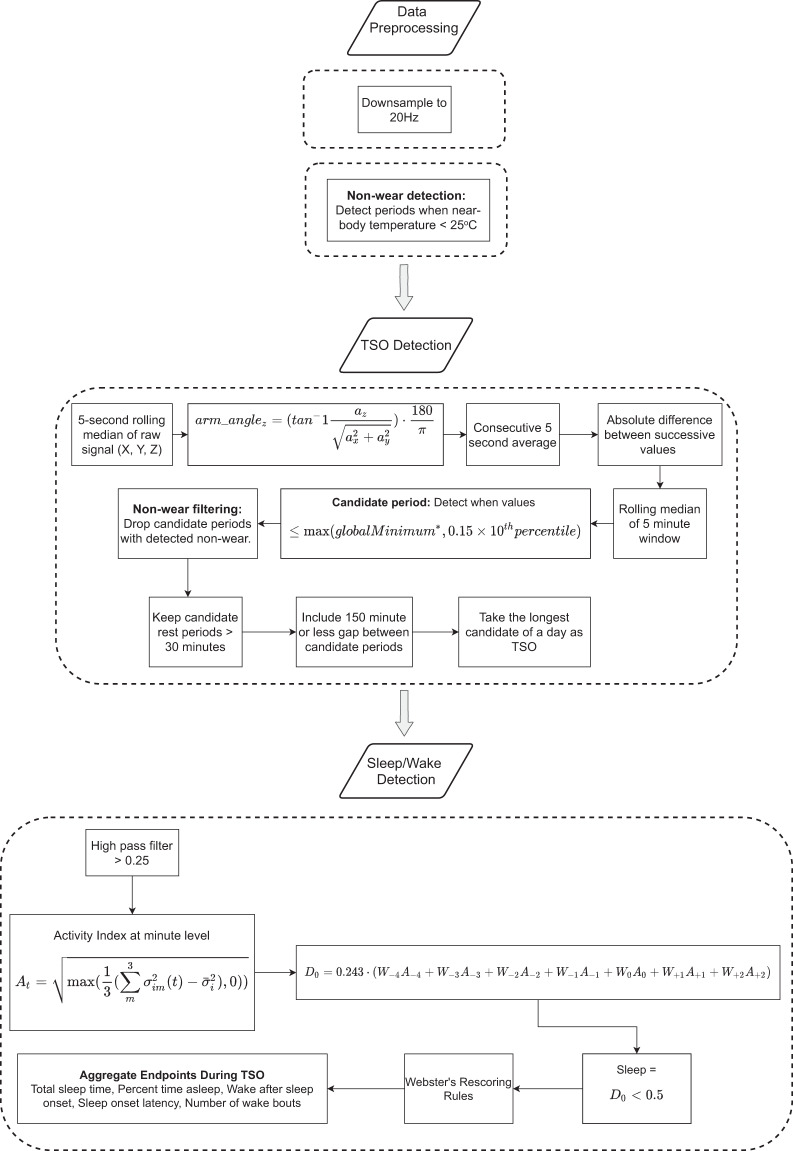
Patients with atopic dermatitis experience increased nocturnal pruritus which leads to scratching and sleep disturbances that significantly contribute to poor quality of life. Objective measurements of nighttime scratching and sleep quantity can help assess the efficacy of an intervention. Wearable sensors can provide novel, objective measures of nighttime scratching and sleep; however, many current approaches were not designed for passive, unsupervised monitoring during daily life. In this work, we present the development and analytical validation of a method that sequentially processes epochs of sample-level accelerometer data from a wrist-worn device to provide continuous digital measures of nighttime scratching and sleep quantity. This approach uses heuristic and machine learning algorithms in a hierarchical paradigm by first determining when the patient intends to sleep, then detecting sleep-wake states along with scratching episodes, and lastly deriving objective measures of both sleep and scratch. Leveraging reference data collected in a sleep laboratory (NCT ID: NCT03490877), results show that sensor-derived measures of total sleep opportunity (TSO; time when patient intends to sleep) and total sleep time (TST) correlate well with reference polysomnography data (TSO: r = 0.72, p < 0.001; TST: r = 0.76, p < 0.001; N = 32). Log transformed sensor derived measures of total scratching duration achieve strong agreement with reference annotated video recordings (r = 0.82, p < 0.001; N = 25). These results support the use of wearable sensors for objective, continuous measurement of nighttime scratching and sleep during daily life.
特应性皮炎患者夜间瘙痒加剧,导致搔抓和睡眠障碍,这显著影响了生活质量。对夜间搔抓和睡眠量进行客观测量有助于评估干预措施的效果。可穿戴传感器能够提供夜间搔抓和睡眠的全新客观测量方法;然而,当前许多方法并非为日常生活中的被动、无监督监测而设计。在这项研究中,我们展示了一种方法的开发与分析验证过程,该方法对来自腕戴设备的样本级加速度计数据片段进行顺序处理,以提供夜间搔抓和睡眠量的连续数字测量结果。此方法在分层范式中使用启发式算法和机器学习算法,首先确定患者何时打算入睡,接着检测睡眠-觉醒状态以及搔抓事件,最后得出睡眠和搔抓的客观测量值。利用在睡眠实验室收集的参考数据(NCT编号:NCT03490877),结果表明,传感器得出的总睡眠机会(TSO;患者打算入睡的时间)和总睡眠时间(TST)测量值与参考多导睡眠图数据具有良好的相关性(TSO:r = 0.72,p < 0.001;TST:r = 0.76,p < 0.001;N = 32)。对数转换后的传感器得出的总搔抓持续时间测量值与参考注释视频记录高度一致(r = 0.82,p < 0.001;N = 25)。这些结果支持在日常生活中使用可穿戴传感器对夜间搔抓和睡眠进行客观、连续的测量。