Laboratory of Aquatic Biology, Department of Biology, University of Leuven-Campus Kulak, E. Sabbelaan 53, B-8500, Kortrijk, Belgium.
Evolutionary Stress Ecology and Ecotoxicology, University of Leuven, Charles Deberiotstraat 32, 3000, Leuven, Belgium.
ISME J. 2021 Aug;15(8):2401-2414. doi: 10.1038/s41396-021-00940-y. Epub 2021 Mar 3.
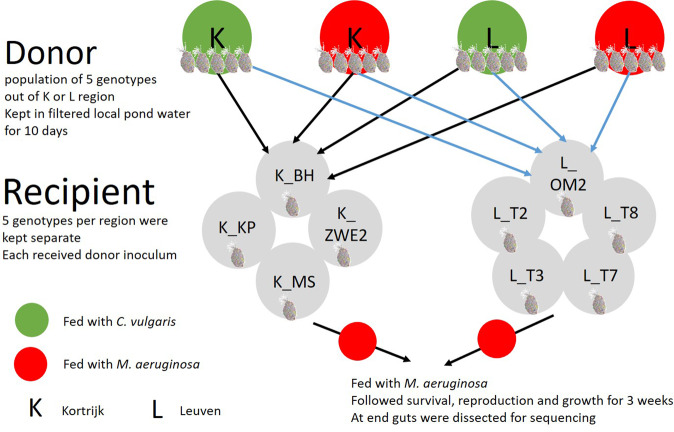
While evidence for the role of the microbiome in shaping host stress tolerance is becoming well-established, to what extent this depends on the interaction between the host and its local microbiome is less clear. Therefore, we investigated whether locally adapted gut microbiomes affect host stress tolerance. In the water flea Daphnia magna, we studied if the host performs better when receiving a microbiome from their source region than from another region when facing a stressful condition, more in particular exposure to the toxic cyanobacteria Microcystis aeruginosa. Therefore, a reciprocal transplant experiment was performed in which recipient, germ-free D. magna, isolated from different ponds, received a donor microbiome from sympatric or allopatric D. magna that were pre-exposed to toxic cyanobacteria or not. We tested for effects on host life history traits and gut microbiome composition. Our data indicate that Daphnia interact with particular microbial strains mediating local adaptation in host stress tolerance. Most recipient D. magna individuals performed better when inoculated with sympatric than with allopatric microbiomes. This effect was most pronounced when the donors were pre-exposed to the toxic cyanobacteria, but this effect was also pond and genotype dependent. We discuss how this host fitness benefit is associated with microbiome diversity patterns.
虽然微生物组在塑造宿主应激耐受性方面的作用的证据已经得到充分确立,但这种作用在多大程度上取决于宿主与其局部微生物组之间的相互作用还不太清楚。因此,我们研究了局部适应的肠道微生物组是否会影响宿主的应激耐受性。在水蚤 Daphnia magna 中,我们研究了当宿主面临应激条件,特别是暴露于有毒蓝藻微囊藻时,从其来源地区接收微生物组是否比从另一个地区接收微生物组表现更好。因此,进行了一项互惠移植实验,其中从不同池塘分离出来的无菌 D. magna 接收来自同域或异域 D. magna 的供体微生物组,这些供体微生物组预先暴露于有毒蓝藻或未暴露于有毒蓝藻。我们测试了对宿主生活史特征和肠道微生物组组成的影响。我们的数据表明,Daphnia 与介导宿主应激耐受性的特定微生物菌株相互作用。当用同域微生物组接种时,大多数接受者 D. magna 个体的表现要好于用异域微生物组接种的个体。当供体预先暴露于有毒蓝藻时,这种效果最为明显,但这种效果也取决于池塘和基因型。我们讨论了这种宿主适应性益处与微生物组多样性模式之间的关系。