Scheffel Thamiris Becker, Grave Nathália, Vargas Pedro, Diz Fernando Mendonça, Rockenbach Liliana, Morrone Fernanda Bueno
Laboratório de Farmacologia Aplicada, Escola de Ciências da Saúde e da Vida, Pontifícia Universidade Católica do Rio Grande do Sul (PUCRS), Porto Alegre, Brazil.
Programa de Pós-Graduação em Biologia Celular e Molecular, Escola de Ciências da Saúde e da Vida, Pontifícia Universidade Católica do Rio Grande do Sul (PUCRS), Porto Alegre, Brazil.
Front Oncol. 2021 Feb 15;10:617385. doi: 10.3389/fonc.2020.617385. eCollection 2020.
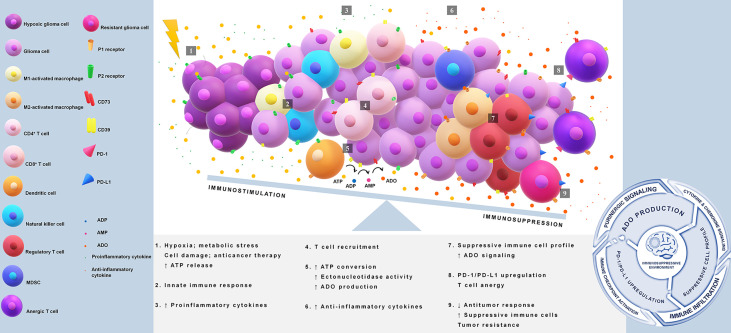
Glioblastoma is the most malignant and lethal subtype of glioma. Despite progress in therapeutic approaches, issues with the tumor immune landscape persist. Multiple immunosuppression pathways coexist in the tumor microenvironment, which can determine tumor progression and therapy outcomes. Research in immune checkpoints, such as the PD-1/PD-L1 axis, has renewed the interest in immune-based cancer therapies due to their ability to prevent immunosuppression against tumors. However, PD-1/PD-L1 blockage is not completely effective, as some patients remain unresponsive to such treatment. The production of adenosine is a major obstacle for the efficacy of immune therapies and is a key source of innate or adaptive resistance. In general, adenosine promotes the pro-tumor immune response, dictates the profile of suppressive immune cells, modulates the release of anti-inflammatory cytokines, and induces the expression of alternative immune checkpoint molecules, such as PD-1, thus maintaining a loop of immunosuppression. In this context, this review aims to depict the complexity of the immunosuppression in glioma microenvironment. We primarily consider the PD-1/PD-L1 axis and adenosine pathway, which may be critical points of resistance and potential targets for tumor treatment strategies.
胶质母细胞瘤是胶质瘤中最恶性且致命的亚型。尽管治疗方法取得了进展,但肿瘤免疫格局的问题依然存在。多种免疫抑制途径在肿瘤微环境中共存,这会决定肿瘤的进展和治疗结果。对免疫检查点(如PD-1/PD-L1轴)的研究重新激发了人们对基于免疫的癌症治疗的兴趣,因为它们能够防止对肿瘤的免疫抑制。然而,PD-1/PD-L1阻断并不完全有效,因为一些患者对此类治疗仍无反应。腺苷的产生是免疫治疗疗效的主要障碍,也是先天性或适应性耐药的关键来源。一般来说,腺苷促进促肿瘤免疫反应,决定抑制性免疫细胞的特征,调节抗炎细胞因子的释放,并诱导替代免疫检查点分子(如PD-1)的表达,从而维持免疫抑制循环。在此背景下,本综述旨在描述胶质瘤微环境中免疫抑制的复杂性。我们主要考虑PD-1/PD-L1轴和腺苷途径,它们可能是耐药的关键点以及肿瘤治疗策略的潜在靶点。