Sivixay Souliphone, Bai Gaowa, Tsuruta Takeshi, Nishino Naoki
Department of Animal Science, Graduate School of Life and Environmental Science, Okayama University, Okayama, Japan.
Department of Health Science and Social Welfare, Takahashi, Japan.
AIMS Microbiol. 2021 Jan 14;7(1):1-12. doi: 10.3934/microbiol.2021001. eCollection 2021.
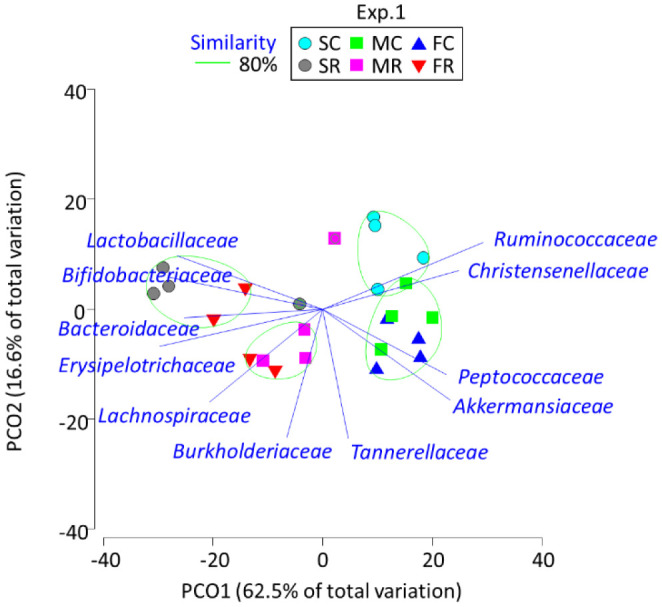
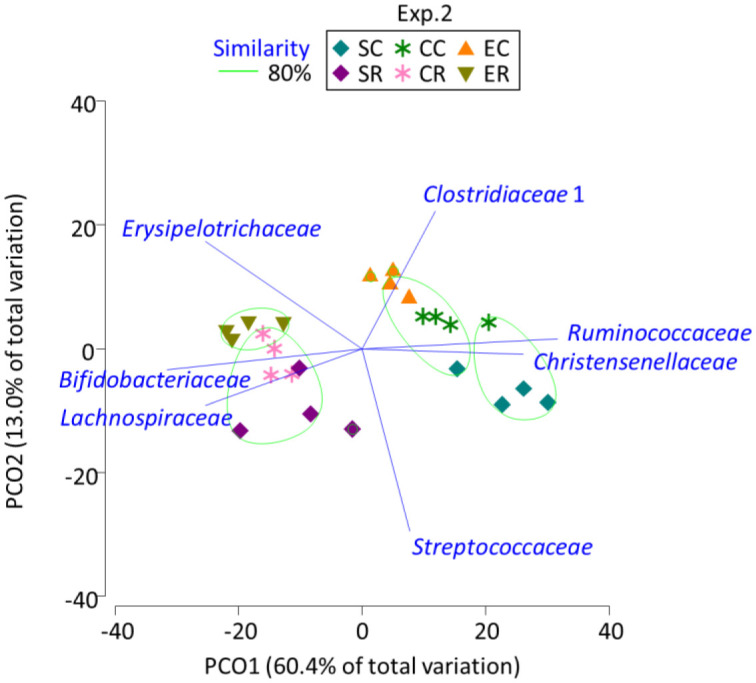
Diet is considered the most influential factor in modulating the gut microbiota but how dietary protein sources differ in their modulatory effects is not well understood. In this study, soy, meat (mixture of beef and pork), and fish proteins (experiment 1) and soy, milk (casein), and egg proteins (experiment 2) were fed to rats with cellulose (CEL) and raffinose (RAF); the microbiota composition and short-chain fatty acid concentration in the cecum were determined. Egg protein feeding decreased the concentration of acetic acid and the richness and diversity of the cecum microbiota. RAF feeding increased the concentrations of acetic and propionic acids and decreased the richness and diversity of the cecum microbiota. When fed with CEL, the abundance of and , and , and enhanced with soy protein, meat and fish proteins, and egg protein, respectively. The effects of dietary proteins diminished with RAF feeding and the abundance of , , and increased and that of and decreased regardless of the protein source. These results indicate that, although the effect of prebiotics is more robust and distinctive, dietary protein sources may influence the composition and metabolic activities of the gut microbiota. The stimulatory effects of soy, meat, and egg proteins on , , and deserve further examination to better elucidate the dietary manipulation of the gut microbiota.
饮食被认为是调节肠道微生物群的最具影响力的因素,但不同蛋白质来源的饮食在调节效果上有何差异尚不清楚。在本研究中,将大豆蛋白、肉类(牛肉和猪肉的混合物)和鱼类蛋白(实验1)以及大豆蛋白、牛奶蛋白(酪蛋白)和鸡蛋蛋白(实验2)与纤维素(CEL)和棉子糖(RAF)一起喂给大鼠;测定盲肠中的微生物群组成和短链脂肪酸浓度。喂食鸡蛋蛋白会降低乙酸浓度以及盲肠微生物群的丰富度和多样性。喂食RAF会增加乙酸和丙酸的浓度,并降低盲肠微生物群的丰富度和多样性。当与CEL一起喂食时, 、 以及 丰度分别在喂食大豆蛋白、肉类和鱼类蛋白以及鸡蛋蛋白时增加。喂食RAF会减弱饮食蛋白质的作用,无论蛋白质来源如何, 、 以及 的丰度增加,而 和 的丰度降低。这些结果表明,尽管益生元的作用更强且更具特异性,但饮食蛋白质来源可能会影响肠道微生物群的组成和代谢活性。大豆蛋白、肉类蛋白和鸡蛋蛋白对 、 以及 的刺激作用值得进一步研究,以更好地阐明对肠道微生物群的饮食调控。