Porotnikov I V, Antonova O Yu, Mitrofanova O P
Federal Research Center the N.I. Vavilov All-Russian Institute of Plant Genetic Resources (VIR), St. Petersburg, Russia.
Vavilovskii Zhurnal Genet Selektsii. 2020 Oct;24(6):557-567. doi: 10.18699/VJ20.649.
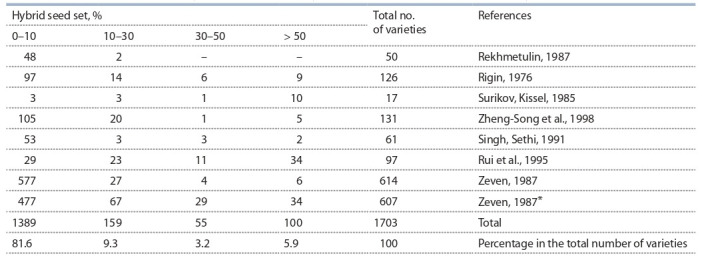
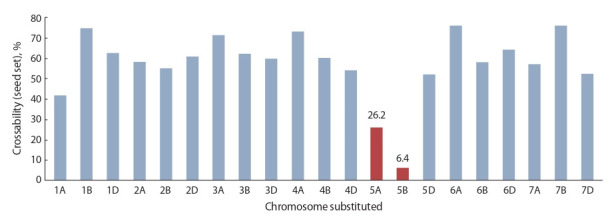
Bread wheat (Triticum aestivum L.), the varieties of which are widely used for the grain production, is difficultly crossable with related species of Triticeae Dum. This factor limits the chance of introduction of alien genetic material into the wheat gene pool and the possibility of new varieties breeding with good adaptation to adverse environmental factors. The crossability between wheat and related species is controlled by Kr1-Kr4 genes (Crossability with Rye, Hordeum and Aegilops spp.) and the SKr gene (Suppressor of crossability). SKr and Kr1 have the largest influence on the trait. In the case of the recessive alleles, these genes do not function and the quantity of hybrid seeds after pollination with alien species can achieve more than 50 %. SKr is located on 5BS between the GBR0233 and Xgwm234 markers, closely linked with the markers Xcfb341, TGlc2 and gene12. Kr1 was mapped on 5BL, proximally to the Ph1 gene, between the EST-SSR markers Xw5145 and Xw9340. The markers of SKr were used to control the transfer of its recessive allele into other wheat genotypes, which made it possible to obtain highly crossable forms. However, the advantages of using the SKr and Kr1 markers in marker-assisted selection and in the screening of ex situ collections are not sufficiently studied. The published Kr1 sequence for varieties with different crossability offers great prospects, because it will be possible to create allele-specific markers. In this review, the following issues are considered: genetic resources created by wheat and rye hybridization, the geographical distribution of easy-to-cross forms of wheat, genetic control of the wheat and rye compatibility, advances of the use of molecular markers in the mapping of Kr-genes and their transmission control.
普通小麦(Triticum aestivum L.)的品种被广泛用于粮食生产,但它与小麦族(Triticeae Dum.)的相关物种很难杂交。这一因素限制了将外来遗传物质引入小麦基因库的机会,以及培育出能良好适应不利环境因素的新品种的可能性。小麦与相关物种之间的杂交亲和性受Kr1 - Kr4基因(与黑麦、大麦和山羊草属物种的杂交亲和性)和SKr基因(杂交亲和性抑制因子)控制。SKr和Kr1对该性状影响最大。在隐性等位基因的情况下,这些基因不起作用,用外来物种授粉后杂交种子的数量可超过50%。SKr位于5BS上GBR0233和Xgwm234标记之间,与标记Xcfb341、TGlc2和基因12紧密连锁。Kr1被定位在5BL上,靠近Ph1基因,位于EST - SSR标记Xw5145和Xw9340之间。SKr的标记被用于控制其隐性等位基因向其他小麦基因型的转移,从而有可能获得高杂交亲和性的类型。然而,在标记辅助选择和异位种质资源筛选中使用SKr和Kr1标记的优势尚未得到充分研究。已发表的不同杂交亲和性品种的Kr1序列具有很大前景,因为有可能创建等位基因特异性标记。在本综述中,考虑了以下问题:小麦与黑麦杂交创造的遗传资源、小麦易杂交类型的地理分布、小麦与黑麦亲和性的遗传控制、在Kr基因定位及其传递控制中使用分子标记的进展。