Department of Research and Development, Multi-Chemical Industry Santé Animale, Lot. 157, Z I, Sud-Ouest (ERAC) B.P.: 278, 28810, Mohammedia, Morocco.
Department of Microbiology, Immunology and Contagious Diseases, Agronomic and Veterinary Institute Hassan II, Madinat Al Irfane, 6202, Rabat, Morocco.
Acta Vet Scand. 2021 Mar 4;63(1):9. doi: 10.1186/s13028-021-00574-2.
Goatpox is a viral disease caused by infection with goatpox virus (GTPV) of the genus Capripoxvirus, Poxviridae family. Capripoxviruses cause serious disease to livestock and contribute to huge economic losses. Goatpox and sheeppox are endemic to Africa, particularly north of the Equator, the Middle East and many parts of Asia. GTPV and sheeppox virus are considered host-specific; however, both strains can cause clinical disease in either goats or sheep with more severe disease in the homologous species and mild or sub-clinical infection in the other. Goatpox has never been reported in Morocco, Algeria or Tunisia despite the huge population of goats living in proximity with sheep in those countries. To evaluate the susceptibility and pathogenicity of indigenous North African goats to GTPV infection, we experimentally inoculated eight locally bred goats with a virulent Vietnamese isolate of GTPV. Two uninfected goats were kept as controls. Clinical examination was carried out daily and blood was sampled for virology and for investigating the antibody response. After necropsy, tissues were collected and assessed for viral DNA using real-time PCR.
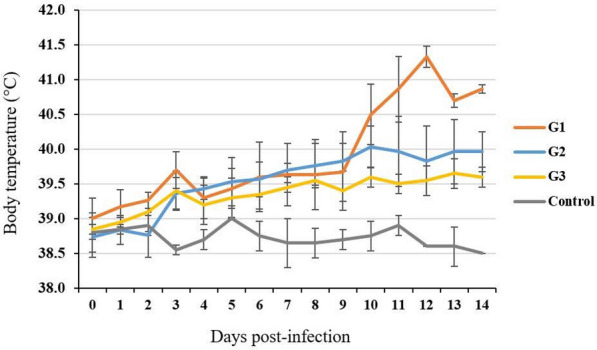
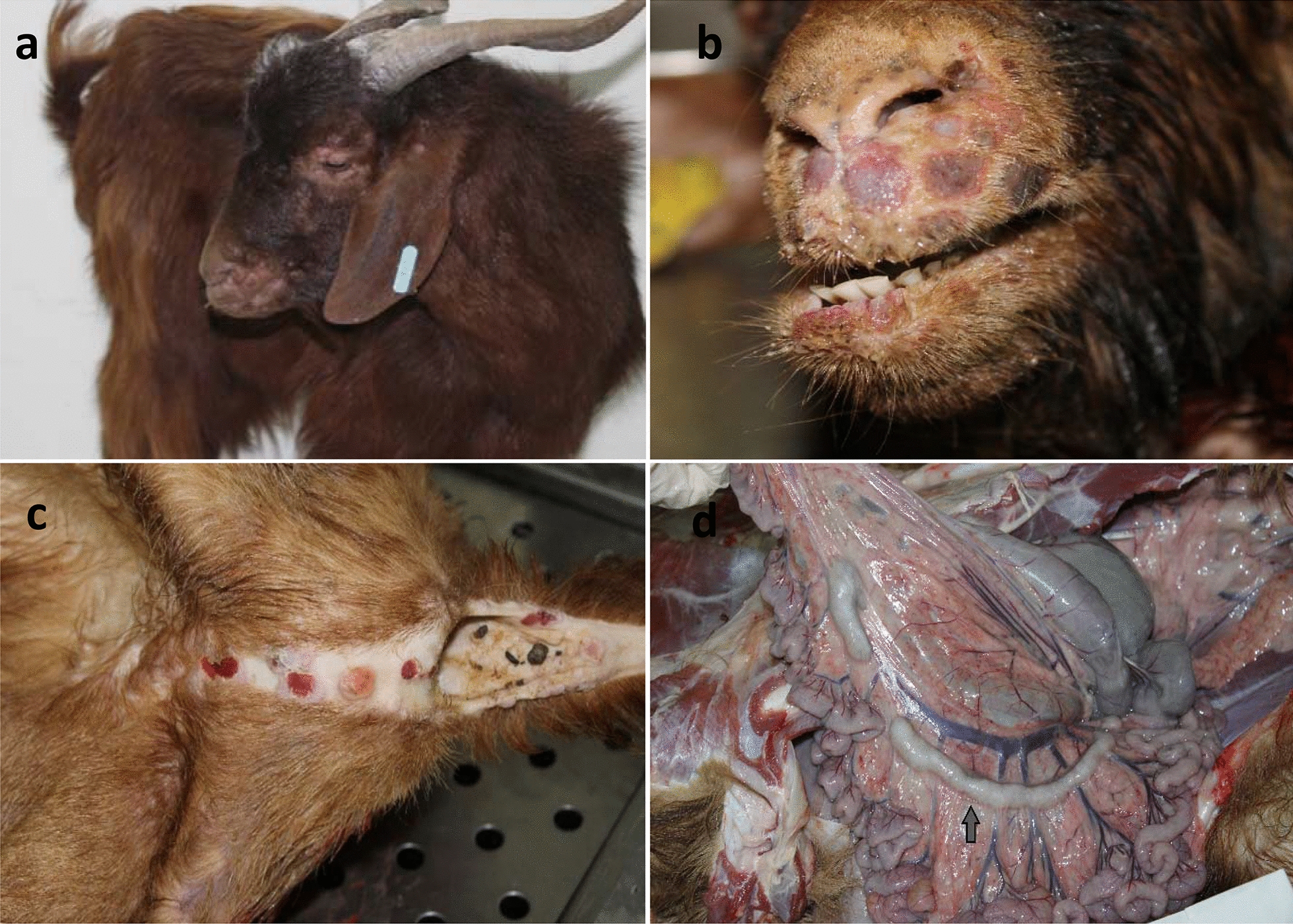
Following the experimental infection, all inoculated goats displayed clinical signs characteristic of goatpox including varying degrees of hyperthermia, loss of appetite, inactivity and cutaneous lesions. The infection severely affected three of the infected animals while moderate to mild disease was noticed in the remaining goats. A high antibody response was developed. High viral DNA loads were detected in skin crusts and nodules, and subcutaneous tissue at the injection site with cycle threshold (Ct) values ranging from 14.6 to 22.9, while lower viral loads were found in liver and lung (Ct = 35.7 and 35.1). The results confirmed subcutaneous tropism of the virus.
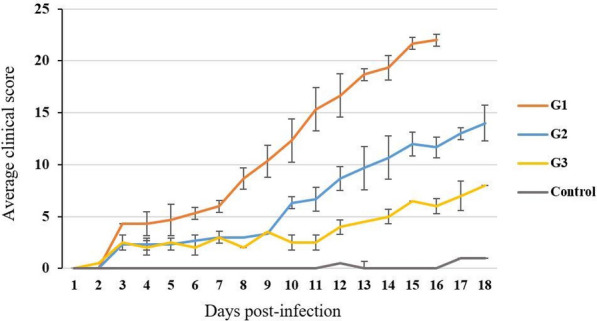
Clinical signs of goatpox were reproduced in indigenous North African goats and confirmed a high susceptibility of the North African goat breed to GTPV infection. A clinical scoring system is proposed that can be applied in GTPV vaccine efficacy studies.
山羊痘是一种由山羊痘病毒(GTPV)引起的病毒性疾病,该病毒属于痘病毒科山羊痘病毒属。山羊痘病毒会导致牲畜患病,造成巨大的经济损失。山羊痘和绵羊痘流行于非洲,特别是赤道以北、中东和亚洲许多地区。GTPV 和绵羊痘病毒被认为具有宿主特异性;然而,这两种毒株都可以导致山羊或绵羊出现临床疾病,在同源物种中疾病更为严重,而在另一种物种中则表现为轻度或亚临床感染。尽管摩洛哥、阿尔及利亚和突尼斯有大量的山羊与绵羊生活在一起,但这些国家从未报告过山羊痘病例。为了评估本地北非山羊对 GTPV 感染的易感性和致病性,我们用一种来自越南的强毒 GTPV 分离株对 8 只本地繁殖的山羊进行了实验性接种。将 2 只未感染的山羊作为对照保留。每天进行临床检查并采集血液进行病毒学和抗体反应研究。剖检后,采集组织并使用实时 PCR 检测病毒 DNA。
在实验感染后,所有接种的山羊均表现出山羊痘的临床特征,包括不同程度的发热、食欲不振、活动减少和皮肤损伤。感染严重影响了其中 3 只感染动物,而其余山羊则出现了中度至轻度疾病。产生了高抗体反应。在皮肤结痂和结节以及注射部位的皮下组织中检测到高病毒 DNA 载量,循环阈值(Ct)值范围为 14.6 至 22.9,而在肝脏和肺中检测到的病毒载量较低(Ct 值分别为 35.7 和 35.1)。结果证实了病毒的皮下嗜性。
在本地北非山羊中重现了山羊痘的临床症状,并证实了北非山羊品种对 GTPV 感染的高度易感性。提出了一种临床评分系统,可用于 GTPV 疫苗效力研究。