School of Nursing, Tongji Medical College, Huazhong University of Science and Technology, Wuhan, China.
School of Nursing, Hubei University of Science and Technology, Xianning, China.
BMJ Open. 2021 Mar 4;11(3):e041578. doi: 10.1136/bmjopen-2020-041578.
To assess the prevalence of frailty and identify predictors of frailty among Chinese community-dwelling older adults with type 2 diabetes.
A cross-sectional design.
Two community health centres in central China.
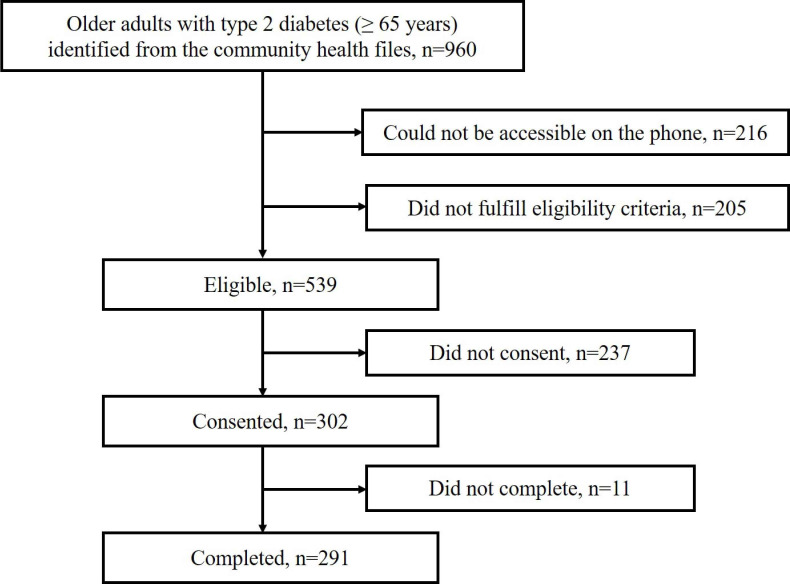
291 community-dwelling older adults aged ≥65 years with type 2 diabetes.
Data were collected via face-to-face interviews, anthropometric measurements, laboratory tests and community health files. The main outcome measure was frailty, as assessed by the frailty phenotype criteria. The multivariate logistic regression model was used to identify the predictors of frailty.
The prevalence of prefrailty and frailty were 51.5% and 19.2%, respectively. The significant predictors of frailty included alcohol drinking (ex-drinker) (OR 4.461, 95% CI 1.079 to 18.438), glycated haemoglobin (OR 1.434, 95% CI 1.045 to 1.968), nutritional status (malnutrition risk/malnutrition) (OR 8.062, 95% CI 2.470 to 26.317), depressive symptoms (OR 1.438, 95% CI 1.166 to 1.773) and exercise behaviour (OR 0.796, 95% CI 0.716 to 0.884).
A high prevalence of frailty was found among older adults with type 2 diabetes in the Chinese community. Frailty identification and multifaceted interventions should be developed for this population, taking into consideration proper glycaemic control, nutritional instruction, depressive symptoms improvement and enhancement of self-care behaviours.
评估中国社区 2 型糖尿病老年患者衰弱的流行情况,并确定衰弱的预测因素。
横断面设计。
中国中部的两个社区卫生中心。
291 名年龄≥65 岁且患有 2 型糖尿病的社区居住老年人。
通过面对面访谈、人体测量学测量、实验室检查和社区健康档案收集数据。主要观察指标为衰弱,通过衰弱表型标准评估。采用多变量逻辑回归模型确定衰弱的预测因素。
衰弱前期和衰弱的患病率分别为 51.5%和 19.2%。衰弱的显著预测因素包括饮酒(既往饮酒者)(OR 4.461,95%CI 1.079 至 18.438)、糖化血红蛋白(OR 1.434,95%CI 1.045 至 1.968)、营养状况(营养不良风险/营养不良)(OR 8.062,95%CI 2.470 至 26.317)、抑郁症状(OR 1.438,95%CI 1.166 至 1.773)和运动行为(OR 0.796,95%CI 0.716 至 0.884)。
中国社区 2 型糖尿病老年患者衰弱的患病率较高。应针对这一人群进行衰弱识别和多方面干预,考虑适当的血糖控制、营养指导、改善抑郁症状和增强自我护理行为。