Abose Abera, Adhena Girmay, Dessie Yadeta
Department of Reproductive Health, West Badewacho, Ethiopia.
Department of Reproductive Health, Tigray Regional Health Bureau, Tigray, Ethiopia.
Open Access J Contracept. 2021 Feb 26;12:63-72. doi: 10.2147/OAJC.S297267. eCollection 2021.
Male involvement in family planning use particularly in long-acting and permanent contraceptive methods (LAPCM) is a key strategy to reduce fertility, and promote maternal and child health. Despite this, little is known about male involvement in LAPCM use of their partners in Africa, particularly in Ethiopia. This study aimed to assess male involvement in long-acting and permanent contraceptive method use in west Badewacho district, Southern Ethiopia.
A community-based cross-sectional study was conducted among 564 participants from April 1 to 30/2019. A multi-stage sampling technique was used to select eligible participants. A pre-tested, structured, and interviewer-administered questionnaire was used. Binary and multivariable logistic regression analysis was done to identify associated factors. The adjusted odds ratio with 95% CI was estimated to show the direction and strength of the association. Variables with p<0.05 were considered statistically significant.
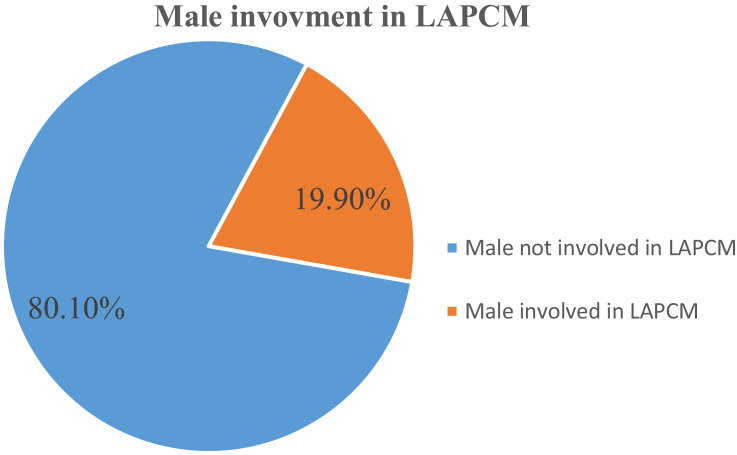
About 108 (19.9%, 95% CI: (16.8, 23.2)) participants were involved in LAPCM use. Being urban dweller [AOR=3.13; 95% CI: (1.58, 6.19)], discussion with wives about LAPCM [AOR=2.81; 95% CI: (1.64, 4.8)], having good knowledge about LAPCM [AOR=2.55; 95% CI: (1.42, 4.57)], and positive attitude towards LAPCM [AOR=2.16; 95% CI: (1.16, 4.02)] were significantly associated factors.
Overall, the male involvement in LAPCM use was low. Enhancing male involvement in family planning use through creating community awareness, encouraging inter-spousal communication to enhance decision making, and increasing positive attitude towards LAPCM in the community is crucial to decrease the problem.
男性参与计划生育,尤其是长效和永久性避孕方法的使用,是降低生育率、促进母婴健康的关键策略。尽管如此,在非洲,特别是在埃塞俄比亚,对于男性参与其伴侣使用长效和永久性避孕方法的情况知之甚少。本研究旨在评估埃塞俄比亚南部西巴德瓦乔区男性参与长效和永久性避孕方法使用的情况。
2019年4月1日至30日,对564名参与者进行了一项基于社区的横断面研究。采用多阶段抽样技术选择符合条件的参与者。使用经过预测试、结构化且由访谈员管理的问卷。进行二元和多变量逻辑回归分析以确定相关因素。估计调整后的比值比及95%置信区间以显示关联的方向和强度。p<0.05的变量被认为具有统计学意义。
约108名(19.9%,95%置信区间:(16.8, 23.2))参与者参与了长效和永久性避孕方法的使用。居住在城市地区 [调整后的比值比=3.13;95%置信区间:(1.58, 6.19)]、与妻子讨论长效和永久性避孕方法 [调整后的比值比=2.81;95%置信区间:(1.64, 4.8)]、对长效和永久性避孕方法有充分了解 [调整后的比值比=2.55;95%置信区间:(1.42, 4.57)] 以及对长效和永久性避孕方法持积极态度 [调整后的比值比=2.16;95%置信区间:(1.16, 4.02)] 是显著相关因素。
总体而言,男性参与长效和永久性避孕方法使用的比例较低。通过提高社区意识、鼓励夫妻间沟通以增强决策能力以及增强社区对长效和永久性避孕方法的积极态度来提高男性对计划生育的参与度,对于解决这一问题至关重要。