Nguyen Marielle, Holdbrooks Heaven, Mishra Prasanthi, Abrantes Maria A, Eskew Sherri, Garma Mariajamiela, Oca Cyr-Geraurd, McGuckin Carrie, Hein Cynthia B, Mitchell Ryan D, Kazi Sufyan, Chew Stephanie, Casaburi Giorgio, Brown Heather K, Frese Steven A, Henrick Bethany M
Neonatology, Kaiser Permanente Orange County, Anaheim, CA, United States.
Evolve Biosystems Inc., Davis, CA, United States.
Front Pediatr. 2021 Feb 16;9:618009. doi: 10.3389/fped.2021.618009. eCollection 2021.
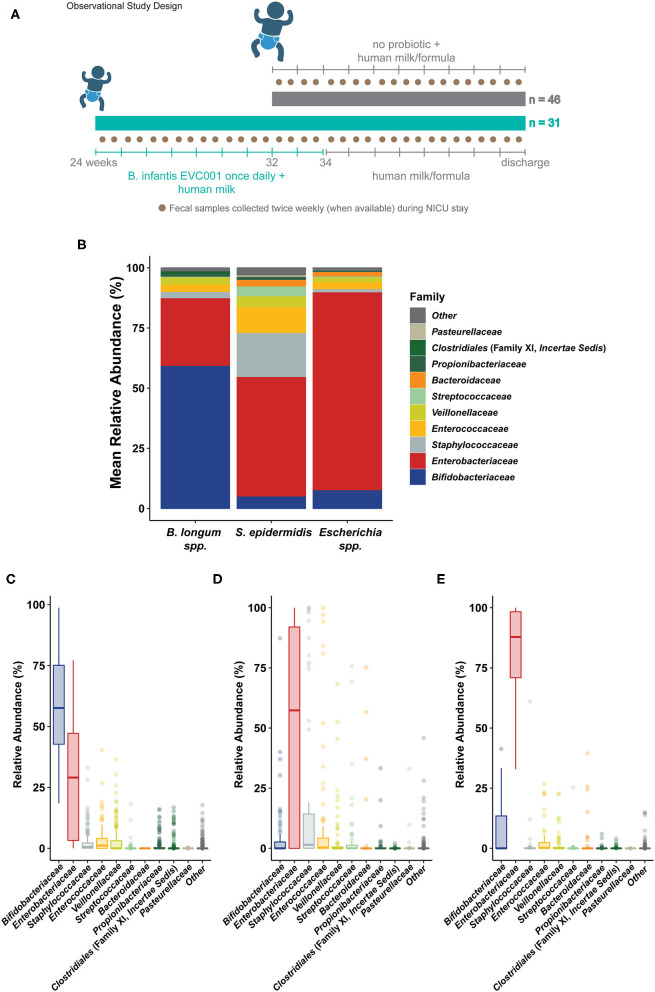
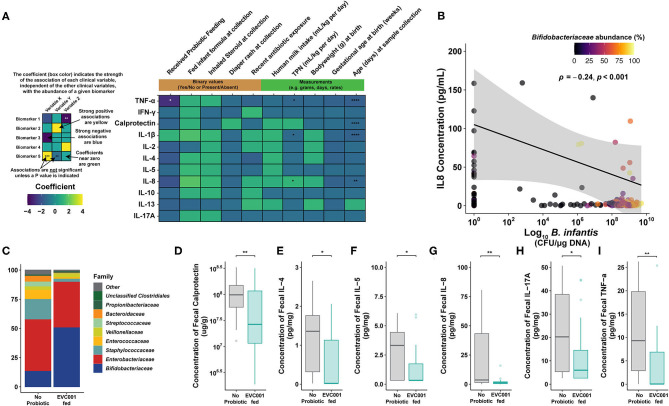
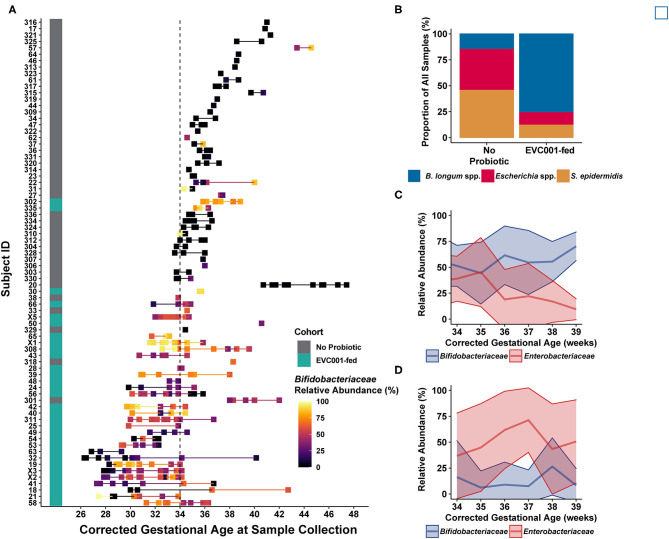
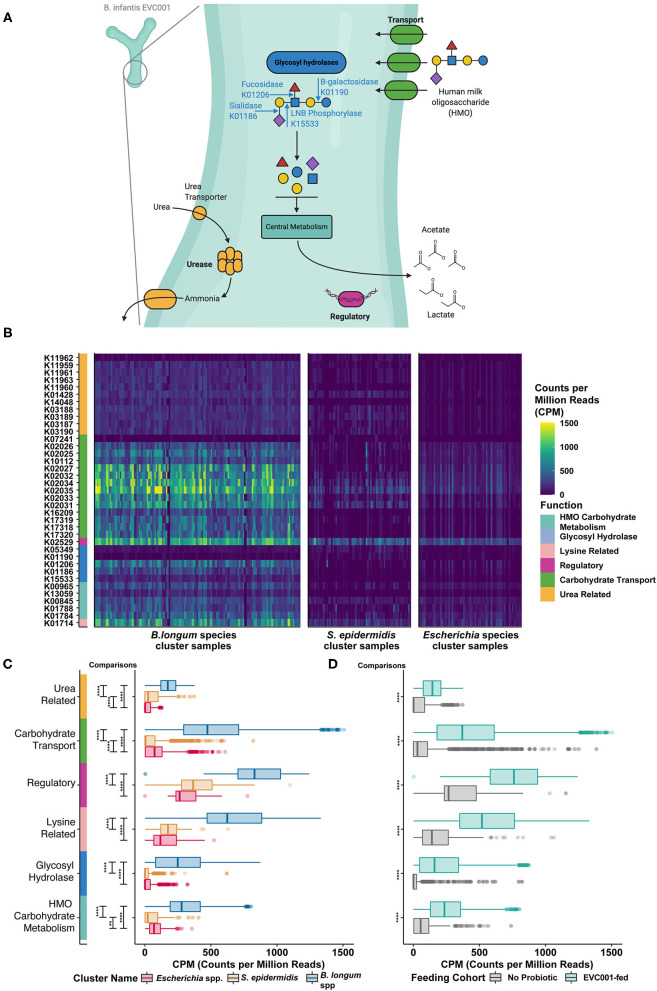
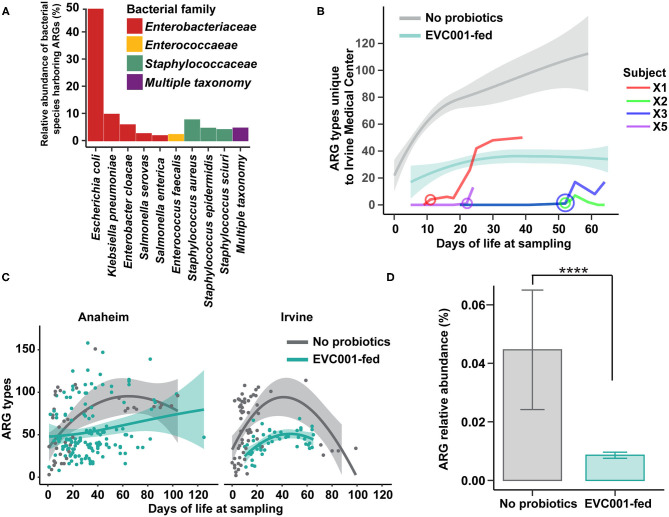
Preterm birth is a major determinant of neonatal survival and morbidity, but the gut microbiome and associated enteric inflammation are also key factors in neonatal development and the risk of associated morbidities. We prospectively and longitudinally followed two cohorts of preterm infants, one of which was fed activated subsp. () EVC001 8 × 10 CFU daily, and the other was not fed a probiotic. Hospital feeding protocol assigned all infants born at <1500 g and/or < 32 weeks corrected gestational age to the probiotic feeding protocol, whereas infants born at >1500 g and/or >32 weeks corrected gestational age were not fed a probiotic. Fecal samples were opportunistically collected from 77 infants throughout the hospital stay, and subjected to shotgun metagenomic sequencing and quantification of enteric inflammation. De-identified metadata was collected from patient medical records. The gut microbiome of preterm infants was typified by a high abundance of and/or , and multivariate modeling identified the probiotic intervention, rather than degree of prematurity, day of life, or other clinical interventions, as the primary source of change in the gut microbiome. Among infants fed EVC001, a high abundance of total developed rapidly, the majority of which was confirmed via subspecies-specific qPCR. Associated with this higher abundance of , we found increased functional capacity for utilization of human milk oligosaccharides (HMOs), as well as reduced abundance of antibiotic resistance genes (ARGs) and the taxa that harbored them. Importantly, we found that infants fed EVC001 exhibited diminished enteric inflammation, even when other clinical variables were accounted for using multivariate modeling. These results provide an important observational background for probiotic use in a NICU setting, and describe the clinical, physiological, and microbiome-associated improvements in preterm infants associated with EVC001 feeding.
早产是新生儿生存和发病的主要决定因素,但肠道微生物群和相关的肠道炎症也是新生儿发育及相关发病风险的关键因素。我们对两组早产儿进行了前瞻性纵向跟踪研究,其中一组每天喂食8×10⁸CFU的活化亚种()EVC001,另一组未喂食益生菌。医院喂养方案将所有出生体重<1500g和/或矫正胎龄<32周的婴儿分配到益生菌喂养方案组,而出生体重>1500g和/或矫正胎龄>32周的婴儿不喂食益生菌。在整个住院期间,从77名婴儿中随机采集粪便样本,进行鸟枪法宏基因组测序并对肠道炎症进行定量分析。从患者病历中收集去识别化的元数据。早产儿的肠道微生物群以高丰度的和/或为特征,多变量建模确定益生菌干预而非早产程度、出生天数或其他临床干预是肠道微生物群变化的主要来源。在喂食EVC001的婴儿中,总丰度迅速升高,其中大部分通过亚种特异性定量聚合酶链反应得到证实。与这种较高的丰度相关,我们发现利用人乳寡糖(HMOs)的功能能力增强,以及抗生素抗性基因(ARGs)及其携带菌的丰度降低。重要的是,我们发现即使在使用多变量建模考虑其他临床变量时,喂食EVC001的婴儿肠道炎症也有所减轻。这些结果为新生儿重症监护病房(NICU)环境中益生菌的使用提供了重要的观察背景,并描述了与EVC001喂养相关的早产儿在临床、生理和微生物群方面的改善情况。