Bunmaprasert Torphong, Chaibhuddanugul Nattharut, Keeratiruangrong Jakkrit, Raphitphan Raphi, Sugandhavesa Nantawit, Liawrungrueang Wongthawat
Department of Orthopedics, Faculty of Medicine, Chiang Mai University, Chiang Mai, Thailand.
Trauma Case Rep. 2021 Feb 10;32:100409. doi: 10.1016/j.tcr.2021.100409. eCollection 2021 Apr.
Neglected fracture-dislocation thoracic spine without neurological deficit is an extremely rare injury. Current studies reveal that global sagittal balance is very important for quality of life (QOL). Complex deformity causes difficulty with dissection in the surgical planning and type of spinal osteotomy. Restoration of global balance parameters are related to a successful outcome, if the surgeon understands the morphology of complex bone deformity and the surgical tactics of spinal osteotomy.
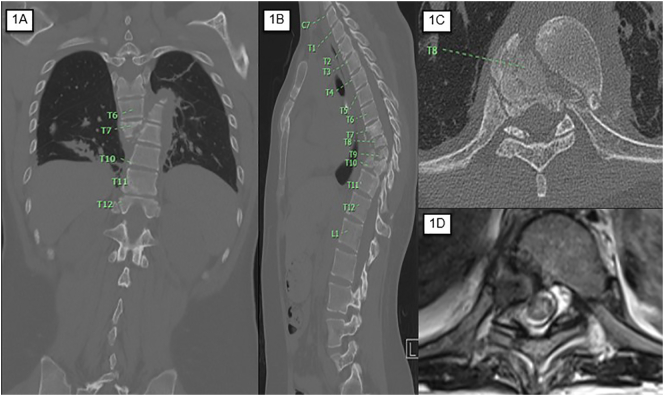
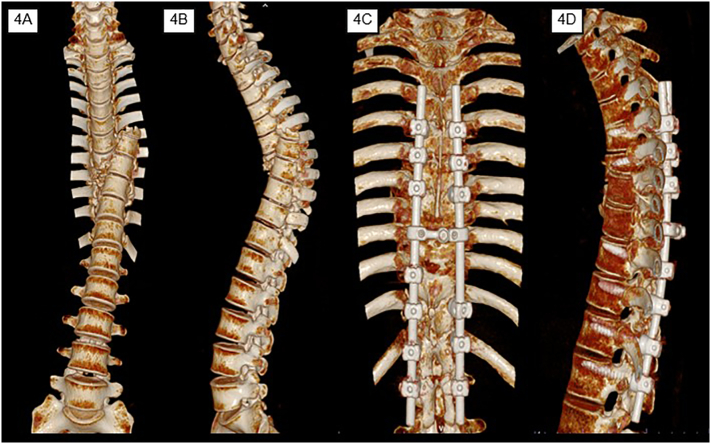
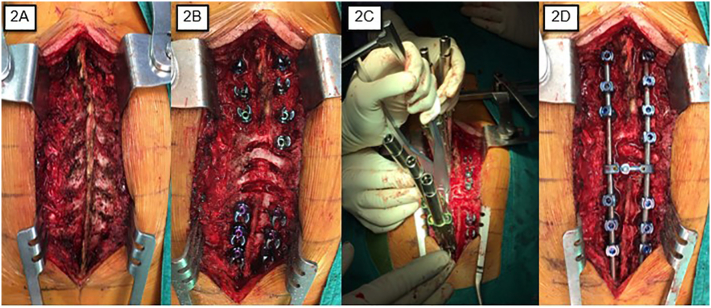
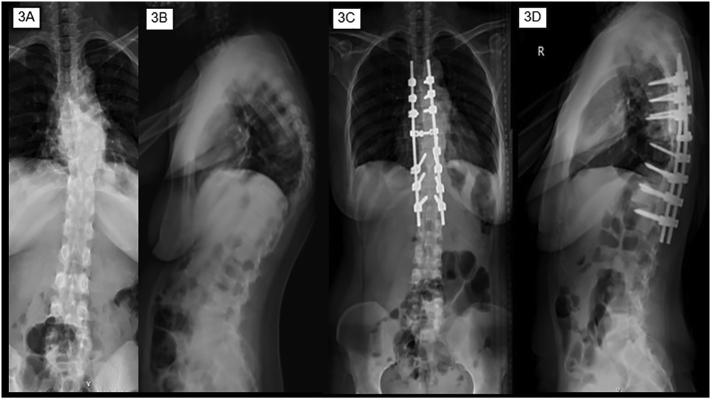
A 23-year-old female presented with untreated thoracic kyphotic deformity without paraplegia (ASIA E), following a motor vehicle accident 2 months earlier. Radiographic imaging and computed tomography scan revealed a complex fracture-dislocation at the T8-T9 level with kyphosis deformity, abnormal C7 plump line, and 65 degrees of sagittal Cobb's angle (T7-T11). The multilevel Ponte osteotomy surgical technique was performed at the apex of the kyphosis. After the patient underwent corrective osteotomy and instrumentation, postoperative radiograph and CT scan revealed 24 degrees of sagittal Cobb's angle (T7-T11). The patient's balance was recovered when followed up at 1 year. The patient's quality of life was improved and thus she was extremely satisfied with this treatment.
Neglected fracture-dislocation thoracic spine without neurological deficit is rarely seen. It is a complex deformity injury. In this case, we performed multilevel Ponte osteotomy, instead of osteosynthesis, to restore the complex deformity that was affecting global balance. Successful outcomes are the result of good surgical preoperative planning and the surgical tactics of spinal osteotomy.
未伴神经功能缺损的被忽视的胸椎骨折脱位是一种极为罕见的损伤。目前的研究表明,整体矢状面平衡对生活质量(QOL)非常重要。复杂畸形会给手术规划中的解剖操作及脊柱截骨类型带来困难。如果外科医生了解复杂骨畸形的形态及脊柱截骨的手术策略,恢复整体平衡参数与手术成功结果相关。
一名23岁女性,在2个月前发生机动车事故后,出现未经治疗的胸椎后凸畸形且无截瘫(美国脊髓损伤协会E级)。影像学检查和计算机断层扫描显示T8 - T9水平存在复杂的骨折脱位并伴有后凸畸形、C7垂线异常以及矢状面Cobb角为65度(T7 - T11)。在脊柱后凸顶点处采用多节段Ponte截骨手术技术。患者接受矫正截骨和内固定术后,术后X线片和CT扫描显示矢状面Cobb角为24度(T7 - T11)。随访1年时患者的平衡得以恢复。患者的生活质量得到改善,因此对该治疗极为满意。
未伴神经功能缺损的被忽视的胸椎骨折脱位很少见。它是一种复杂的畸形损伤。在本病例中,我们采用多节段Ponte截骨术而非骨接合术来恢复影响整体平衡的复杂畸形。成功的结果得益于良好的术前手术规划及脊柱截骨的手术策略。