Social Paediatrics, Wilhelmina Children's Hospital University Medical Centre, Utrecht, The Netherlands.
Division management, Julius Center for Health Sciences and Primary Care, Utrecht, The Netherlands.
BMJ Paediatr Open. 2021 Feb 17;5(1):e000958. doi: 10.1136/bmjpo-2020-000958. eCollection 2021.
To determine: (1) which biological/lifestyle, psychological and/or social factors are associated with fatigue among children with a chronic disease and (2) how much each of these factors contributes to explaining variance in fatigue.
This was a cross-sectional study across two children's hospitals.
We included children aged 8-18 years who visited the outpatient clinic with cystic fibrosis, an autoimmune disease or postcancer treatment.
Fatigue was assessed using the PedsQL Multidimensional Fatigue Scale. Generic biological/lifestyle, psychological and social factors were assessed using clinical assessment tools and questionnaires. Multiple linear regression analyses were used to test the associations between these factors and fatigue. Finally, a multivariable regression model was used to determine which factor(s) have the strongest effect on fatigue.
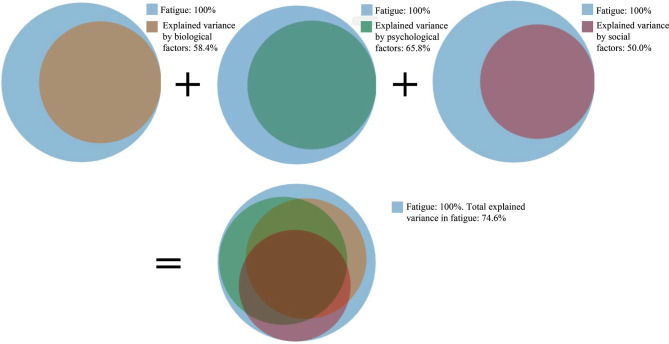
A total of 434 out of 902 children were included (48% participation rate), with a median age of 14.5 years; 42% were male. Among these 434 children, 21.8% were severely fatigued. Together, all biopsychosocial factors explained 74.6% of the variance in fatigue. More fatigue was uniquely associated with poorer physical functioning, more depressive symptoms, more pressure at school, poorer social functioning and older age.
Fatigue among children with a chronic disease is multidimensional. Multiple generic biological/lifestyle, psychological and social factors were strongly associated with fatigue, explaining 58.4%; 65.8% and 50.0% of the variance in fatigue, respectively. Altogether, almost three-quarters of the variance in fatigue was explained by this biopsychosocial model. Thus, when assessing and treating fatigue, a transdiagnostic approach is preferred, taking into account biological, psychological and social factors.
确定:(1)哪些生物/生活方式、心理和/或社会因素与慢性病患儿的疲劳有关;(2)这些因素中有多少因素有助于解释疲劳的差异。
这是一项在两家儿童医院进行的横断面研究。
我们纳入了年龄在 8-18 岁之间、因囊性纤维化、自身免疫性疾病或癌症治疗后而到门诊就诊的患儿。
使用 PedsQL 多维疲劳量表评估疲劳。使用临床评估工具和问卷评估一般的生物/生活方式、心理和社会因素。采用多元线性回归分析来检验这些因素与疲劳之间的关联。最后,采用多变量回归模型来确定哪个(些)因素对疲劳的影响最强。
共有 902 名患儿中的 434 名(48%的参与率)被纳入研究,中位数年龄为 14.5 岁;42%为男性。在这 434 名患儿中,21.8%为严重疲劳。所有生物心理社会因素共同解释了疲劳变异的 74.6%。更严重的疲劳与较差的身体功能、更多的抑郁症状、更多的学校压力、较差的社会功能和年龄较大有关。
慢性病患儿的疲劳是多维度的。多个一般的生物/生活方式、心理和社会因素与疲劳显著相关,分别解释了疲劳变异的 58.4%、65.8%和 50.0%。总体而言,疲劳变异的近四分之三可以用这种生物心理社会模型来解释。因此,在评估和治疗疲劳时,首选跨诊断方法,同时考虑生物、心理和社会因素。